Bare ActOfficial Text of Article 62
62. Time of holding election to fill vacancy in the office of President and the term of office of person elected to fill casual vacancy.—
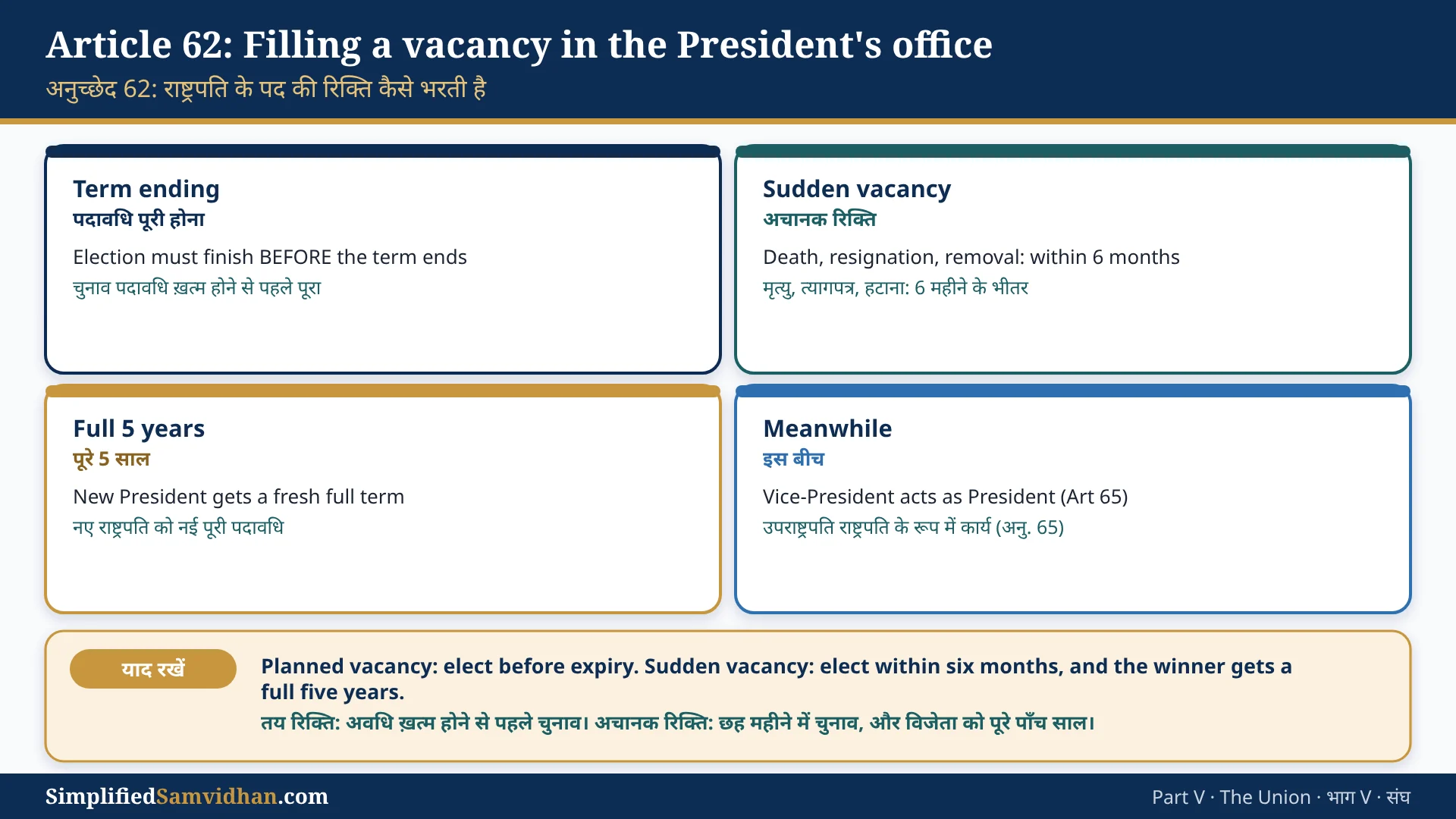
(1) An election to fill a vacancy caused by the expiration of the term of office of President shall be completed before the expiration of the term.
(2) An election to fill a vacancy in the office of President occurring by reason of his death, resignation or removal, or otherwise shall be held as soon as possible after, and in no case later than six months from, the date of occurrence of the vacancy; and the person elected to fill the vacancy shall, subject to the provisions of article 56, be entitled to hold office for the full term of five years from the date on which he enters upon his office.
Clause (1) Planned vacancy: the President's term ends on a known date, so the election must be completed before that date. This is why the result always comes a few days before 25 July.
Clause (2) Sudden vacancy: death, resignation, removal by impeachment, or "otherwise" (for example, the Supreme Court setting aside the election under Article 71). The election must be held as soon as possible and never later than six months.
Full term: the person elected to a sudden vacancy serves five full years from the day of taking office. India has no 'remainder of term' rule for the President.
"Subject to Article 56": the new President can still resign, be impeached, and continues till a successor takes over.
Who fills the gap: Article 62 itself does not say; Article 65 makes the Vice-President act as President, and the 1969 Act covers the case when both offices are empty.
🏠 Everyday Analogy
A cricket team's captain is appointed for a fixed season. The board must pick the next captain before the season ends. If the captain is suddenly injured, the vice-captain leads for a while, but the board must name a new captain within a set time, and that captain gets a full season of his own.
🇮🇳 Real Indian Example
President Fakhruddin Ali Ahmed died on 11 February 1977. Vice-President B. D. Jatti acted as President. N. Sanjiva Reddy was elected unopposed and took office on 25 July 1977, within six months, and served a full five years till 24 July 1982. Every President since has taken office on 25 July.
Two casesArticle 62: Planned Vacancy vs Sudden Vacancy
| Point | Clause (1): term ends | Clause (2): death, resignation, removal, otherwise |
|---|---|---|
| Deadline | Before the term expires | As soon as possible; at most 6 months |
| Gap in office? | No: old President continues till successor (Art 56(1)(c)) | Yes: Vice-President acts (Art 65(1)) |
| Term of winner | 5 years | Full 5 years from taking office |
| Examples | 1952, 1957, 1962, 1967, 1982 ... 2022 | 1969 (after Zakir Husain), 1977 (after F. A. Ahmed) |
The Election Commission of India conducts both kinds of election under Article 324 and the Presidential and Vice-Presidential Elections Act, 1952. For a term-end vacancy the notification cannot be issued earlier than 60 days before the term ends.
1969 storyArticle 62 in Action: The Crisis of 1969
- 3 May 1969: President Zakir Husain died in office, the first President to do so. Vice-President V. V. Giri began acting as President under Article 65.
- Giri wanted to contest the election. On 20 July 1969 he resigned both as Vice-President and as acting President. With both offices empty, the Constitution had no answer.
- Parliament used Article 70 to pass the President (Discharge of Functions) Act, 1969: the Chief Justice of India, or else the senior-most available Supreme Court judge, discharges the functions.
- Chief Justice M. Hidayatullah did so from 20 July to 24 August 1969.
- The election was held on 16 August 1969, inside the six-month limit. Giri won on second-preference votes, the only such count ever, and took office on 24 August 1969.
ComparisonArticle 62 Compared: President vs Vice-President vs USA
| Point | President (Art 62) | Vice-President (Art 68) | US President |
|---|---|---|---|
| Sudden vacancy: deadline | 6 months | "As soon as possible" (no fixed limit) | No election: Vice-President becomes President |
| Term of new office-holder | Full 5 years | Full 5 years | Remainder of the term |
| Who fills the gap | Vice-President acts (Art 65) | Deputy Chairman presides over Rajya Sabha | - |
Quick RevisionKey Points to Remember
- Term-end vacancy: election completed before the term expires (Art 62(1)).
- Sudden vacancy (death, resignation, removal, otherwise): election within six months (Art 62(2)).
- Person elected gets a full five-year term from taking office.
- Vice-President acts meanwhile (Art 65); if both offices are vacant, the Chief Justice (1969 Act under Art 70).
- Used twice: 1969 and 1977.
UPSC · State PSC · JudiciaryArticle 62: Exam Corner
- Prelims trap: "A President elected after a vacancy serves only the remaining term." False. Full five years.
- Prelims trap: "A vacancy in the office of Vice-President must be filled within six months." False. The six-month limit is only for the President; for the Vice-President it is "as soon as possible" (Art 68(2)).
- Prelims: The President (Discharge of Functions) Act, 1969 was made under Article 70.
- Mains (GS II): "Articles 56, 62 and 65 together ensure there is never a vacuum at the top." Explain with the 1969 crisis.
Practice MCQTest Yourself: Article 62
If the President dies in office, within what time must the election to fill the vacancy be held?
Doubts ClearedFrequently Asked Questions
What is Article 62 of the Indian Constitution?
Article 62 fixes when the election to fill a vacancy in the President's office must be held: before the term ends, or within six months of a sudden vacancy, with a full five-year term for the person elected.
Who acts as President when the office is vacant?
The Vice-President, under Article 65(1). If the Vice-President's office is also vacant, the Chief Justice of India discharges the functions under the 1969 Act.
Why does the President take office on 25 July?
Because N. Sanjiva Reddy, elected after the 1977 vacancy, took office on 25 July 1977 for a full five-year term, and every term since has started on that date.