Bare ActOfficial Text of Article 74
74. Council of Ministers to aid and advise President.—
(1) There shall be a Council of Ministers with the Prime Minister at the head to aid and advise the President who shall, in the exercise of his functions, act in accordance with such advice:
Provided that the President may require the Council of Ministers to reconsider such advice, either generally or otherwise, and the President shall act in accordance with the advice tendered after such reconsideration.
(2) The question whether any, and if so what, advice was tendered by Ministers to the President shall not be inquired into in any court.
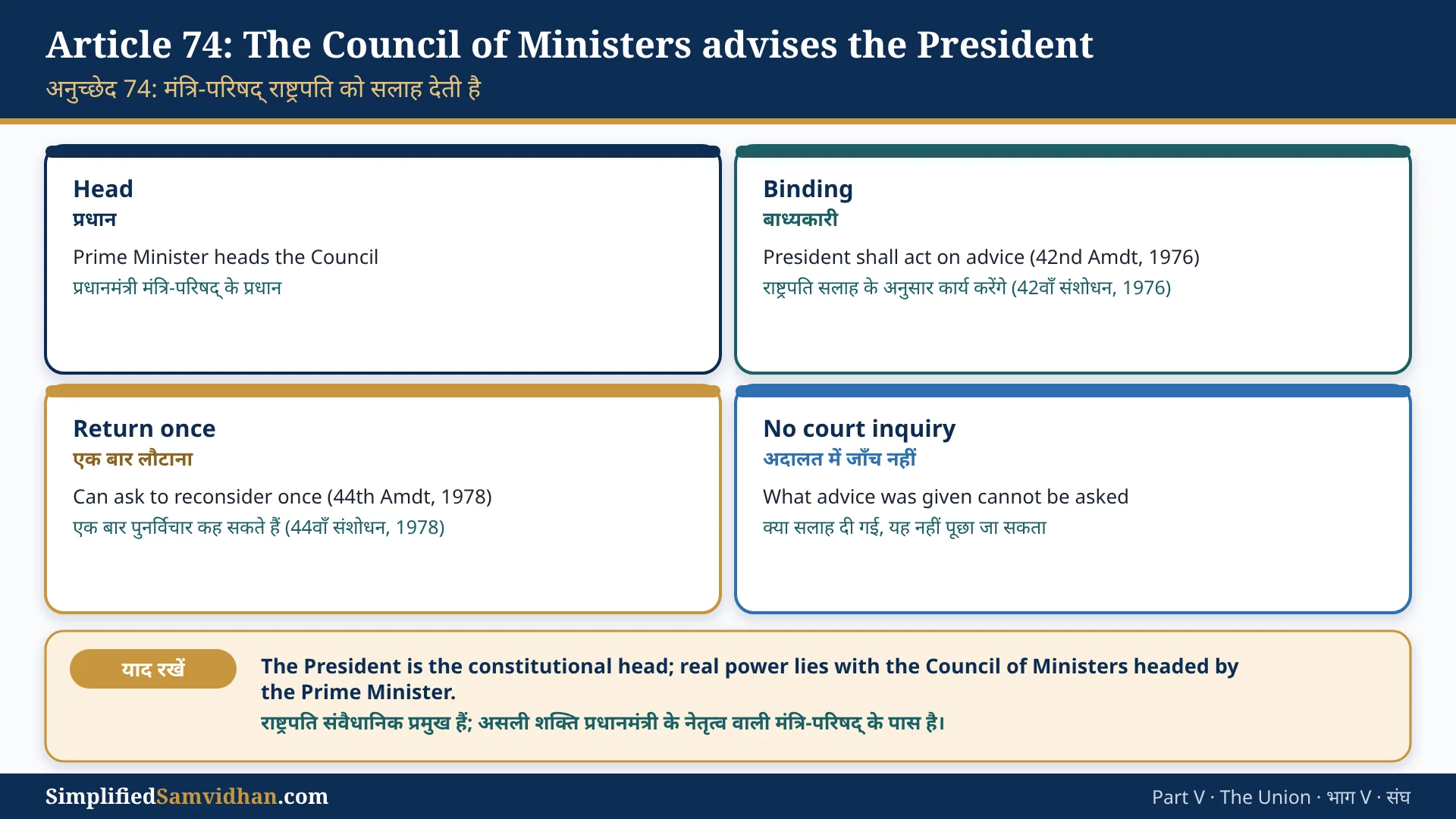
There shall be: a Council of Ministers must always exist. Even when the Lok Sabha is dissolved, the outgoing ministry continues (U.N.R. Rao, 1971). The President cannot rule alone.
Prime Minister at the head: the PM leads the Council; the Council works as one team.
Act in accordance with such advice: these words were added by the 42nd Amendment (1976) to make the advice clearly binding.
Proviso, reconsideration: added by the 44th Amendment (1978). The President can send the advice back once; after reconsideration, the President must act on it.
Clause (2) Secrecy: courts cannot ask whether, or what, advice was given. But the material on which the decision is based is not protected (S. R. Bommai, 1994).
🏠 Everyday Analogy
Think of a ship. The captain's name is on every order and everyone salutes him, but the course is set by the navigation team elected by the crew. The captain may ask the team to check the route once more, but if the team says the same again, the ship goes that way.
🇮🇳 Real Indian Example
In October 1997, the Union Cabinet recommended President's Rule in Uttar Pradesh. President K. R. Narayanan used the proviso and returned the recommendation for reconsideration; the Cabinet decided not to press it, and no President's Rule was imposed. In September 1998 he returned a similar recommendation for Bihar. These are the clearest uses of the 44th Amendment proviso.
HistoryArticle 74: How the Wording Changed (1950, 1976, 1978)
| Year | Change | Effect |
|---|---|---|
| 1950 | "There shall be a Council of Ministers ... to aid and advise the President" | Binding by convention; courts held the President a constitutional head |
| 1976 (42nd Amendment) | Added "who shall ... act in accordance with such advice" | Advice made binding in so many words |
| 1978 (44th Amendment) | Added the proviso on reconsideration | President can return advice once; then bound |
In the Constituent Assembly, Dr B. R. Ambedkar explained that the President would be like the King under the English Constitution: head of the State but not of the executive, who represents the nation but does not rule it.
Key casesArticle 74 in the Supreme Court: Key Cases
- Ram Jawaya Kapur v State of Punjab (1955): India follows the British parliamentary model; the President is a formal head and real executive power is with the Council of Ministers.
- U. N. R. Rao v Indira Gandhi (1971): the Council of Ministers does not end when the Lok Sabha is dissolved; "there shall be" is mandatory, so the President can never act without ministers.
- Shamsher Singh v State of Punjab (1974): a seven-judge bench held that the President and Governors exercise their powers on ministerial advice, save in a few well-known exceptional situations.
- S. R. Bommai v Union of India (1994): Article 74(2) only bars inquiry into the advice itself; the material behind a President's Rule proclamation can be examined by courts.
DiscretionWhere the President Still Uses Judgment
- Appointing a Prime Minister when no party or alliance has a clear majority in the Lok Sabha (for example, inviting the leader most likely to win a confidence vote).
- Returning advice once under the Article 74 proviso, and returning a non-Money Bill once under Article 111.
- Delaying assent to a Bill: President Zail Singh kept the Indian Post Office (Amendment) Bill, 1986 pending, a so-called pocket veto, because the Constitution sets no time limit.
- A government that has lost its majority: asking it to prove its majority on the floor of the House.
- The Constitution does not list these as discretionary powers for the President; they arise from the situation, and courts expect them to be used in good faith.
ComparisonArticle 74 vs Article 163: President vs Governor
| Point | President (Art 74) | Governor (Art 163) |
|---|---|---|
| Advice by | Union Council of Ministers headed by PM | State Council of Ministers headed by CM |
| Discretion in the text | None written | Yes: "except in so far as ... required to exercise ... in his discretion" |
| Can return advice | Once (44th Amendment proviso) | No such proviso |
| Court bar on advice | Art 74(2) | Art 163(3) |
Quick RevisionKey Points to Remember
- A Council of Ministers headed by the Prime Minister aids and advises the President, and must always exist.
- Advice is binding: words added by the 42nd Amendment, 1976.
- President may return advice once for reconsideration: 44th Amendment, 1978.
- Article 74(2): no court can inquire into what advice was given; material is reviewable (Bommai, 1994).
- President = constitutional head (Shamsher Singh, 1974).
UPSC · State PSC · JudiciaryArticle 74: Exam Corner
- Prelims trap: "The 44th Amendment made ministerial advice binding." False. The 42nd made it binding; the 44th added reconsideration.
- Prelims trap: "The Council of Ministers ceases when the Lok Sabha is dissolved." False (U.N.R. Rao, 1971).
- Prelims: Article 74(2) bars courts from inquiring into the advice tendered by ministers.
- Mains (GS II): "The President of India reigns but does not rule." Discuss with Article 74 and situational discretion.
Practice MCQTest Yourself: Article 74
Which Amendment allowed the President to send the advice of the Council of Ministers back once for reconsideration?
Doubts ClearedFrequently Asked Questions
What is Article 74 of the Indian Constitution?
Article 74 provides a Council of Ministers headed by the Prime Minister to aid and advise the President, who must act on that advice, may return it once, and whose advice cannot be inquired into by courts.
Is the President bound by the advice of the Council of Ministers?
Yes. Since the 42nd Amendment the President must act on it; since the 44th, the President may ask for reconsideration once, and must then accept the advice.
What does Article 74(2) mean?
No court can inquire whether ministers gave any advice to the President, or what it was. The underlying material, however, can be examined (S. R. Bommai, 1994).