Bare ActOfficial Text of Article 75
75. Other provisions as to Ministers.—
(1) The Prime Minister shall be appointed by the President and the other Ministers shall be appointed by the President on the advice of the Prime Minister.
(1A) The total number of Ministers, including the Prime Minister, in the Council of Ministers shall not exceed fifteen per cent. of the total number of members of the House of the People.
(1B) A member of either House of Parliament belonging to any political party who is disqualified for being a member of that House under paragraph 2 of the Tenth Schedule shall also be disqualified to be appointed as a Minister under clause (1) for duration of the period commencing from the date of his disqualification till the date on which the term of his office as such member would expire or where he contests any election to either House of Parliament before the expiry of such period, till the date on which he is declared elected, whichever is earlier.
(2) The Ministers shall hold office during the pleasure of the President.
(3) The Council of Ministers shall be collectively responsible to the House of the People.
(4) Before a Minister enters upon his office, the President shall administer to him the oaths of office and of secrecy according to the forms set out for the purpose in the Third Schedule.
(5) A Minister who for any period of six consecutive months is not a member of either House of Parliament shall at the expiration of that period cease to be a Minister.
(6) The salaries and allowances of Ministers shall be such as Parliament may from time to time by law determine and, until Parliament so determines, shall be as specified in the Second Schedule.
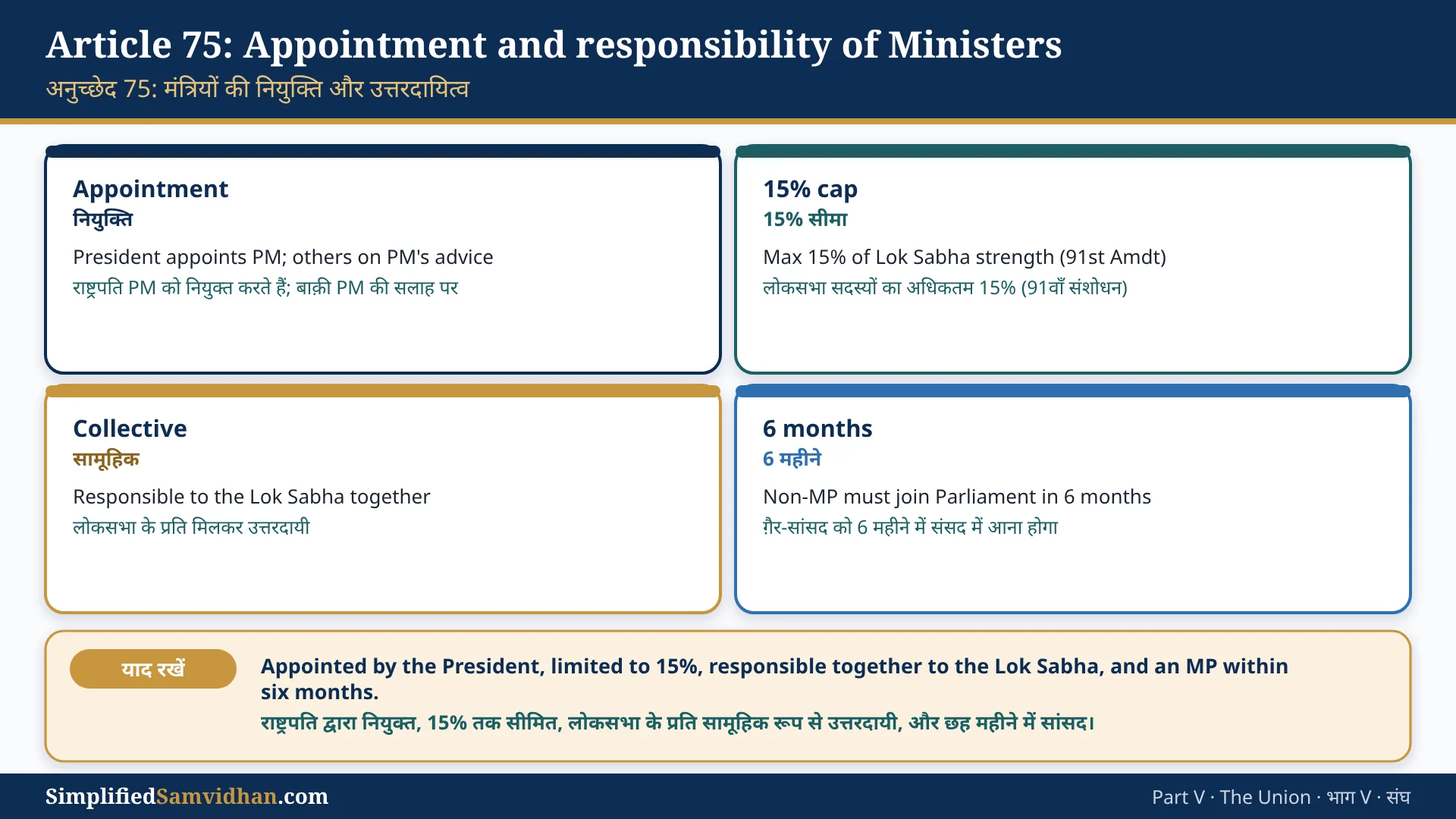
Clause (1) Appointment: the President appoints the Prime Minister, normally the leader of the majority in the Lok Sabha, and appoints other ministers on the PM's advice.
Clause (1A) 15% cap: the whole Council, including the PM, cannot exceed 15% of Lok Sabha members. With 543 members that is at most 81 ministers.
Clause (1B) Defectors: an MP disqualified for defection under the Tenth Schedule cannot become a minister until the term ends or until re-elected, whichever is earlier.
Clause (2) Pleasure: ministers serve at the President's pleasure; in practice the President removes a minister only on the PM's advice.
Clause (3) Collective responsibility: the whole Council stands or falls together. If the Lok Sabha passes a no-confidence motion or rejects a confidence motion, the entire government must resign.
Clauses (4) to (6): oaths of office and secrecy (Third Schedule); a non-member can be minister for at most six consecutive months; salaries are fixed by Parliament (Salaries and Allowances of Ministers Act, 1952).
🏠 Everyday Analogy
A cricket captain (the PM) is picked by the board chairman (the President) because the team backs him; the captain then picks the playing XI. The squad has a size limit (15%). If the team loses the series vote (no-confidence), the whole team is dropped together, not one player.
🇮🇳 Real Indian Example
P. V. Narasimha Rao became Prime Minister on 21 June 1991 without being a member of either House. To stay on beyond six months under Article 75(5), he contested and won the Nandyal Lok Sabha by-election in November 1991. H. D. Deve Gowda too became PM in 1996 as a non-member; the Supreme Court in S. P. Anand v H. D. Deve Gowda (1996) upheld this, as Article 75(5) applies to the PM as well.
All clausesArticle 75 Clause by Clause
| Clause | Rule | Origin |
|---|---|---|
| (1) | President appoints PM; other ministers on PM's advice | 1950 |
| (1A) | Council not more than 15% of Lok Sabha strength | 91st Amendment, 2003 |
| (1B) | Defector disqualified under Tenth Schedule cannot be minister | 91st Amendment, 2003 |
| (2) | Ministers hold office during President's pleasure | 1950 |
| (3) | Collective responsibility to Lok Sabha | 1950 |
| (4) | Oaths of office and secrecy (Third Schedule) | 1950 |
| (5) | Non-member: ceases after six consecutive months | 1950 |
| (6) | Salaries by Parliament law; till then Second Schedule | 1950 |
ResponsibilityCollective Responsibility in Action
- 7 November 1990: V. P. Singh's government lost a confidence vote in the Lok Sabha and resigned.
- 11 April 1997: H. D. Deve Gowda's government lost a confidence vote.
- 17 April 1999: Atal Bihari Vajpayee's government lost a confidence vote by a single vote (269 to 270).
Collective responsibility also means cabinet solidarity: once the Cabinet decides, every minister must support it in public or resign. Individual responsibility flows from clause (2): the PM can ask a minister to resign and the President will remove him or her on the PM's advice.
Key casesArticle 75 in the Supreme Court: Key Cases
- S. P. Anand v H. D. Deve Gowda (1996): a person who is not a member of Parliament can be appointed Prime Minister, subject to becoming a member within six months.
- S. R. Chaudhuri v State of Punjab (2001): a non-member cannot be reappointed minister again and again without getting elected in between; the six-month window is a one-time exception (decided under the State counterpart, Article 164(4), with the same principle for the Union).
- Why the 91st Amendment (2003): jumbo ministries were used to reward defectors. The Amendment capped size at 15% (and at 15% of the Assembly for States under Article 164(1A), with a minimum of 12 ministers) and barred disqualified defectors.
Quick RevisionKey Points to Remember
- President appoints the PM; other ministers on the PM's advice.
- Council of Ministers capped at 15% of Lok Sabha (91st Amendment, 2003).
- Ministers hold office at the pleasure of the President.
- Collectively responsible to the Lok Sabha, not the Rajya Sabha.
- Non-member minister must enter Parliament within six consecutive months.
UPSC · State PSC · JudiciaryArticle 75: Exam Corner
- Prelims trap: "The 15% cap is of the total strength of both Houses." False. Only the Lok Sabha.
- Prelims trap: "The Council of Ministers is collectively responsible to Parliament." Strictly, to the Lok Sabha.
- Prelims: The forms of oath for ministers are in the Third Schedule.
- Mains (GS II): "Collective responsibility is the cornerstone of cabinet government." Discuss.
Practice MCQTest Yourself: Article 75
The ceiling on the size of the Union Council of Ministers (15% of Lok Sabha strength) was introduced by which Amendment?
Doubts ClearedFrequently Asked Questions
What is Article 75 of the Indian Constitution?
Article 75 deals with the appointment of the Prime Minister and ministers, the 15% size limit, the President's pleasure, collective responsibility to the Lok Sabha, oaths, the six-month rule and salaries.
Can a person who is not an MP become a minister or Prime Minister?
Yes, but he or she must become a member of either House within six consecutive months, or cease to be a minister (Article 75(5)).
How many ministers can the Union have at most?
Not more than 15% of the total members of the Lok Sabha, including the Prime Minister; with 543 members, at most 81.