Bare ActOfficial Text of Article 72
72. Power of President to grant pardons, etc., and to suspend, remit or commute sentences in certain cases.—
(1) The President shall have the power to grant pardons, reprieves, respites or remissions of punishment or to suspend, remit or commute the sentence of any person convicted of any offence—
(a) in all cases where the punishment or sentence is by a Court Martial;
(b) in all cases where the punishment or sentence is for an offence against any law relating to a matter to which the executive power of the Union extends;
(c) in all cases where the sentence is a sentence of death.
(2) Nothing in sub-clause (a) of clause (1) shall affect the power conferred by law on any officer of the Armed Forces of the Union to suspend, remit or commute a sentence passed by a Court Martial.
(3) Nothing in sub-clause (c) of clause (1) shall affect the power to suspend, remit or commute a sentence of death exercisable by the Governor of a State under any law for the time being in force.
When it applies: only after a person has been convicted. It is an act of mercy by the executive, not an appeal; the President does not sit as a court.
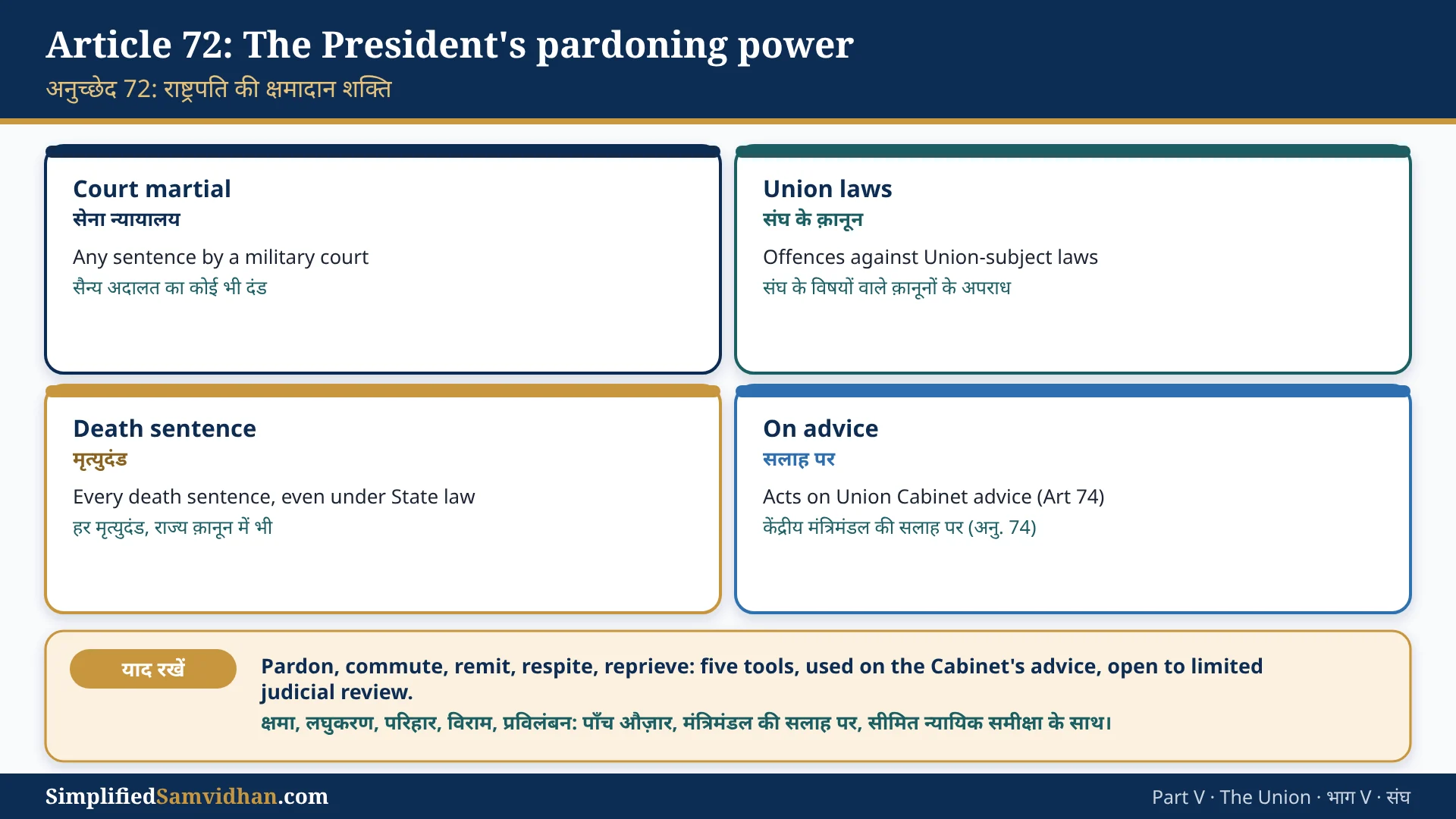
Clause (1)(a) Court martial: any punishment given by a military court. The Governor has no such power.
Clause (1)(b) Union laws: offences against laws on matters in the Union's executive field, for example the Customs Act, the Arms Act or a central tax law.
Clause (1)(c) Death sentence: every death sentence, even if it was passed under a State law. Only the President can fully pardon a death sentence.
Clauses (2) and (3): armed forces officers keep their legal power over court-martial sentences, and the Governor keeps the power to suspend, remit or commute a death sentence. Both powers run side by side with the President's.
On whose advice: the President acts on the advice of the Union Council of Ministers (Article 74). Mercy petitions go through the Ministry of Home Affairs.
🏠 Everyday Analogy
A school's exam board fails a student under the rules. The principal cannot change the marks, because that is the board's job, but the principal can let the student off a punishment, reduce it, or postpone it because of special circumstances. The marks (the conviction) stay; only the punishment is eased.
🇮🇳 Real Indian Example
In Kehar Singh v Union of India (1989), one of the convicts in Indira Gandhi's assassination asked the President for mercy and for an oral hearing. The Supreme Court held that there is no right to an oral hearing, that the President can look at the evidence afresh and reach a different view from the courts without changing the judgment, and that the decision can be reviewed by courts only on limited grounds. The petition had been rejected and Kehar Singh was hanged in January 1989.
Five toolsArticle 72: Pardon, Commutation, Remission, Respite, Reprieve
| Term | Meaning | Example |
|---|---|---|
| Pardon | Removes both the sentence and the conviction; the person is freed of all penalties | A convict is set free fully |
| Commutation | Replaces the punishment with a lighter form | Death sentence changed to life imprisonment |
| Remission | Cuts the period of the sentence without changing its nature | Two years' rigorous imprisonment cut to one |
| Respite | A lesser sentence for a special reason | Pregnancy or physical disability of the convict |
| Reprieve | Stays the execution of a sentence for a time | Death sentence stayed while a mercy plea is decided |
The Article also uses the words suspend, remit or commute the sentence. Courts have read the whole list as a wide power of clemency, but it is always about punishment: the President cannot declare that the court was wrong in law.
ComparisonArticle 72 vs Article 161: President vs Governor
| Point | President (Art 72) | Governor (Art 161) |
|---|---|---|
| Laws covered | Offences against laws on Union matters | Offences against laws on State matters |
| Court martial | Yes | No |
| Death sentence | Can pardon, commute, remit, suspend, respite, reprieve | Can suspend, remit or commute, but cannot pardon |
| Advice | Union Council of Ministers | State Council of Ministers |
| Judicial review | Limited (Epuru Sudhakar, 2006) | Limited (same principles) |
Key casesArticle 72 in the Supreme Court: Key Cases
- Maru Ram v Union of India (1980): the President exercises the power on the advice of the Council of Ministers, not personally.
- Kehar Singh v Union of India (1989): no right to an oral hearing; the President may examine the record and differ from the courts; the courts can review the decision on limited grounds; no need to give detailed reasons.
- Epuru Sudhakar v State of Andhra Pradesh (2006): a pardon or remission can be struck down if it is mala fide, based on irrelevant or political considerations, made without applying the mind, or arbitrary. Here a Governor's remission to a political worker was set aside.
- Shatrughan Chauhan v Union of India (2014): long, unexplained delay in deciding a mercy petition is a ground to commute a death sentence to life imprisonment; the Court also laid down guidelines, such as informing the convict and family of a rejection and a gap of 14 days before execution.
ProcessHow a Mercy Petition Reaches the President
- The convict, a relative or anyone on their behalf sends a written petition to the President (and usually first to the Governor).
- The Ministry of Home Affairs collects the case record, the trial and appeal judgments, and the State government's views.
- The Home Minister's recommendation goes to the President; under Article 74 the President acts on this advice, but may send it back once for reconsideration.
- There is no time limit in the Constitution. Execution is stayed while the petition is pending, and the decision is conveyed to the convict and the jail.
Quick RevisionKey Points to Remember
- Covers three cases: court martial, offences under Union laws, and all death sentences.
- Five forms: pardon, commutation, remission, respite, reprieve.
- Exercised on the advice of the Union Cabinet (Maru Ram, 1980).
- Governor (Art 161) cannot pardon a death sentence and has no court-martial power.
- Judicial review only on narrow grounds (Kehar Singh 1989, Epuru Sudhakar 2006).
UPSC · State PSC · JudiciaryArticle 72: Exam Corner
- Prelims trap: "The Governor can pardon a death sentence." False. The Governor can only suspend, remit or commute it.
- Prelims trap: "The President's pardoning power is beyond judicial review." False. It is reviewable on limited grounds.
- Prelims: Respite = lesser sentence for a special reason; reprieve = temporary stay of the sentence.
- Mains (GS II): "The pardoning power is an act of grace, but not a matter of whim." Discuss with cases.
Practice MCQTest Yourself: Article 72
Which of the following can the President do under Article 72 but the Governor cannot under Article 161?
Doubts ClearedFrequently Asked Questions
What is Article 72 of the Indian Constitution?
Article 72 gives the President power to pardon, commute, remit, respite or reprieve the punishment of a convicted person in court-martial cases, offences under Union laws, and all death-sentence cases.
Does the President decide mercy petitions alone?
No. Under Article 74 the President acts on the advice of the Union Council of Ministers, given through the Ministry of Home Affairs.
Can a court review a pardon?
Yes, on limited grounds: mala fides, irrelevant or political considerations, non-application of mind or arbitrariness (Epuru Sudhakar, 2006).
What is the difference between pardon and commutation?
A pardon wipes out the sentence and conviction completely; commutation only replaces the punishment with a lighter one, such as death to life imprisonment.