Bare ActOfficial Text of Article 63
63. The Vice-President of India.—
There shall be a Vice-President of India.
64. The Vice-President to be ex officio Chairman of the Council of States.—
The Vice-President shall be ex officio Chairman of the Council of States and shall not hold any other office of profit:
Provided that during any period when the Vice-President acts as President or discharges the functions of the President under article 65, he shall not perform the duties of the office of Chairman of the Council of States and shall not be entitled to any salary or allowance payable to the Chairman of the Council of States under article 97.
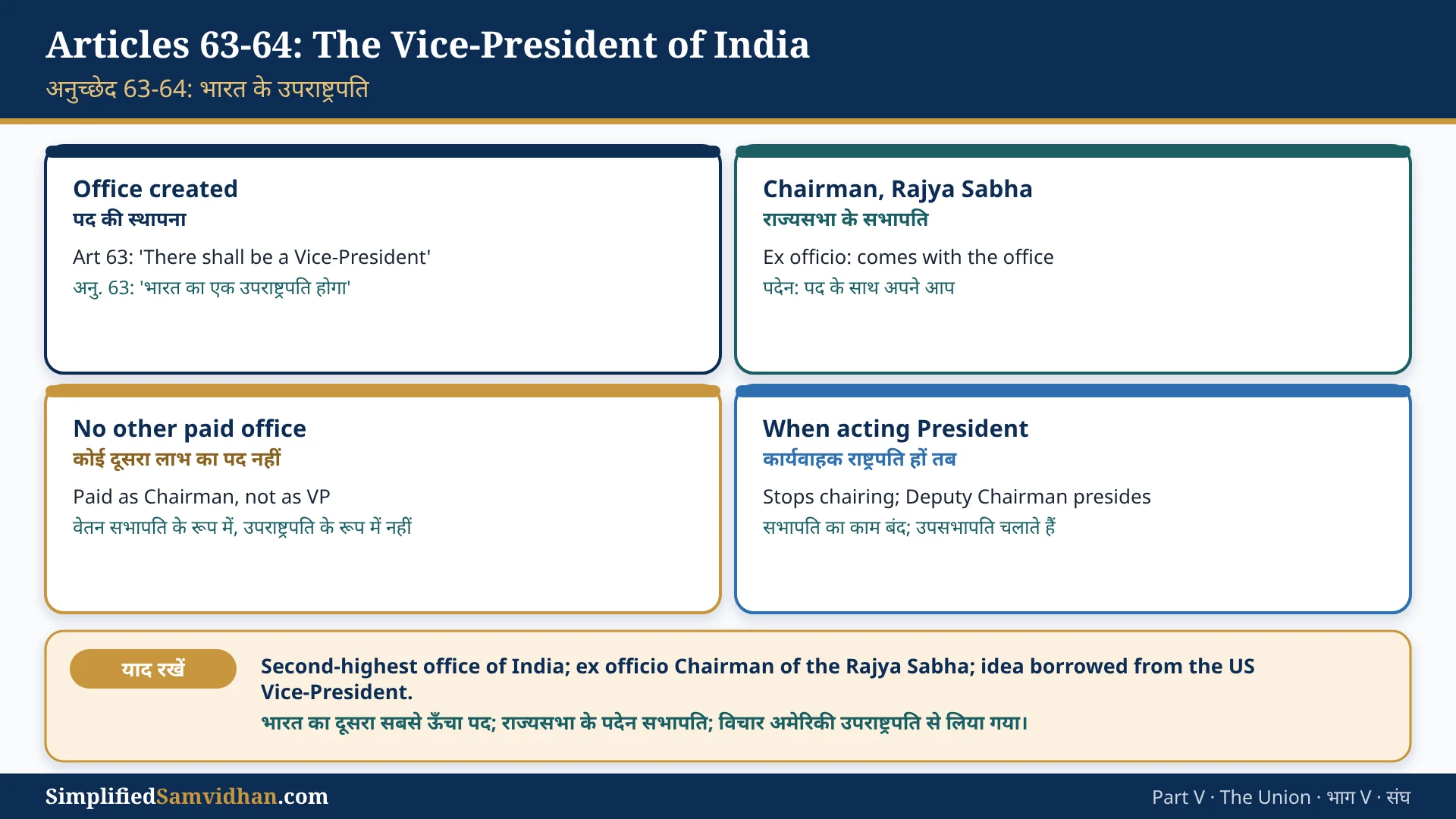
Article 63: India must always have a Vice-President. It is the second-highest constitutional office, after the President.
Article 64, ex officio Chairman: whoever becomes Vice-President automatically chairs the Rajya Sabha (Council of States). No separate election for Chairman is held.
No other office of profit: the Vice-President cannot take any other paid post.
Proviso: while acting as President (Article 65), the Vice-President does not chair the Rajya Sabha and does not draw the Chairman's salary; he or she is paid as President for that period.
Salary: the Constitution gives no salary to the post of Vice-President as such; the pay comes as Chairman under Article 97 and the Salaries and Allowances of Officers of Parliament Act, 1953 (now Rs 4 lakh a month).
🏠 Everyday Analogy
Think of a school's vice-principal who, by rule, also runs the senior students' council. If the principal falls ill, the vice-principal takes over the principal's room for those days, and the council meetings are run by the council's own deputy head.
🇮🇳 Real Indian Example
On 21 July 2025 Vice-President Jagdeep Dhankhar resigned, citing health. Until a new Vice-President took over, Deputy Chairman Harivansh ran the Rajya Sabha. C. P. Radhakrishnan was elected on 9 September 2025, defeating B. Sudershan Reddy by 452 votes to 300, and became the 15th Vice-President and Chairman of the Rajya Sabha on 12 September 2025.
As ChairmanArticle 64: What the Vice-President Does as Chairman of the Rajya Sabha
| Role | Provision |
|---|---|
| Presides over sittings, keeps order, interprets rules | Rules of Procedure of the Rajya Sabha |
| Casting vote only in case of a tie (not a member, so no ordinary vote) | Art 100(1) |
| Decides disqualification on defection of Rajya Sabha members | Tenth Schedule, para 6 |
| Deputy Chairman presides when the office is vacant or the Chairman is absent | Arts 89, 91 |
| Cannot preside while a resolution for his or her removal is under consideration | Art 92 |
Unlike the Lok Sabha Speaker, the Chairman is not a member of the House he or she runs. That is why the Chairman has only a casting vote, and why the Chairman does not certify Money Bills, which is the Speaker's job (Article 110(4)).
HistoryArticles 63-64: Origin and Facts
- Borrowed from the USA: the American Vice-President is President of the Senate. But unlike the US, India's Vice-President does not automatically become President when there is a vacancy; he or she only acts till a new President is elected (Article 65).
- First Vice-President: S. Radhakrishnan (1952-1962), who served two terms and then became President. Hamid Ansari (2007-2017) is the other Vice-President with two full terms.
- Six Vice-Presidents later became President: S. Radhakrishnan, Zakir Husain, V. V. Giri, R. Venkataraman, Shankar Dayal Sharma and K. R. Narayanan.
- Resignations: V. V. Giri (1969, to contest for President) and Jagdeep Dhankhar (July 2025, on health grounds) left office early.
- Present: C. P. Radhakrishnan, 15th Vice-President, in office since 12 September 2025.
ComparisonArticles 63-64 Compared: Vice-President of India vs Vice-President of the USA
| Point | India | USA |
|---|---|---|
| Presides over | Rajya Sabha (ex officio Chairman) | Senate (President of the Senate) |
| If President's office falls vacant | Acts as President till a new one is elected (max 6 months) | Becomes President for the rest of the term |
| Elected by | MPs of both Houses (Art 66) | Electoral College, on a joint ticket with the President |
| Vote in the House | Casting vote only | Tie-breaking vote only |
Quick RevisionKey Points to Remember
- Art 63 creates the office of Vice-President, the second-highest office.
- Art 64: ex officio Chairman of the Rajya Sabha; no other office of profit.
- While acting as President: does not chair the Rajya Sabha and gets no Chairman's salary.
- Paid as Chairman under Art 97 (Rs 4 lakh a month); casting vote only (Art 100).
- Current: C. P. Radhakrishnan (15th), since 12 September 2025.
UPSC · State PSC · JudiciaryArticles 63-64: Exam Corner
- Prelims trap: "The Vice-President is a member of the Rajya Sabha." False. He or she chairs it but is not a member.
- Prelims trap: "The Vice-President gets a separate salary for the post of Vice-President." False. The pay is as Chairman of the Rajya Sabha.
- Prelims trap: "On a vacancy, the Vice-President becomes President for the rest of the term." False. That is the US rule.
- Mains (GS II): "The Vice-President's role is largely that of a presiding officer." Discuss.
Practice MCQTest Yourself: Articles 63-64
From which post does the Vice-President of India draw a salary?
Doubts ClearedFrequently Asked Questions
What is Article 63 of the Indian Constitution?
Article 63 says: "There shall be a Vice-President of India." It creates the second-highest office of the Republic.
What is Article 64 of the Indian Constitution?
Article 64 makes the Vice-President the ex officio Chairman of the Rajya Sabha and bars any other office of profit; while acting as President he or she does not chair the House or draw the Chairman's pay.
Who is the current Vice-President of India?
C. P. Radhakrishnan, the 15th Vice-President, elected on 9 September 2025 and in office since 12 September 2025.