Bare ActOfficial Text of Article 67
67. Term of office of Vice-President.—
A Vice-President shall hold office for a term of five years from the date on which he enters upon his office:
Provided that—
(a) a Vice-President may, by writing under his hand addressed to the President, resign his office;
(b) a Vice-President may be removed from his office by a resolution of the Council of States passed by a majority of all the then members of the Council and agreed to by the House of the People; but no resolution for the purpose of this clause shall be moved unless at least fourteen days' notice has been given of the intention to move the resolution;
(c) a Vice-President shall, notwithstanding the expiration of his term, continue to hold office until his successor enters upon his office.
68. Time of holding election to fill vacancy in the office of Vice-President and the term of office of person elected to fill casual vacancy.—
(1) An election to fill a vacancy caused by the expiration of the term of office of Vice-President shall be completed before the expiration of the term.
(2) An election to fill a vacancy in the office of Vice-President occurring by reason of his death, resignation or removal, or otherwise shall be held as soon as possible after the occurrence of the vacancy, and the person elected to fill the vacancy shall, subject to the provisions of article 67, be entitled to hold office for the full term of five years from the date on which he enters upon his office.
69. Oath or affirmation by the Vice-President.—
Every Vice-President shall, before entering upon his office, make and subscribe before the President, or some person appointed in that behalf by him, an oath or affirmation in the following form, that is to say—
"I, A.B., do swear in the name of God / solemnly affirm that I will bear true faith and allegiance to the Constitution of India as by law established and that I will faithfully discharge the duty upon which I am about to enter."
70. Discharge of President's functions in other contingencies.—
Parliament may make such provision as it thinks fit for the discharge of the functions of the President in any contingency not provided for in this Chapter.
71. Matters relating to, or connected with, the election of a President or Vice-President.—
(1) All doubts and disputes arising out of or in connection with the election of a President or Vice-President shall be inquired into and decided by the Supreme Court whose decision shall be final.
(2) If the election of a person as President or Vice-President is declared void by the Supreme Court, acts done by him in the exercise and performance of the powers and duties of the office of President or Vice-President, as the case may be, on or before the date of the decision of the Supreme Court shall not be invalidated by reason of that declaration.
(3) Subject to the provisions of this Constitution, Parliament may by law regulate any matter relating to or connected with the election of a President or Vice-President.
(4) The election of a person as President or Vice-President shall not be called in question on the ground of the existence of any vacancy for whatever reason among the members of the electoral college electing him.
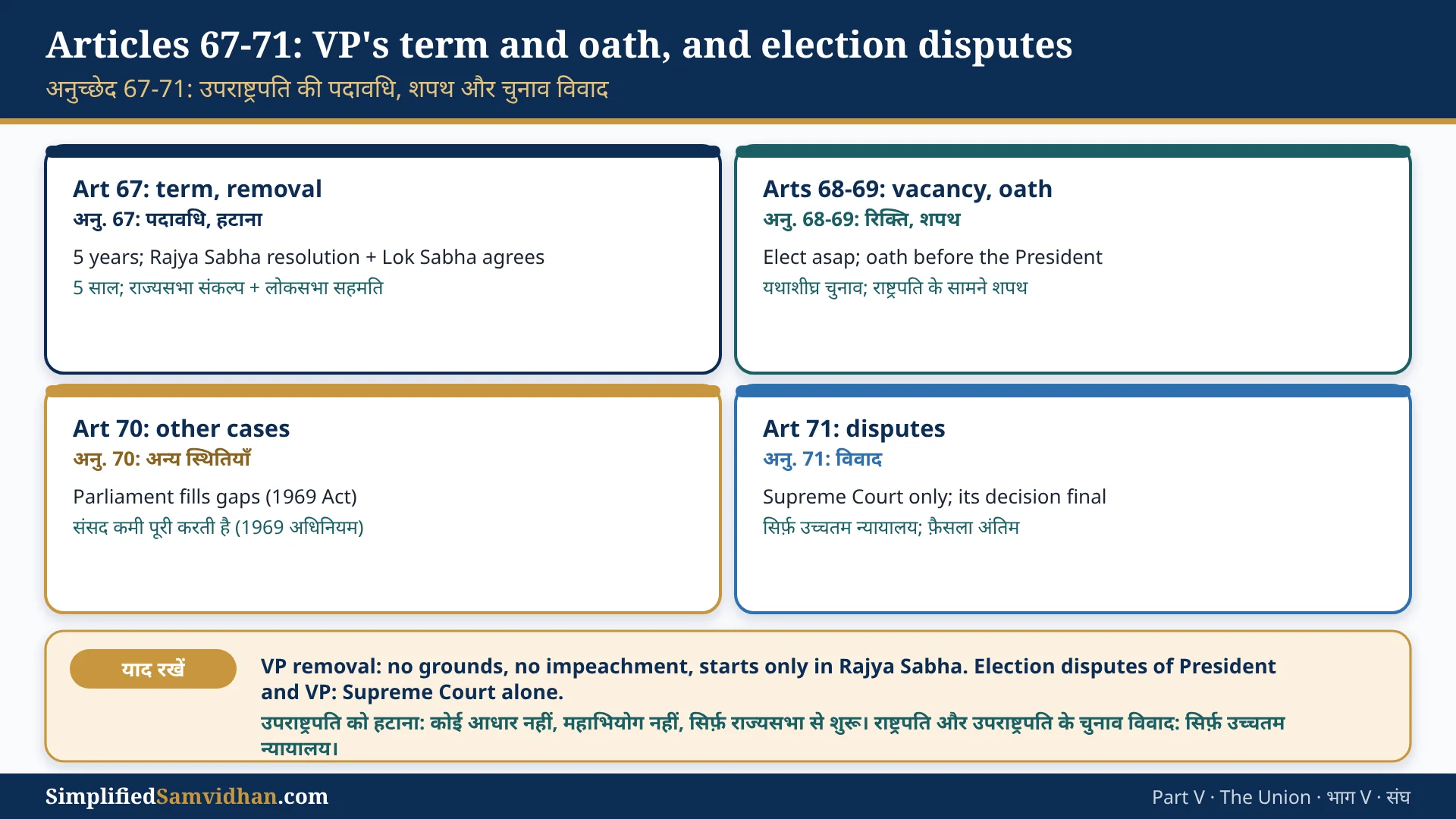
Article 67 Term: five years from taking office. The Vice-President resigns by writing to the President, and stays in office till a successor takes over.
Article 67(b) Removal: a resolution of the Rajya Sabha passed by a majority of all its then members (effective majority), then agreed to by the Lok Sabha (simple majority), after 14 days' notice. No ground is stated and there is no 'impeachment'.
Article 68 Vacancy: term-end vacancy filled before expiry; sudden vacancy filled "as soon as possible" (no six-month limit, unlike the President); the person elected gets a full five years.
Article 69 Oath: before the President (or a person the President appoints): "bear true faith and allegiance to the Constitution" and "faithfully discharge the duty".
Article 70: Parliament may provide for the President's functions in any situation the Chapter did not foresee.
Article 71: all doubts and disputes about the election of the President or Vice-President go only to the Supreme Court, whose decision is final. Acts done before an election is set aside remain valid, and vacancies in the electoral college are no ground to challenge an election.
🏠 Everyday Analogy
A housing society's vice-chairman can be voted out by the managing committee and confirmed by the general body, without any formal trial. But if anyone disputes how the chairman or vice-chairman was elected, only the highest court in town may decide, so the society does not fight the same election in many places.
🇮🇳 Real Indian Example
In December 2024 opposition members gave notice of a resolution under Article 67(b) to remove Vice-President Jagdeep Dhankhar, the first such notice ever. Deputy Chairman Harivansh rejected it, noting among other things that the required 14 days' notice could not be completed within that session. No Vice-President has ever been removed.
RemovalArticle 67(b) vs Article 61: Removing the Vice-President vs Impeaching the President
| Point | Vice-President (Art 67(b)) | President (Art 61) |
|---|---|---|
| Ground | None stated | Violation of the Constitution |
| Where it starts | Rajya Sabha only | Either House |
| Notice | 14 days | 14 days, signed by 1/4 of the House |
| Majority | RS: majority of all then members; LS: agrees (simple majority) | 2/3 of total membership in each House |
| Hearing | No formal investigation | Other House investigates; President can be represented |
| Word used | Removal | Impeachment |
During removal proceedings the Vice-President cannot preside over the Rajya Sabha but may speak and take part (Article 92).
Article 71Article 71: Election Disputes, the 39th Amendment and Its Reversal
- Who decides: only the Supreme Court; no High Court can hear a presidential election petition. The details are in Part III of the Presidential and Vice-Presidential Elections Act, 1952: a petition must be filed within 30 days of the result, by a candidate or by at least 20 electors (10 for the Vice-President).
- 1975, 39th Amendment: during the Emergency Article 71 was rewritten so that such disputes would be decided by an authority set up by Parliament's law, and Article 329A shielded the Prime Minister's and Speaker's elections from the courts.
- 1978, 44th Amendment: restored the original Article 71, giving the Supreme Court back its power. (Article 329A, struck down in part in Indira Gandhi v. Raj Narain, 1975, was also removed.)
- Cases: in Charan Lal Sahu v. Giani Zail Singh (1984) the Court dismissed a petition against the 1982 election, holding that a mere candidate without the required proposers had no standing. Petitions against other elections, such as R. Venkataraman's in 1987, were also dismissed. No President's election has ever been set aside.
- Clause (2): even if an election is declared void, the acts done till then stay valid, so laws signed and appointments made are not undone.
Article 70Article 70: The Safety Valve Used in 1969
- The Constitution covers a vacancy in the President's office (Article 65) but not the case where the President and the Vice-President offices are both vacant or both unable to act.
- In July 1969 exactly that happened. Using Article 70, Parliament passed the President (Discharge of Functions) Act, 1969: in such a case the Chief Justice of India, or if not available the senior-most available judge of the Supreme Court, discharges the President's functions.
- The Act is still in force, so the order of succession is: President, Vice-President, Chief Justice of India, senior-most Supreme Court judge.
Quick RevisionKey Points to Remember
- Art 67: VP term 5 years; resigns to the President; removed by Rajya Sabha (effective majority) + Lok Sabha agrees.
- Art 68: VP vacancy filled "as soon as possible"; full five-year term for the new VP.
- Art 69: oath before the President: "bear true faith and allegiance to the Constitution".
- Art 70: Parliament provides for other contingencies (1969 Act: Chief Justice next in line).
- Art 71: election disputes of President/VP decided only by the Supreme Court; 39th Am (1975) changed it, 44th Am (1978) restored it.
UPSC · State PSC · JudiciaryArticles 67-71: Exam Corner
- Prelims trap: "The Vice-President can be impeached on the ground of violation of the Constitution." False. Removal under Article 67(b) has no stated ground and is not called impeachment.
- Prelims trap: "A resolution to remove the Vice-President can start in the Lok Sabha." False. Only in the Rajya Sabha.
- Prelims trap: "The Chief Justice administers the oath to the Vice-President." False. The President does (Article 69).
- Prelims trap: "Disputes about the President's election are decided by the Election Commission." False. The Supreme Court (Article 71).
- Mains (GS II): "Why is the removal of the Vice-President simpler than the impeachment of the President?" Discuss.
Practice MCQTest Yourself: Articles 67-71
A resolution to remove the Vice-President of India can be moved in:
Doubts ClearedFrequently Asked Questions
What is Article 67 of the Indian Constitution?
Article 67 fixes the Vice-President's five-year term, resignation to the President, removal by a Rajya Sabha resolution agreed to by the Lok Sabha, and continuing till a successor takes office.
What is Article 71 of the Indian Constitution?
Article 71 says that all doubts and disputes about the election of the President or Vice-President are decided by the Supreme Court, whose decision is final.
Who administers the oath to the Vice-President?
The President, or a person appointed by the President for this purpose (Article 69).
Who acts as President if both the President's and Vice-President's offices are vacant?
The Chief Justice of India, or if not available the senior-most available Supreme Court judge, under the President (Discharge of Functions) Act, 1969 made under Article 70.