Bare ActOfficial Text of Article 65
65. The Vice-President to act as President or to discharge his functions during casual vacancies in the office, or during the absence, of President.—
(1) In the event of the occurrence of any vacancy in the office of the President by reason of his death, resignation or removal, or otherwise, the Vice-President shall act as President until the date on which a new President elected in accordance with the provisions of this Chapter to fill such vacancy enters upon his office.
(2) When the President is unable to discharge his functions owing to absence, illness or any other cause, the Vice-President shall discharge his functions until the date on which the President resumes his duties.
(3) The Vice-President shall, during, and in respect of, the period while he is so acting as, or discharging the functions of, President, have all the powers and immunities of the President and be entitled to such emoluments, allowances and privileges as may be determined by Parliament by law and, until provision in that behalf is so made, such emoluments, allowances and privileges as are specified in the Second Schedule.
66. Election of Vice-President.—
(1) The Vice-President shall be elected by the members of an electoral college consisting of the members of both Houses of Parliament in accordance with the system of proportional representation by means of the single transferable vote and the voting at such election shall be by secret ballot.
(2) The Vice-President shall not be a member of either House of Parliament or of a House of the Legislature of any State, and if a member of either House of Parliament or of a House of the Legislature of any State be elected Vice-President, he shall be deemed to have vacated his seat in that House on the date on which he enters upon his office as Vice-President.
(3) No person shall be eligible for election as Vice-President unless he—
(a) is a citizen of India;
(b) has completed the age of thirty-five years; and
(c) is qualified for election as a member of the Council of States.
(4) A person shall not be eligible for election as Vice-President if he holds any office of profit under the Government of India or the Government of any State or under any local or other authority subject to the control of any of the said Governments.
Explanation.—For the purposes of this article, a person shall not be deemed to hold any office of profit by reason only that he is the President or Vice-President of the Union or the Governor of any State or is a Minister either for the Union or for any State.
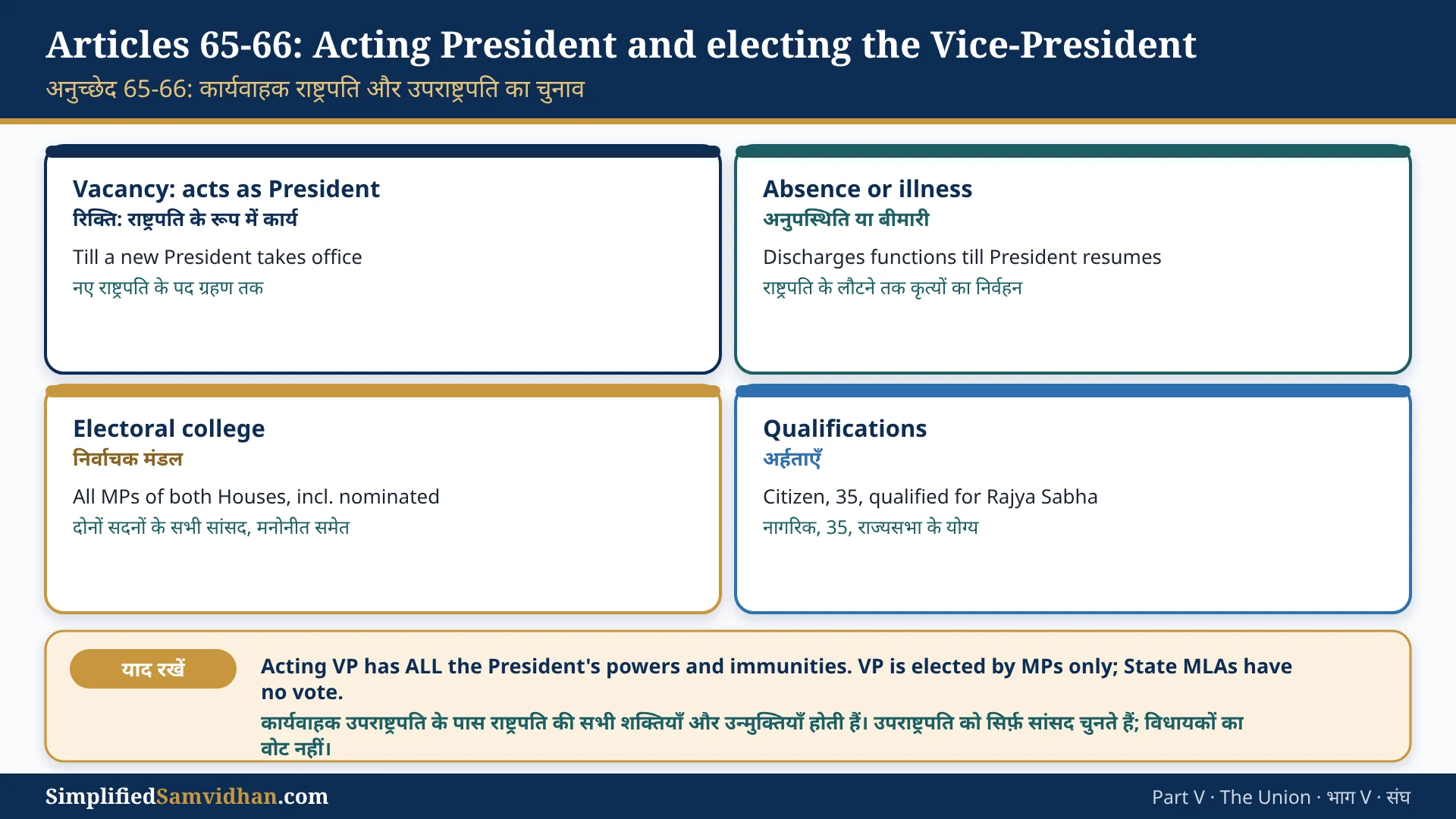
Article 65(1) Vacancy: if the President dies, resigns, is removed, or the office falls vacant otherwise, the Vice-President acts as President until the newly elected President takes office.
Article 65(2) Absence or illness: if the President is temporarily unable to work, the Vice-President discharges the functions until the President resumes.
Article 65(3): during that period the Vice-President has all the powers and immunities of the President and gets the President's pay, not the Rajya Sabha Chairman's (proviso to Article 64).
Article 66(1) Election: by an electoral college of all members of both Houses, elected and nominated, by proportional representation through the single transferable vote, secret ballot. Every MP's vote has the same value.
Article 66(2): the Vice-President cannot be a member of any legislature; the seat is vacated on taking office.
Article 66(3)-(4): citizen, 35 years, qualified for the Rajya Sabha, no office of profit (Ministers, Governors and the President/Vice-President exempt).
🏠 Everyday Analogy
A hospital's deputy director takes charge when the director is on leave, with full authority to sign every order, and hands it back the day the director returns. Only the hospital's doctors, not the whole town, vote to choose that deputy.
🇮🇳 Real Indian Example
In the September 2025 Vice-Presidential election, held after Jagdeep Dhankhar's resignation, the electoral college had 781 members (both Houses, minus vacancies). C. P. Radhakrishnan won 452 first-preference votes against 300 for B. Sudershan Reddy. State MLAs had no role, unlike in the President's election.
Acting PresidentsArticle 65 in Practice: India's Acting Presidents
| Acting President | Period | Why |
|---|---|---|
| V. V. Giri (Vice-President) | 3 May - 20 July 1969 | Death of Zakir Husain |
| M. Hidayatullah (Chief Justice) | 20 July - 24 August 1969 | Giri resigned; both offices vacant (1969 Act) |
| B. D. Jatti (Vice-President) | 11 February - 25 July 1977 | Death of Fakhruddin Ali Ahmed |
Article 65(2), the 'absence or illness' clause, has also been used for short spells, for example when President Zail Singh was abroad for medical treatment in 1982, Vice-President M. Hidayatullah discharged his functions. Hidayatullah is thus the only person to have done the President's job both as Chief Justice and as Vice-President.
ComparisonArticle 66 vs Article 54: Vice-President's Election vs President's Election
| Point | President (Arts 54-55, 58) | Vice-President (Art 66) |
|---|---|---|
| Electors | Elected MPs + elected MLAs (incl. Delhi, Puducherry) | All MPs, elected and nominated |
| State legislatures | Yes | No |
| Nominated MPs | No | Yes |
| Vote value | Weighted (MLA by State population; MP 700 in 2022) | Equal: one MP, one vote |
| Method | PR by STV, secret ballot | PR by STV, secret ballot |
| Must qualify for | Lok Sabha | Rajya Sabha |
| Minimum age | 35 | 35 |
11th AmendmentArticle 66 and the 11th Amendment, 1961
- Originally Article 66(1) said the Vice-President would be elected by members of both Houses "assembled at a joint meeting".
- The 11th Amendment, 1961 replaced this with an electoral college, so MPs no longer need to meet together; they vote at polling stations like in the President's election.
- The same amendment added Article 71(4): an election cannot be challenged just because there were vacancies in the electoral college.
- Nomination needs 20 proposers and 20 seconders from the electoral college and a deposit of Rs 15,000 (Presidential and Vice-Presidential Elections Act, 1952).
Quick RevisionKey Points to Remember
- Art 65(1): on a vacancy, the Vice-President acts as President till the new President takes office.
- Art 65(2): during absence or illness, the Vice-President discharges the functions.
- Art 65(3): all powers, immunities and pay of the President during that time.
- Art 66: elected by all MPs (incl. nominated); PR by STV; secret ballot; State MLAs have no vote.
- Qualifications: citizen, 35, qualified for the Rajya Sabha, no office of profit.
UPSC · State PSC · JudiciaryArticles 65-66: Exam Corner
- Prelims trap: "Nominated members cannot vote in the Vice-President's election." False. They can (but not in the President's).
- Prelims trap: "State Legislative Assemblies take part in electing the Vice-President." False. Only Parliament.
- Prelims trap: "An acting President has only routine powers." False. Article 65(3) gives all powers and immunities.
- Mains (GS II): "Compare the election of the President and the Vice-President of India and explain the reasons for the differences."
Practice MCQTest Yourself: Articles 65-66
Who elects the Vice-President of India?
Doubts ClearedFrequently Asked Questions
What is Article 65 of the Indian Constitution?
Article 65 lets the Vice-President act as President when the office is vacant, or discharge the President's functions during absence or illness, with all the President's powers and immunities.
What is Article 66 of the Indian Constitution?
Article 66 deals with the election of the Vice-President by all members of both Houses of Parliament through the single transferable vote, and with the qualifications for the office.
Do nominated MPs vote in the Vice-President's election?
Yes. All members of both Houses, elected and nominated, form the electoral college for the Vice-President.