Bare ActOfficial Text of Article 73
73. Extent of executive power of the Union.—
(1) Subject to the provisions of this Constitution, the executive power of the Union shall extend—
(a) to the matters with respect to which Parliament has power to make laws; and
(b) to the exercise of such rights, authority and jurisdiction as are exercisable by the Government of India by virtue of any treaty or agreement:
Provided that the executive power referred to in sub-clause (a) shall not, save as expressly provided in this Constitution or in any law made by Parliament, extend in any State to matters with respect to which the Legislature of the State has also power to make laws.
(2) Until otherwise provided by Parliament, a State and any officer or authority of a State may, notwithstanding anything in this article, continue to exercise in matters with respect to which Parliament has power to make laws for that State such executive power or functions as the State or officer or authority thereof could exercise immediately before the commencement of this Constitution.
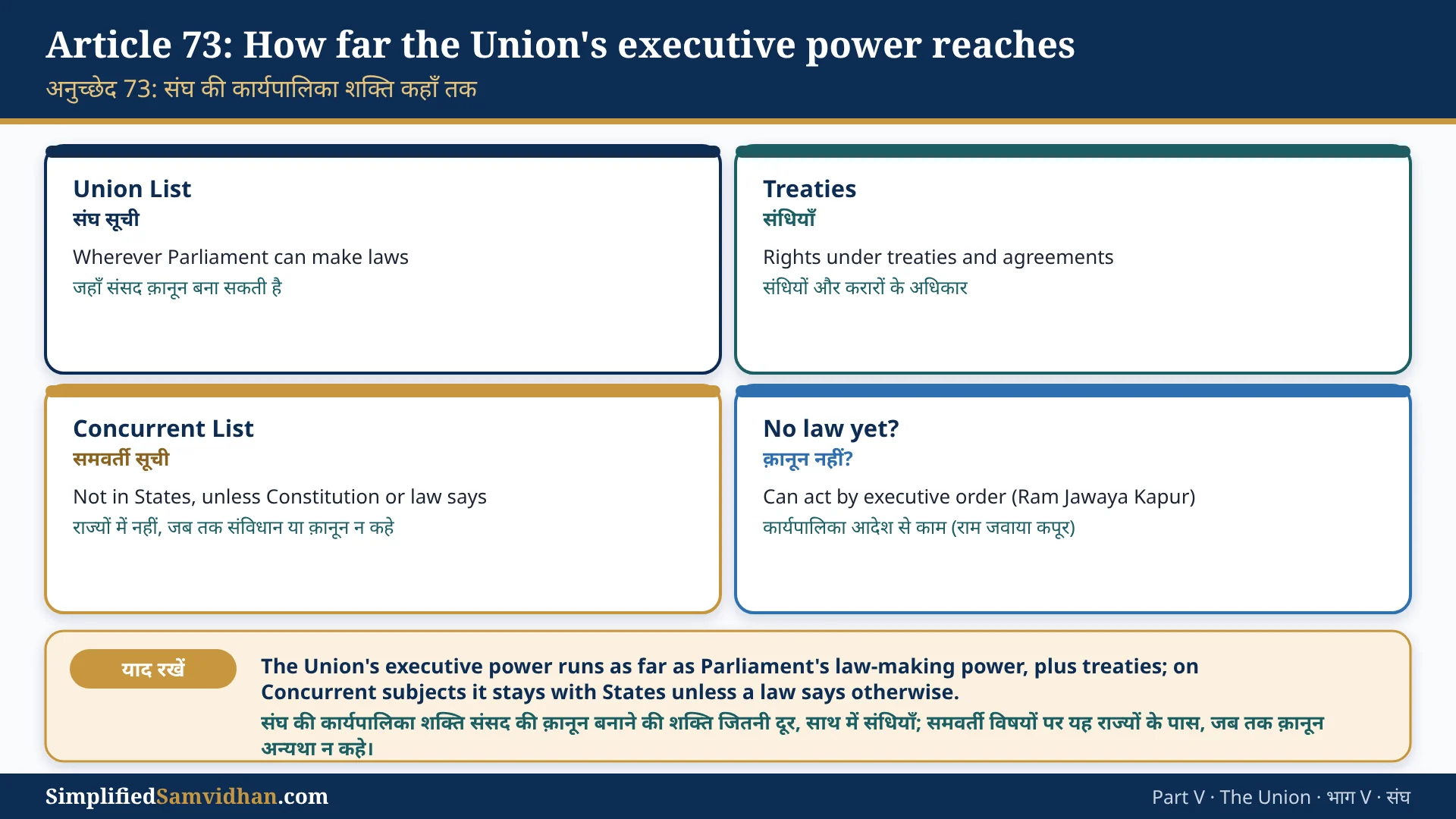
Clause (1)(a) Law and action go together: on every matter on which Parliament can legislate (Union List, Concurrent List, and residuary matters under Article 248), the Union can also act. Defence, railways, foreign affairs and currency are clear examples.
Clause (1)(b) Treaties: the Union can use all rights, authority and jurisdiction India has under a treaty or agreement, for example under a water-sharing treaty or a trade agreement.
Proviso, Concurrent List: on subjects where States can also make laws (education, forests, criminal law and others), the executive power inside a State stays with the State. The Union gets it only where the Constitution or a Parliament law expressly gives it.
Clause (2) Continuity: State officers who were doing certain work before 1950 on matters now in Parliament's field could continue it until Parliament made other arrangements. This avoided a gap in administration in 1950.
"Subject to the provisions of this Constitution": executive power cannot break Fundamental Rights or any other limit in the Constitution.
🏠 Everyday Analogy
Think of a company where the board (Parliament) decides which departments the head office controls. Wherever the board can set rules, the head office manager (the Union executive) can also run things. For shared departments, the branch office (the State) runs daily work unless the board's written rules hand it to the head office.
🇮🇳 Real Indian Example
In Ram Jawaya Kapur v State of Punjab (1955), the Punjab government took over the printing and sale of school textbooks by executive order, without passing a law. Publishers said this needed a law. A Constitution Bench held that the executive power of a State (Article 162) and of the Union (Article 73) is co-extensive with the legislature's power, so the government can act on any matter within that field even without a specific law, as long as it does not infringe anyone's legal rights. Since the publishers had no right to have their books chosen, the order was valid.
ReachArticle 73: Where the Union Executive Can and Cannot Act
| Field | Who makes laws | Who has executive power |
|---|---|---|
| Union List (List I) | Parliament only | Union |
| Residuary matters (Art 248) | Parliament only | Union |
| Concurrent List (List III) | Parliament and States | States, unless the Constitution or a Parliament law gives it to the Union |
| State List (List II) | States (Parliament only in special cases) | States (Art 162) |
| Treaties and agreements | Parliament can implement (Art 253) | Union |
Examples of a Parliament law giving executive power on a Concurrent subject to the Union: central agencies and authorities created under central laws on Concurrent matters. Without such a law, the State machinery carries out Concurrent laws.
ComparisonArticle 73 vs Article 162: Union and State Executive Power
| Point | Union (Art 73) | State (Art 162) |
|---|---|---|
| Basic rule | Extends to matters on which Parliament can legislate | Extends to matters on which the State Legislature can legislate |
| Treaties | Yes, rights under treaties | No |
| Concurrent List | Only where the Constitution or Parliament law expressly says | Yes, unless limited by the Constitution or Parliament law |
| Vested in | President (Art 53) | Governor (Art 154) |
Key casesArticle 73 in Court: Acting Without a Law
- Ram Jawaya Kapur v State of Punjab (1955): executive power is what remains after the legislative and judicial functions are taken away; it is co-extensive with legislative power, and the government need not wait for a law to act in its field.
- Bishamber Dayal Chandra Mohan v State of UP (1982): the government can act by executive order where there is no law, but cannot take away a person's rights, such as property or trade, without the authority of law.
- Limit from Article 21 and 19: any action that restricts life, liberty or the freedoms of Article 19 needs a valid law; an executive order alone is not enough.
- In practice: many Union welfare schemes, guidelines and policies run on executive decisions under Article 73, with money approved by Parliament through the budget.
Quick RevisionKey Points to Remember
- Union executive power extends to all matters on which Parliament can make laws (Art 73(1)(a)).
- It also covers rights and jurisdiction under treaties and agreements (Art 73(1)(b)).
- Concurrent List: stays with States unless the Constitution or a Parliament law expressly gives it to the Union.
- State counterpart: Article 162.
- Executive power is co-extensive with legislative power (Ram Jawaya Kapur, 1955).
UPSC · State PSC · JudiciaryArticle 73: Exam Corner
- Prelims trap: "The Union has executive power over all Concurrent List matters in every State." False. Only if the Constitution or a Parliament law expressly provides.
- Prelims: Ram Jawaya Kapur (1955) is the leading case on the meaning of executive power.
- Prelims: Article 73(1)(b) is the basis of the Union's power to act under treaties; Article 253 lets Parliament make laws to implement them.
- Mains (GS II): "Executive power in India follows legislative power." Explain with Articles 73 and 162 and the Concurrent List.
Practice MCQTest Yourself: Article 73
Under Article 73, the executive power of the Union on a Concurrent List matter extends to a State:
Doubts ClearedFrequently Asked Questions
What is Article 73 of the Indian Constitution?
Article 73 sets the extent of the Union's executive power: all matters on which Parliament can make laws, and rights under treaties and agreements, except Concurrent matters in States unless expressly provided.
Can the Union government act without a law?
Yes, within its field it can act by executive order if no law exists, as held in Ram Jawaya Kapur (1955), but it cannot take away anyone's rights without a valid law.
Which Article is the State counterpart of Article 73?
Article 162, which extends a State's executive power to matters on which its Legislature can make laws.