Governor of Rajasthan: Appointment, Powers and Discretion (RAS Notes)
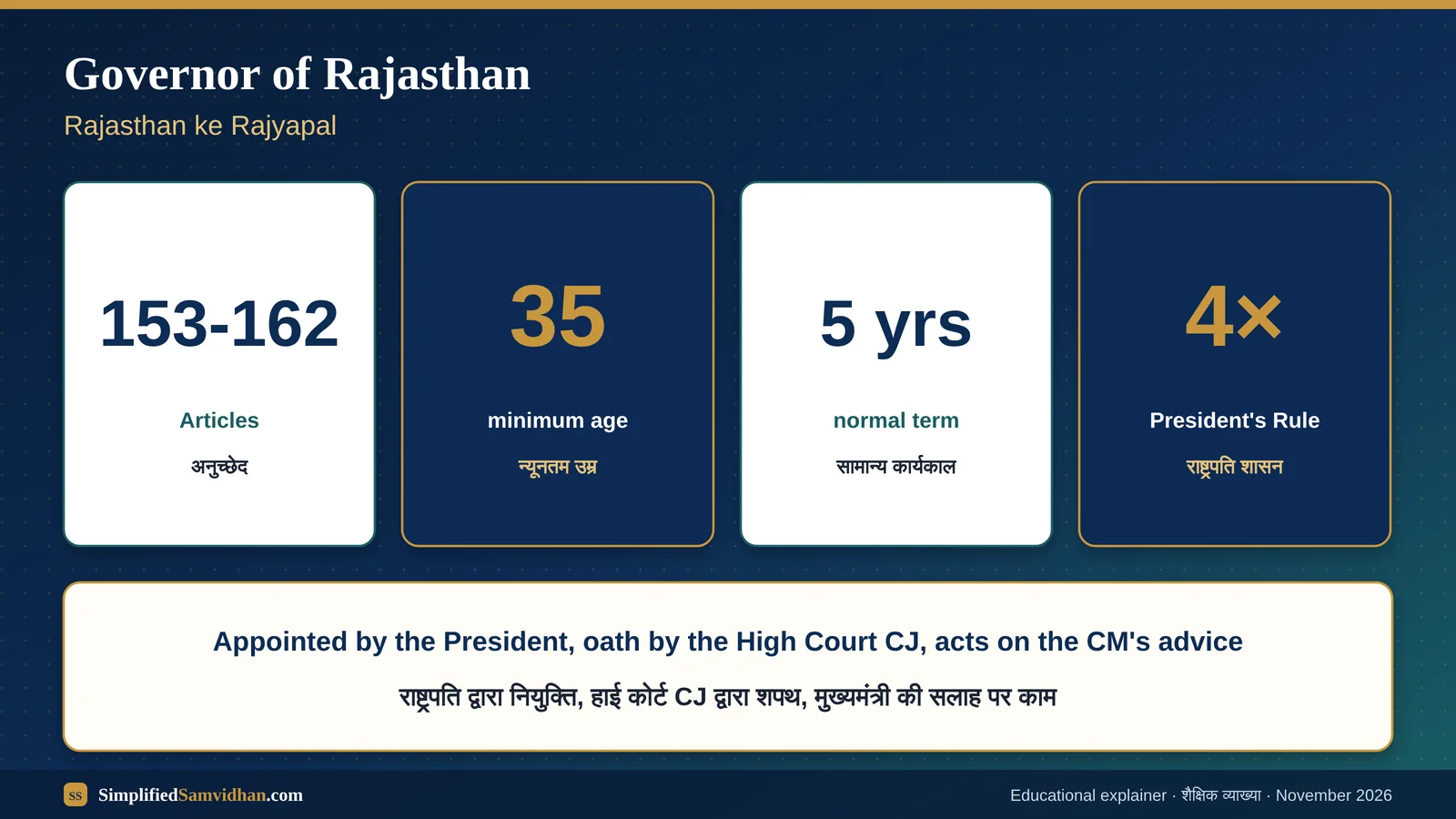
Everything RAS asks about the Governor on one page: articles, appointment, oath, five kinds of powers, Rajasthan firsts, the latest Supreme Court view on assent to bills, and practice MCQs.
Short answerGovernor of Rajasthan in Simple Words
Short answer: the Governor is the constitutional head of Rajasthan. All state orders run in his name (Art 154), but real power is with the Chief Minister and Council of Ministers, whose advice he must follow except in a few discretionary matters (Art 163). He is appointed by the President (Art 155), must be a citizen aged 35 (Art 157), holds office at the pleasure of the President for normally 5 years (Art 156), and takes oath before the Chief Justice of the Rajasthan High Court (Art 159). Rajasthan's Governor today is Haribhau Kisanrao Bagade (since July 2024).
🏠 Everyday analogy
Think of a school: the Principal's name is on every certificate (Governor), but the teachers' committee (Council of Ministers) actually runs classes. The Principal steps in on his own only in rare situations, like when no committee exists.
🇮🇳 Real Indian example
When no party won a clear majority, the Governor chooses whom to invite as Chief Minister; when the state machinery fails, he sends a report to the President for President's Rule under Article 356. Rajasthan has seen President's Rule four times: 1967, 1977, 1980 and 1992-93.
Prelims: Article numbers (153-162, 163, 213); who gives oath, who appoints, age; first Governor / Rajpramukh / first woman Governor of Rajasthan
Mains: discretionary powers and the Governor's role in Centre-State relations; assent to bills (Art 200) after the 2025 Supreme Court opinion
Constitution textWhat the Constitution Says (Articles 153-156, 163)
Article 153. There shall be a Governor for each State: Provided that nothing in this article shall prevent the appointment of the same person as Governor for two or more States.
Article 154(1). The executive power of the State shall be vested in the Governor and shall be exercised by him either directly or through officers subordinate to him in accordance with this Constitution.
Article 155. The Governor of a State shall be appointed by the President by warrant under his hand and seal.
Article 156(1). The Governor shall hold office during the pleasure of the President.
Article 163(1). There shall be a Council of Ministers with the Chief Minister at the head to aid and advise the Governor in the exercise of his functions, except in so far as he is by or under this Constitution required to exercise his functions or any of them in his discretion.
Appointment and termAppointment, Qualification, Oath, Term and Removal (Articles 155-159)
| Point | Rule | Article |
|---|---|---|
| Appointment | By the President, by warrant under hand and seal (on the Union Cabinet's advice) | 155 |
| Qualification | Citizen of India, completed 35 years | 157 |
| Conditions | Not an MP/MLA, no office of profit; free official residence (Raj Bhavan, Jaipur); salary cannot be cut during term | 158 |
| Oath | Before the Chief Justice of the High Court (or the senior-most judge) | 159 |
| Term | At the President's pleasure; normally 5 years; resignation addressed to the President; continues till successor comes | 156 |
| Removal | No impeachment; the President can remove him any time. But removal cannot be arbitrary (B.P. Singhal case, 2010) | 156 |
| Two states | One person can be Governor of two or more states (7th Amendment, 1956) | 153 |
| Immunity | No criminal case during term; not answerable to any court for official acts | 361 |
PowersFive Kinds of Powers of the Governor
Executive
Appoints the CM and, on his advice, ministers (Art 164); appoints the Advocate General (165), State Election Commissioner (243K), RPSC Chairman and members (316). Chancellor of state universities under state laws.
Legislative
Summons, prorogues and dissolves the Vidhan Sabha (174); addresses the first session each year (176); assents to bills or withholds or returns or reserves them for the President (200); issues ordinances when the House is not in session (213).
Financial
Budget (Annual Financial Statement) is laid in his name (202); money bills need his recommendation (207); Contingency Fund of the State is at his disposal (267); constitutes the State Finance Commission every 5 years (243I).
Judicial
Pardons, reprieves, remissions for offences under state law (161), but not death sentence pardon or court-martial; appoints district judges with the High Court (233).
Discretionary
Choosing a CM when no one has a clear majority; reserving a bill for the President (200); report for President's Rule (356); asking the CM for information (167); extra roles under special provisions (e.g. 371).
Governor vs PresidentGovernor vs President: Differences Asked in Exams
Governor (State)
- Appointed by the President
- Removed at the President's pleasure
- Has some constitutional discretion (Art 163)
- Cannot pardon a death sentence
- Oath: High Court Chief Justice
President (Union)
- Elected by an electoral college
- Removed only by impeachment (Art 61)
- No constitutional discretion in the text (Art 74)
- Can pardon a death sentence (Art 72)
- Oath: Chief Justice of India
Rajasthan factsRajasthan Facts: Rajpramukh, First Governor, President's Rule
| Fact | Answer |
|---|---|
| Rajpramukh before Governors (1949-56) | Maharaja Sawai Man Singh II of Jaipur |
| First Governor (1 Nov 1956, after state reorganisation) | Gurumukh Nihal Singh / गुरुमुख निहाल सिंह |
| First woman Governor | Pratibha Patil (2004-07), later President of India |
| Previous Governor | Kalraj Mishra / कलराज मिश्र (2019-2024) |
| Present Governor | Haribhau Kisanrao Bagade (since 31 July 2024), former Maharashtra Assembly Speaker |
| Residence | Raj Bhavan, Jaipur |
| President's Rule in Rajasthan | 4 times: 1967, 1977, 1980, 1992-93 (after the Babri demolition, Shekhawat government dismissed) |
Current affairsCurrent Affairs of the Last One Year Linked to the Governor
- 20 Nov 2025, Supreme Court opinion (Presidential Reference under Article 143): a 5-judge bench led by CJI B.R. Gavai said courts cannot fix deadlines for the Governor or President to act on bills, and there is no 'deemed assent'. This changed the 8 April 2025 Tamil Nadu Governor judgment, which had set time limits. The bench also said a Governor may reserve even a re-passed bill for the President; for long, unexplained inaction a court can only ask him to decide, not decide for him.
- Rajasthan Coaching Centres (Control and Regulation) Act, 2025: passed by the Assembly and signed by Governor Bagade; a recent example of the Governor's assent under Article 200.
- 7 Sep 2026: Governor Bagade administered the oath to Justice Sanjay Kumar Agrawal as Chief Justice of the Rajasthan High Court (Article 219 read with the Third Schedule).
- As Chancellor (Oct 2026): the Governor reviewed state universities and asked them to become centres of excellence with research and skill courses.
Mains answerRAS Mains: How to Write the Answer
- Q. 'The Governor is a constitutional head but also an agent of the Centre.' Examine. (10 marks) Answer frame: (1) constitutional head: Art 154, 163, acts on advice; (2) Centre's link: appointed by and holds office at the pleasure of the President, Art 356 report, reserving bills (Art 200); (3) checks: B.P. Singhal (2010) on removal, S.R. Bommai (1994) on floor test, 2025 opinion on assent; (4) reforms: Sarkaria and Punchhi Commission advice (eminent, non-political person, consult the CM); conclusion: a bridge, not a boss.
- Q. Write a note on the discretionary powers of the Governor. (5 marks) List 4-5 situations (hung assembly, reserving bill, Art 356 report, special responsibilities) + one case.
Quick revisionOne-Line Revision Points (Exam Ready)
- Appointed by the President (Art 155); pleasure of the President (156).
- Age 35, citizen (157); oath by High Court Chief Justice (159).
- Pardon (161), but not death sentence; ordinance (213).
- Aid and advice + discretion (163); appoints CM (164), AG (165).
- Assent to bills (200); bills reserved for President (201).
- Rajpramukh: Sawai Man Singh II; first Governor: Gurumukh Nihal Singh; first woman: Pratibha Patil; now: Haribhau Bagade.
Practice MCQPractice MCQs (with Answers): Governor of Rajasthan
Who administers the oath of office to the Governor of Rajasthan?
Which Article says one person can be Governor of two or more States?
The Governor CANNOT do which of these?
Who was the first woman Governor of Rajasthan?
Before the post of Governor, Rajasthan had a Rajpramukh. Who was it?
In the 2025 Presidential Reference opinion, the Supreme Court held that:
Choose the CORRECT statement:
How many times has President's Rule been imposed in Rajasthan?
Which case said that a Governor cannot be removed arbitrarily, even though he holds office at the President's pleasure?
Who is the Governor of Rajasthan (November 2026)?
Doubts ClearedFrequently Asked Questions
Who appoints the Governor of Rajasthan?
The President of India, by warrant under hand and seal (Article 155), acting on the advice of the Union Council of Ministers.
Can the Governor refuse to sign a bill?
Under Article 200 he can assent, withhold assent, return it (non-money bill) for reconsideration, or reserve it for the President. After the November 2025 Supreme Court opinion, courts cannot set a deadline for this.
Is the Governor of Rajasthan the Chancellor of universities?
Yes, under the state university laws (not the Constitution) the Governor is the Chancellor of state universities.
Sources and further readingSources We Checked
Checked on 9 November 2026 against the Constitution, the Raj Bhavan and Assembly websites, and the Supreme Court's opinion of 20 November 2025 in the Presidential Reference on Articles 200-201. The Hindi text of the Articles is a simple rendering.