Prime Minister and Union Council of Ministers: RAS Notes
Why the PM is the real executive, how ministers are appointed, the 15% and 6-month rules, the PM's roles and the latest debates, with practice MCQs.
Short answerPM and Council of Ministers in Simple Words
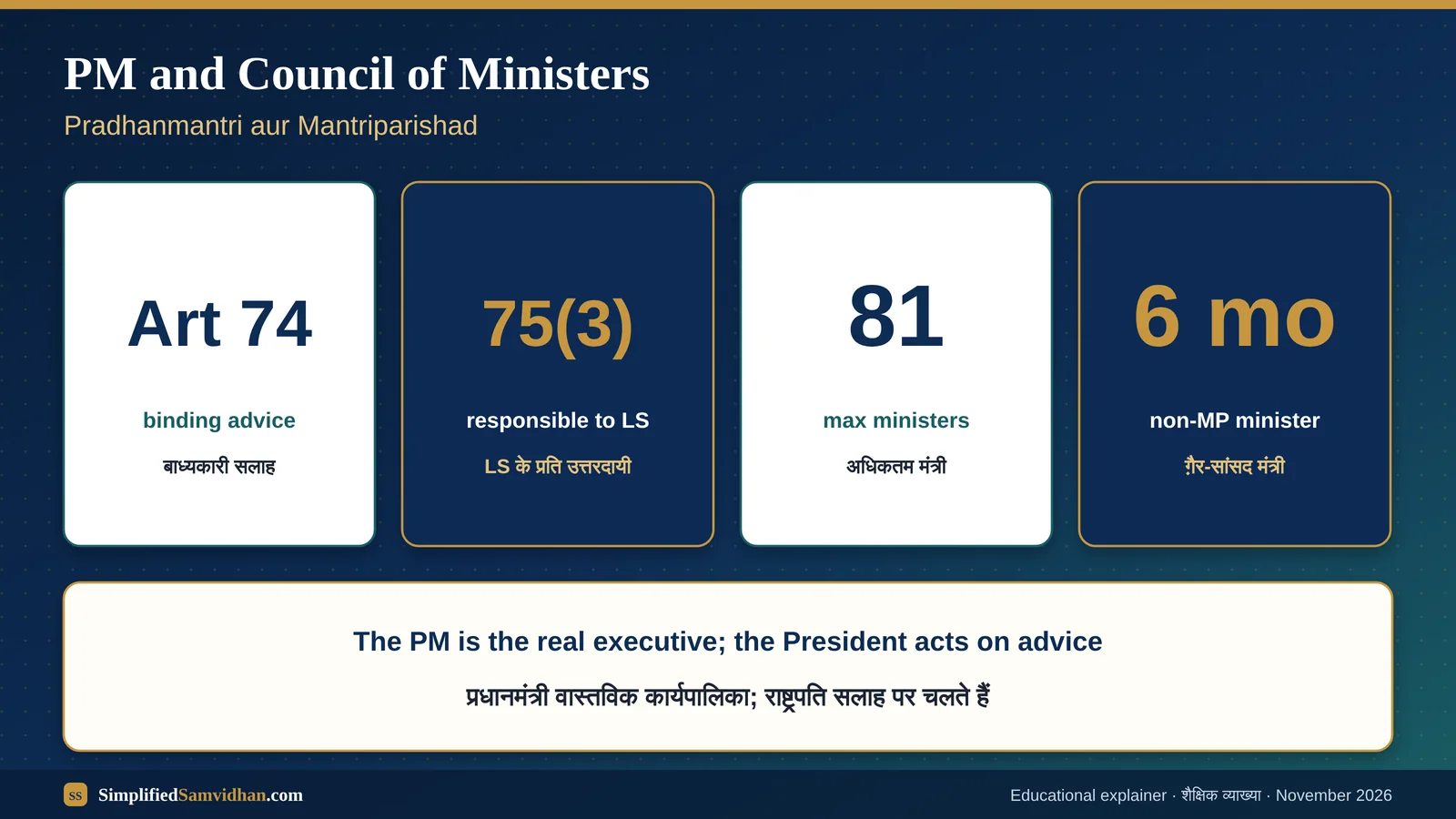
Short answer: the President is the formal head, but the Prime Minister is the real head of the Union government. Under Art 74 the Council of Ministers headed by the PM advises the President, and the President must act on that advice (42nd and 44th Amendments; the President can send it back once). The President appoints as PM the leader who has the support of the Lok Sabha, and appoints other ministers on the PM's advice (Art 75). The whole ministry is collectively responsible to the Lok Sabha (75(3)). Ministers cannot be more than 15% of the Lok Sabha (91st Amendment, 2003), i.e. 81. A non-MP can be a minister for only 6 months. Narendra Modi took oath for a third term on 9 June 2024.
🏠 Everyday analogy
The President is the ship's flag; the PM is the captain who actually steers, and the crew (ministers) sinks or swims together.
🇮🇳 Real Indian example
The CM-Council of Ministers system in Rajasthan (Arts 163-164) is a copy of this model at the state level.
Prelims: Articles 74, 75, 77, 78; 15% limit (91st Amendment), 6-month rule; Cabinet vs Council of Ministers; kitchen cabinet
Mains: PM: 'first among equals' or dominant?; collective responsibility in coalition era
Constitution textWhat the Constitution Says
Article 74(1). There shall be a Council of Ministers with the Prime Minister at the head to aid and advise the President who shall, in the exercise of his functions, act in accordance with such advice: Provided that the President may require the Council of Ministers to reconsider such advice ... and the President shall act in accordance with the advice tendered after such reconsideration.
Article 75(3). The Council of Ministers shall be collectively responsible to the House of the People.
Levels of ministersWho Is in the Council of Ministers
- 1Cabinet ministers
Senior ministers heading key ministries; the Cabinet takes the big decisions.
- 2Ministers of State (Independent Charge)
Run a ministry on their own but are not in the Cabinet.
- 3Ministers of State
Assist Cabinet ministers.
- 4Cabinet committees
e.g. Appointments Committee and Cabinet Committee on Security, both chaired by the PM.
PM's rolesFour Roles of the Prime Minister
Head of government
Picks ministers, allots portfolios, can ask any minister to resign.
Link with the President (Art 78)
Must inform the President of all Cabinet decisions and give information asked for.
Leader of the House
Advises the President on summoning, prorogation and dissolution of the Lok Sabha.
Chairman of key bodies
NITI Aayog, National Disaster Management Authority, Inter-State Council.
Current affairsCurrent Affairs of the Last One Year
- Third term (9 June 2024): Narendra Modi became the second PM after Nehru to win three consecutive terms, this time leading a coalition (NDA) in which the BJP alone did not have a majority.
- 130th Constitution Amendment Bill (introduced 20 August 2025): a PM, CM or minister detained for 30 consecutive days on charges punishable with 5 years or more would lose office; the JPC deferred its report on 17 July 2026.
- Related: Powers of the President · Parliament · Rajasthan CM · RAS polity syllabus
Mains answerRAS Mains: How to Write the Answer
- Q. Is the Indian PM 'first among equals'? (10 marks) Frame: constitutional position (74, 75, 78) → sources of power (party leader, Cabinet chair, appointments, dissolution advice) → limits (coalition partners, Lok Sabha majority, courts, federal states) → examples (Nehru, Indira, coalition era 1996-2014, 2024 coalition) → conclusion: strength depends on the mandate.
Quick revisionOne-Line Revision Points (Exam Ready)
- Advice binding on the President (74, 42nd/44th Amendments).
- Collectively responsible to the Lok Sabha (75(3)).
- Max 15% of LS = 81 (91st Amendment, 2003).
- Non-MP minister: 6 months (75(5)).
- PM's duty to inform the President: 78.
Practice MCQPractice MCQs (with Answers): Prime Minister
Which Article makes the advice of the Council of Ministers binding on the President?
The Council of Ministers is collectively responsible to:
The 15% cap on the size of the Council of Ministers was added by:
A person who is not an MP can remain a minister for at most:
Which Article describes the duties of the PM towards the President?
With 543 Lok Sabha members, the maximum number of Union ministers (including the PM) is:
'Cabinet' is mentioned in the Constitution in:
Who chairs NITI Aayog?
The 130th Constitution Amendment Bill (2025) deals with:
Choose the CORRECT statement:
Doubts ClearedFrequently Asked Questions
What is collective responsibility?
All ministers stand or fall together: if the Lok Sabha passes a no-confidence motion, the whole Council of Ministers must resign (Art 75(3)).
How many ministers can the Union government have?
At most 15% of the Lok Sabha's strength, including the PM: 81 with 543 members.
Sources and further readingSources We Checked
Checked on 11 November 2026 against the Constitution (Articles 74-78) and news reports on the 130th Amendment Bill.