Bare ActOfficial Text of Article 77
77. Conduct of business of the Government of India.—
(1) All executive action of the Government of India shall be expressed to be taken in the name of the President.
(2) Orders and other instruments made and executed in the name of the President shall be authenticated in such manner as may be specified in rules to be made by the President, and the validity of an order or instrument which is so authenticated shall not be called in question on the ground that it is not an order or instrument made or executed by the President.
(3) The President shall make rules for the more convenient transaction of the business of the Government of India, and for the allocation among Ministers of the said business.
(4) [Omitted by the Constitution (Forty-fourth Amendment) Act, 1978.]
78. Duties of Prime Minister as respects the furnishing of information to the President, etc.—
It shall be the duty of the Prime Minister—
(a) to communicate to the President all decisions of the Council of Ministers relating to the administration of the affairs of the Union and proposals for legislation;
(b) to furnish such information relating to the administration of the affairs of the Union and proposals for legislation as the President may call for; and
(c) if the President so requires, to submit for the consideration of the Council of Ministers any matter on which a decision has been taken by a Minister but which has not been considered by the Council.
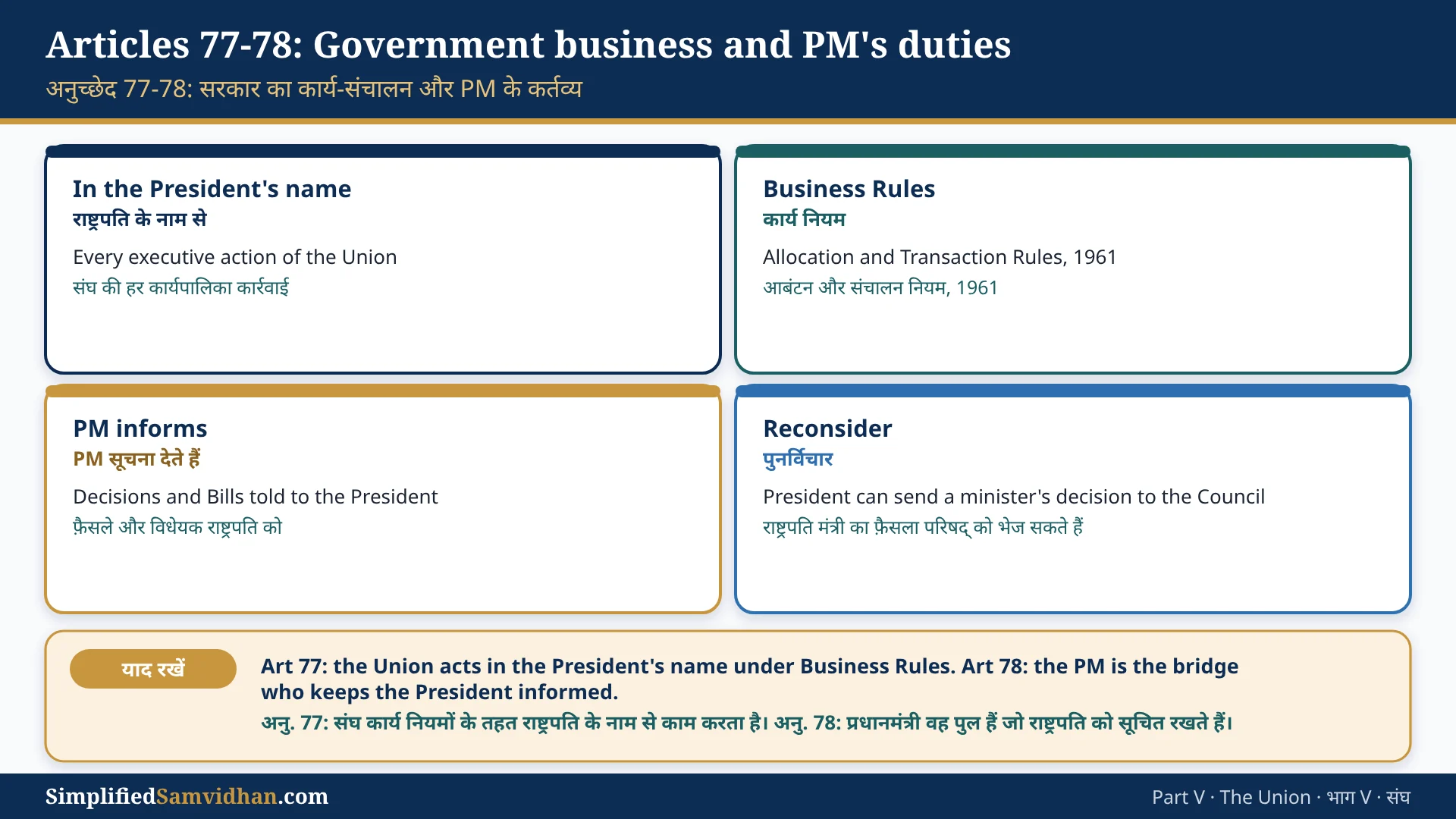
Article 77(1) In the President's name: a government order, a contract or a notification of the Union is written as "by order and in the name of the President", even though a ministry made it. This keeps the President as the formal head of the executive (Article 53).
Article 77(2) Signing: rules say which officers can authenticate such orders (usually a Secretary, Joint Secretary or other authorised officer). No one can challenge a properly signed order just because the President did not sign it personally.
Article 77(3) Business Rules: the President makes the Allocation of Business Rules, 1961 (which ministry handles which subject) and the Transaction of Business Rules, 1961 (which matters need the Cabinet, which a minister can decide). A new ministry, such as the Ministry of Cooperation in 2021, is created by amending these rules.
Article 78 PM's duties: the Prime Minister must (a) tell the President all Cabinet decisions and Bills planned, (b) give information the President asks for, and (c) if the President wants, place a minister's own decision before the whole Council of Ministers for reconsideration.
🏠 Everyday Analogy
Think of a school where every certificate says "issued in the name of the Principal", but class teachers and the office actually prepare and sign them under the school's rules. The Vice-Principal (the PM) runs the staff room and must keep the Principal (the President) informed of every major decision, and if the Principal is unhappy with one teacher's decision, he can ask the full staff meeting to look at it again.
🇮🇳 Real Indian Example
In 1987 President Giani Zail Singh wrote to Prime Minister Rajiv Gandhi complaining that he was not being kept informed on important matters, as Article 78 requires. The tension was sharpest over the Indian Post Office (Amendment) Bill, 1986, which allowed interception of mail; the President kept it pending without assent (the famous "pocket veto"). The episode is the classic example that Article 78 is a real duty, not a courtesy.
Business RulesThe Two Business Rules of 1961
| Rules | What they do | Example |
|---|---|---|
| Allocation of Business Rules, 1961 | List which ministry/department handles which subject (First and Second Schedules) | Cooperation moved to a new Ministry of Cooperation (July 2021) |
| Transaction of Business Rules, 1961 | Say how business is done: which cases go to the Cabinet or its committees, which a minister decides | Appointments Committee of the Cabinet decides top posts |
Both were made on 14 January 1961 under Article 77(3) and are amended often. Cabinet Committees (such as on Security, Economic Affairs and Appointments) work under the Transaction Rules. The Cabinet Secretariat helps run them.
The storyThe Story: From the 1935 Act to the 42nd and 44th Amendments
Article 77 follows section 17 of the Government of India Act, 1935, where orders were issued in the Governor-General's name. Article 78 borrows the British convention that the Prime Minister keeps the Crown informed; Dr B. R. Ambedkar said in the Constituent Assembly that the President has a right to be informed, so that he can advise and warn the government.
During the Emergency the 42nd Amendment (1976) added clause (4) to Article 77, saying no court could inquire whether rules of business were followed. The 44th Amendment (1978) removed it, restoring normal judicial review.
Key casesArticles 77-78 in Court: Key Cases
- A. Sanjeevi Naidu v State of Madras (1970): a decision taken by a minister or an officer under the business rules is the decision of the government itself; the Cabinet need not decide everything.
- Samsher Singh v State of Punjab (1974): where the Constitution speaks of the satisfaction of the President or Governor, it means the satisfaction of the Council of Ministers, acting under the business rules.
- Article 77(2) shield: an order properly authenticated cannot be attacked on the ground that the President did not make it; but it can still be challenged on other grounds, such as violation of Fundamental Rights.
Quick RevisionKey Points to Remember
- All executive action of the Union is taken in the name of the President (Art 77(1)).
- President makes the Allocation and Transaction of Business Rules, 1961 (Art 77(3)).
- Art 77(4) was added by the 42nd and omitted by the 44th Amendment.
- Art 78: the PM must communicate Cabinet decisions and proposed laws to the President.
- President can ask the PM to place a minister's decision before the whole Council (Art 78(c)).
UPSC · State PSC · JudiciaryArticles 77-78: Exam Corner
- Prelims: The Allocation of Business Rules are made by the President, not by Parliament.
- Prelims trap: "Article 78 lists the duties of the President." False. It lists the duties of the Prime Minister.
- Prelims: The State counterparts are Article 166 (business of State government) and Article 167 (duties of the Chief Minister).
- Mains (GS II): "The President's right to be informed is the main tool of persuasion for a constitutional head." Discuss.
Practice MCQTest Yourself: Articles 77-78
Under which Article does the Prime Minister have the duty to communicate the decisions of the Council of Ministers to the President?
Doubts ClearedFrequently Asked Questions
What is Article 77 of the Indian Constitution?
Article 77 says all executive action of the Government of India is taken in the President's name, lets the President make rules on authenticating orders, and on the transaction and allocation of government business among ministers.
What are the duties of the Prime Minister under Article 78?
To communicate Cabinet decisions and proposals for legislation to the President, to give information the President asks for, and to place a minister's decision before the Council if the President requires.
Who makes the Allocation of Business Rules?
The President, under Article 77(3). The present rules are the Government of India (Allocation of Business) Rules, 1961.