Bare ActOfficial Text of Article 76
76. Attorney-General for India.—
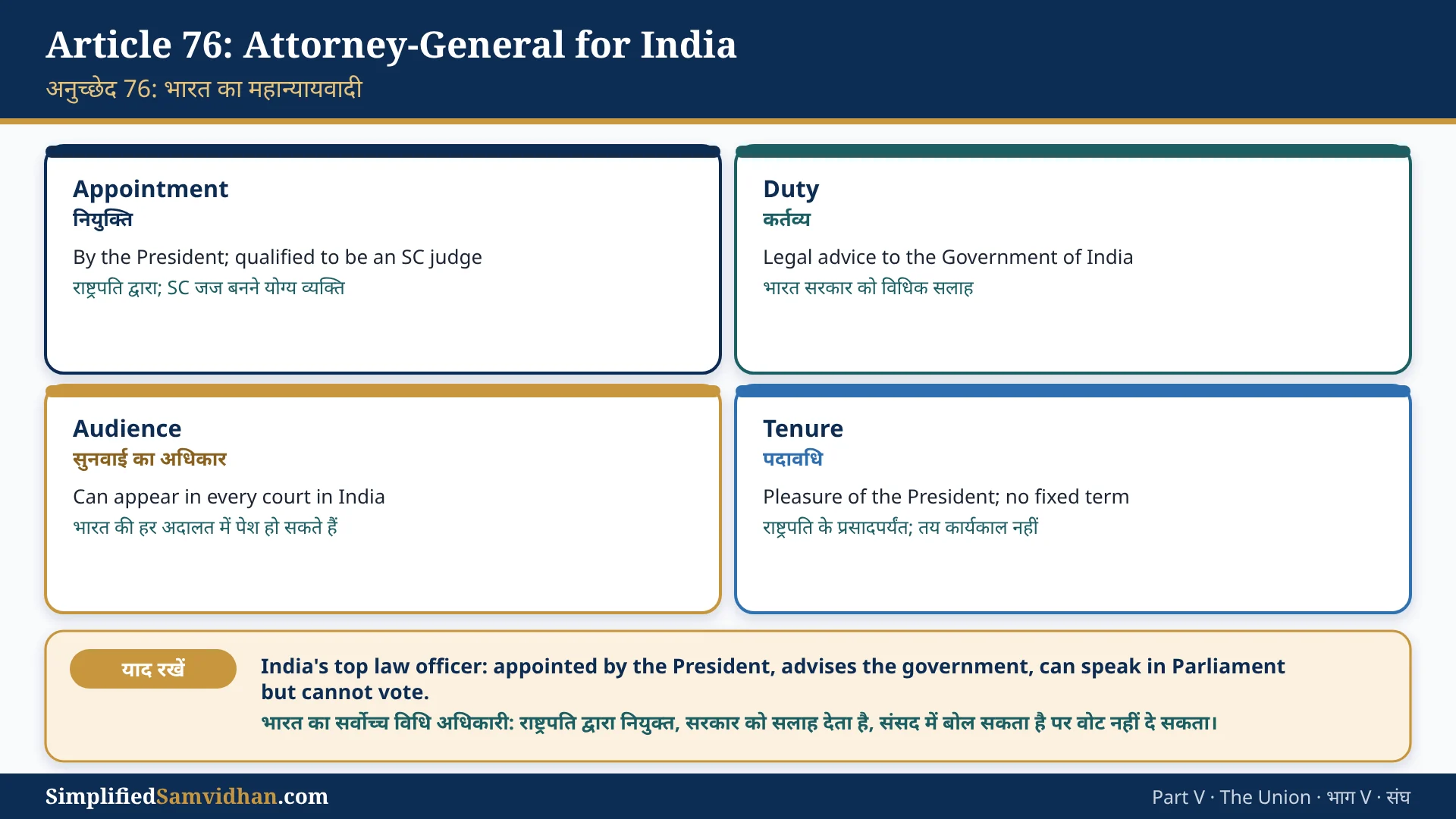
(1) The President shall appoint a person who is qualified to be appointed a Judge of the Supreme Court to be Attorney-General for India.
(2) It shall be the duty of the Attorney-General to give advice to the Government of India upon such legal matters, and to perform such other duties of a legal character, as may from time to time be referred or assigned to him by the President, and to discharge the functions conferred on him by or under this Constitution or any other law for the time being in force.
(3) In the performance of his duties the Attorney-General shall have right of audience in all courts in the territory of India.
(4) The Attorney-General shall hold office during the pleasure of the President, and shall receive such remuneration as the President may determine.
Clause (1) Who can be AG: anyone qualified to be a Supreme Court judge under Article 124(3): an Indian citizen who has been a High Court judge for 5 years, or a High Court advocate for 10 years, or is a distinguished jurist in the President's opinion. There is no upper age limit for the AG, unlike a judge.
Clause (2) What the AG does: gives legal advice to the Government of India, performs legal duties the President assigns (such as arguing the Union's cases and Presidential References under Article 143), and does whatever the Constitution or a law gives him to do.
Clause (3) Right of audience: the AG can appear and argue in every court in India, from a district court to the Supreme Court.
Clause (4) Tenure and pay: the Constitution fixes no term and no removal procedure. The AG serves during the President's pleasure (in practice the government's choice) and gets the fee the President fixes. By convention the AG resigns when the government changes.
🏠 Everyday Analogy
A big company has a chief legal counsel. The board (the government) picks a senior lawyer it trusts, asks for advice before signing big deals, and sends the counsel to court when the company is sued. If the board changes, the new board usually picks its own counsel. The Attorney General is that chief counsel for the Government of India.
🇮🇳 Real Indian Example
When a State government challenges a Central law in the Supreme Court, or the President sends a question to the Court under Article 143, the Attorney General usually argues for the Union. In 2024-25 the AG argued the Centre's side in the Presidential Reference on timelines for Governors and the President to act on Bills, decided by a five-judge Constitution Bench in November 2025. A citizen who wants the Supreme Court to start criminal contempt against someone also needs the AG's or the Solicitor General's written consent under Section 15 of the Contempt of Courts Act, 1971.
Rights and limitsRights and Limits of the Attorney General
| Point | Rule | Source |
|---|---|---|
| Speak in Parliament | Can speak and take part in either House, joint sittings and committees | Article 88 |
| Vote in Parliament | Cannot vote (not a member) | Article 88 |
| Privileges | Enjoys the privileges and immunities of an MP | Article 105(4) |
| Private practice | Allowed, but not against the Government of India | Law Officers (Conditions of Service) Rules, 1987 |
| Criminal defence | Cannot defend accused persons without government permission | 1987 Rules |
| Company director | Cannot accept a directorship without permission | 1987 Rules |
| Cabinet | Not a member of the Union Cabinet | Practice since 1950 |
The storyHow the Office Came and Who Held It
The office comes from the Advocate-General for India under the Government of India Act, 1935 (section 16), modelled on the British Attorney General. But the Constituent Assembly made one big change: in Britain the Attorney General is a politician and a member of the government; in India he is a professional lawyer, outside the Cabinet, so that his advice stays independent. The Draft Constitution's Article 63 was adopted with little debate as Article 76.
- M. C. Setalvad (28 January 1950 to 1 March 1963): the first and longest-serving Attorney General.
- Soli J. Sorabjee served twice (1989-90 and 1998-2004).
- K. K. Venugopal (2017-2022), the 15th, served beyond the age of 90.
- R. Venkataramani, the 16th, since 1 October 2022; reappointed for two more years from 1 October 2025, till 30 September 2027.
The Solicitor General (at present Tushar Mehta) and Additional Solicitors General help the AG, but their posts are created by the Law Officers Rules, not by the Constitution.
CompareAttorney General vs Advocate General vs Solicitor General
| Point | Attorney General | Advocate General | Solicitor General |
|---|---|---|---|
| Level | Union | State | Union |
| Source | Article 76 | Article 165 | Law Officers Rules, 1987 |
| Appointed by | President | Governor | Appointments Committee of the Cabinet |
| Qualification | As for an SC judge | As for a HC judge | Senior advocate (by practice) |
| Speaks in | Parliament (Art 88) | State Legislature (Art 177) | No such right |
Quick RevisionKey Points to Remember
- Attorney General = highest law officer of India (Article 76).
- Appointed by the President; must be qualified to be an SC judge.
- No fixed term; holds office during the pleasure of the President.
- Right of audience in all courts in India (clause 3).
- Can speak in Parliament but cannot vote (Article 88).
UPSC · State PSC · JudiciaryArticle 76: Exam Corner
- Prelims trap: "The Attorney General is a member of the Union Cabinet." False.
- Prelims trap: "The AG has a fixed five-year term." False. No term is fixed; pleasure of the President.
- Prelims: The AG can take part in Parliament's proceedings under Article 88 but has no vote.
- Prelims: The State counterpart is the Advocate General under Article 165.
- Mains (GS II): "The Attorney General is a lawyer for the government, not for the party in power." Discuss.
Practice MCQTest Yourself: Article 76
Which of the following is TRUE about the Attorney General of India?
Doubts ClearedFrequently Asked Questions
What is Article 76 of the Indian Constitution?
Article 76 creates the office of the Attorney General of India: appointment by the President, qualification of a Supreme Court judge, duty to advise the government, right of audience in all courts, and tenure at the President's pleasure.
Who is the present Attorney General of India?
R. Venkataramani, the 16th Attorney General, in office since 1 October 2022; his term was extended till 30 September 2027.
Who was the first Attorney General of India?
M. C. Setalvad, from 28 January 1950 to 1 March 1963, also the longest-serving.
Can the Attorney General vote in Parliament?
No. Under Article 88 he can speak and take part in the proceedings of either House, but he is not a member and cannot vote.