Bare ActOfficial Text of Article 80
80. Composition of the Council of States.—
(1) The Council of States shall consist of—
(a) twelve members to be nominated by the President in accordance with the provisions of clause (3); and
(b) not more than two hundred and thirty-eight representatives of the States and of the Union territories.
(2) The allocation of seats in the Council of States to be filled by representatives of the States and of the Union territories shall be in accordance with the provisions in that behalf contained in the Fourth Schedule.
(3) The members to be nominated by the President under sub-clause (a) of clause (1) shall consist of persons having special knowledge or practical experience in respect of such matters as the following, namely:— Literature, science, art and social service.
(4) The representatives of each State in the Council of States shall be elected by the elected members of the Legislative Assembly of the State in accordance with the system of proportional representation by means of the single transferable vote.
(5) The representatives of the Union territories in the Council of States shall be chosen in such manner as Parliament may by law prescribe.
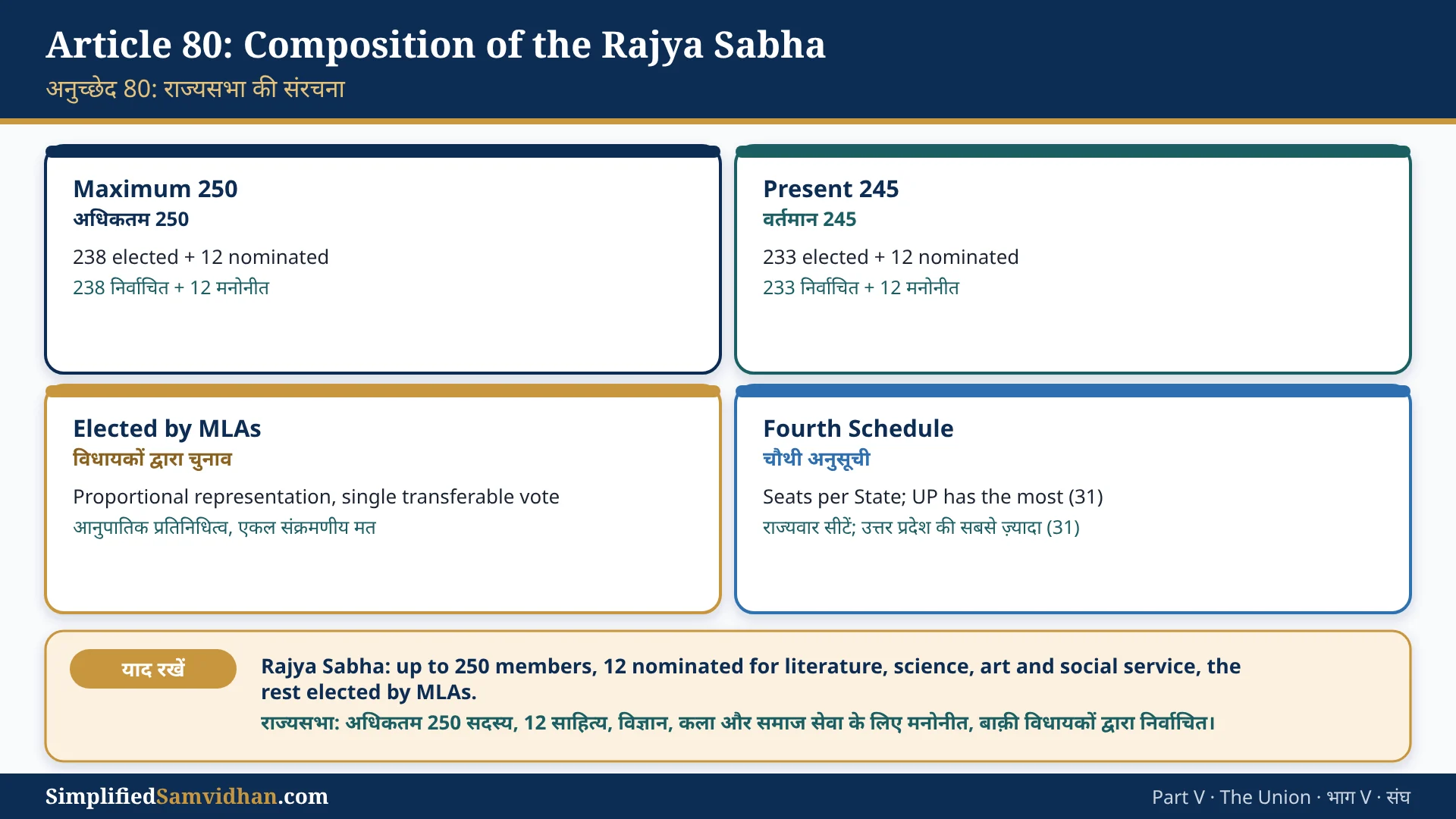
Clause (1) Size: at most 250 members: 12 nominated plus up to 238 representatives of the States and Union territories. The present strength is 245 (233 elected + 12 nominated).
Clause (2) Fourth Schedule: seats are given to States roughly by population, so big States get more: Uttar Pradesh 31, Maharashtra 19, Tamil Nadu 18, Rajasthan 10, and small States such as Goa or Sikkim 1 each. Unlike the US Senate, States do not get equal seats.
Clause (3) Nominated members: 12 people with special knowledge or practical experience in literature, science, art and social service, so that experts reach Parliament without fighting elections.
Clause (4) How States elect: the elected MLAs of each State vote. Nominated MLAs and MLCs do not. The method is proportional representation by single transferable vote, so parties get seats in proportion to their MLAs. Since 2003 voting is by open ballot: party MLAs show their ballot to the party's agent.
Clause (5) Union territories: Parliament decides by law. Only Delhi (3), Jammu and Kashmir (4) and Puducherry (1) have Rajya Sabha seats, chosen by the elected members of their Assemblies.
🏠 Everyday Analogy
Imagine a national council of all State cricket associations. Each association sends members in proportion to its size, chosen by its own elected office-bearers, not by the fans directly. On top of that the President invites 12 famous coaches, writers and scientists to add expert advice. That council is the Rajya Sabha.
🇮🇳 Real Indian Example
Rajasthan has 10 Rajya Sabha seats and a 200-member Assembly. Elections are staggered (3, 3 and 4 seats every two years). If 3 seats fall vacant, a candidate needs a quota of (200 / (3 + 1)) + 1 = 51 first-preference votes to win. So a party with 120 MLAs can win 2 seats on its own, and the third goes to whoever gathers 51 votes. Nominated members such as Lata Mangeshkar (1999), Sachin Tendulkar (2012) and P. T. Usha (2022) came in through clause (3).
Fourth ScheduleSeats in the Rajya Sabha: Biggest States and UTs
| State / UT | Seats | State / UT | Seats |
|---|---|---|---|
| Uttar Pradesh | 31 | Madhya Pradesh | 11 |
| Maharashtra | 19 | Rajasthan | 10 |
| Tamil Nadu | 18 | Odisha | 10 |
| West Bengal | 16 | Kerala | 9 |
| Bihar | 16 | Jammu and Kashmir (UT) | 4 |
| Karnataka | 12 | Delhi (UT) | 3 |
| Andhra Pradesh / Gujarat | 11 each | Puducherry (UT) | 1 |
The storyThe Story: Nominated Members and Changes Over Time
The idea of nominating eminent people came from the Irish Constitution, whose Senate has members from panels of culture, agriculture and other fields. In the Constituent Assembly, N. Gopalaswami Ayyangar said that a few seats should go to people who may not win elections but whose learning and experience the House needs.
- 7th Amendment (1956): after the reorganisation of States, the words "and of the Union territories" were added.
- 35th (1974) and 36th (1975) Amendments: Sikkim got a seat, first as an associate State and then as a full State.
- 2003: the Representation of the People Act was amended to drop the rule that a member must live in the State that elects him or her, and to bring in open ballot to stop cross-voting for money.
Key caseKuldip Nayar v Union of India (2006)
- Journalist Kuldip Nayar challenged the 2003 changes, arguing that the Rajya Sabha would stop being a House of the States if members need not live there, and that open ballot hurt free voting.
- A five-judge Constitution Bench upheld both changes. Residence is not a constitutional requirement; it is for Parliament to decide under Article 84. Open ballot fights corruption and suits party discipline under the Tenth Schedule.
- The Court said federalism does not demand that every Rajya Sabha member be a resident of the State, and that the Rajya Sabha is not a copy of the US Senate.
Quick RevisionKey Points to Remember
- Rajya Sabha maximum 250: 238 elected + 12 nominated; present 245.
- Nominated for literature, science, art and social service (clause 3).
- State members elected by elected MLAs by single transferable vote.
- Seats per State in the Fourth Schedule; UP 31 is the most.
- Only Delhi, J&K and Puducherry among UTs have seats.
UPSC · State PSC · JudiciaryArticle 80: Exam Corner
- Prelims trap: "Sports is one of the fields named in Article 80(3)." False. Only literature, science, art and social service.
- Prelims trap: "Nominated MLAs vote in Rajya Sabha elections." False. Only elected MLAs.
- Prelims: Nominated Rajya Sabha members cannot vote in the President's election but can vote in the Vice-President's.
- Mains (GS II): "Open ballot and the end of the domicile rule have weakened the federal character of the Rajya Sabha." Critically examine.
Practice MCQTest Yourself: Article 80
The 12 members nominated to the Rajya Sabha by the President must have special knowledge in which fields?
Doubts ClearedFrequently Asked Questions
What is Article 80 of the Indian Constitution?
Article 80 lays down the composition of the Rajya Sabha: 12 members nominated by the President and not more than 238 representatives of the States and Union territories, elected as the Article and the Fourth Schedule provide.
How many members are there in the Rajya Sabha now?
245: 233 elected representatives of States and UTs and 12 nominated members. The maximum allowed is 250.
How are Rajya Sabha members elected?
By the elected members of each State's Legislative Assembly, through proportional representation by means of the single transferable vote, with open ballot since 2003.