Bare ActOfficial Text of Article 79
79. Constitution of Parliament.—
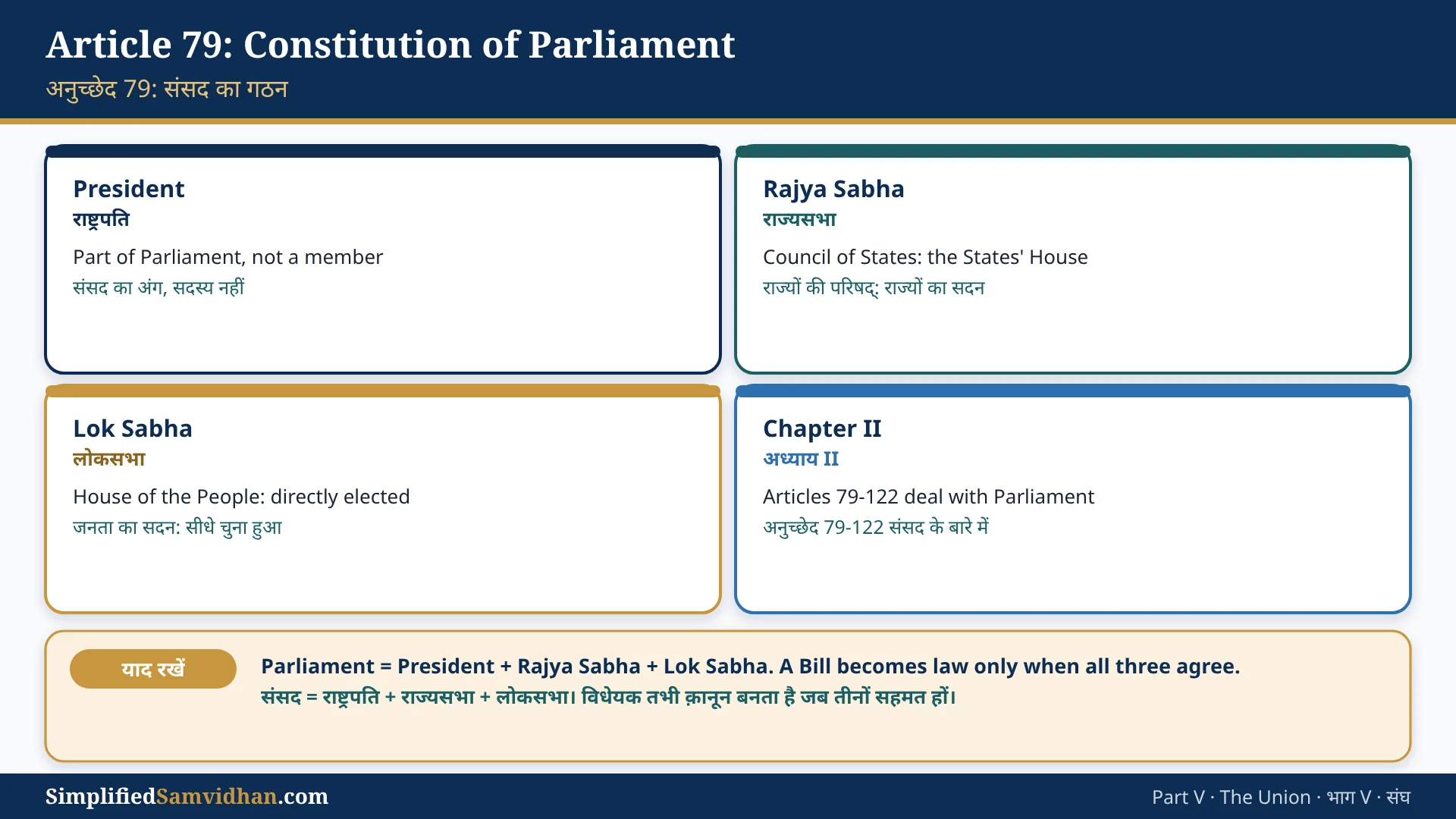
There shall be a Parliament for the Union which shall consist of the President and two Houses to be known respectively as the Council of States and the House of the People.
One Parliament for the Union: India has one national legislature; each State has its own legislature under Article 168.
Three parts: the President, the Council of States (Rajya Sabha), which represents the States and Union territories, and the House of the People (Lok Sabha), elected directly by voters.
Bicameral: having two Houses is called a bicameral legislature. The Lok Sabha speaks for the people as a whole; the Rajya Sabha speaks for the States, which suits a federation.
Why the President is a part: the President summons and prorogues the Houses and dissolves the Lok Sabha (Article 85), addresses them (Articles 86-87), gives assent to Bills (Article 111), issues ordinances when Parliament is not in session (Article 123) and calls a joint sitting (Article 108).
🏠 Everyday Analogy
Think of a house that needs three keys to open the locker of laws: one key with the Lok Sabha, one with the Rajya Sabha and one with the President. The two Houses debate and vote, but the locker opens only when the President turns the third key by giving assent.
🇮🇳 Real Indian Example
When Parliament passes a Bill, say a new criminal law, it still says "Bill" after both Houses vote. It becomes an Act only on the day the President signs it; the three criminal laws of 2023 (BNS, BNSS and BSA), for example, got the President's assent on 25 December 2023, days after both Houses had passed them. That is Article 79 in action: the President completes Parliament.
Two HousesLok Sabha and Rajya Sabha at a Glance
| Point | Lok Sabha (House of the People) | Rajya Sabha (Council of States) |
|---|---|---|
| Article | 81 | 80 |
| Maximum size | 550 elected (530 States + 20 UTs) under Art 81 | 250 (238 elected + 12 nominated) |
| Present size | 543 elected | 245 (233 elected + 12 nominated) |
| Elected by | People directly | Elected MLAs (single transferable vote) |
| Term | 5 years, can be dissolved | Permanent; one-third retire every 2 years |
| Presiding officer | Speaker | Vice-President (Chairman) |
| Minimum age | 25 years | 30 years |
The storyThe Story: How India Chose This Parliament
The Constituent Assembly took the idea of the head of State being part of the legislature from Britain, where Parliament is the "Crown-in-Parliament". It rejected the American model, where the President is outside Congress. There was a debate on whether India needed a second House at all; members such as N. Gopalaswami Ayyangar argued that a Council of States would give a calm second look to hasty laws and a voice to the States, and that view won.
- 26 January 1950 to April 1952: the Constituent Assembly itself worked as the Provisional Parliament (Article 379, now omitted).
- 3 April 1952: the first Rajya Sabha was constituted; 17 April 1952, the first Lok Sabha.
- 13 May 1952: both Houses held their first sittings.
- 1954: the Hindi names Lok Sabha (14 May) and Rajya Sabha (23 August) were announced in the Houses.
- 28 May 2023: the new Parliament building was inaugurated; the Houses first sat there on 19 September 2023.
CompareIndia, Britain and the USA Compared
| Country | Legislature consists of | Head of State part of it? |
|---|---|---|
| India | President + Rajya Sabha + Lok Sabha | Yes (Article 79) |
| Britain | Monarch + House of Lords + House of Commons | Yes (Crown-in-Parliament) |
| USA | Senate + House of Representatives (Congress) | No (separation of powers) |
Quick RevisionKey Points to Remember
- Parliament = President + Rajya Sabha + Lok Sabha (Article 79).
- The President is part of Parliament but not a member of either House.
- India has a bicameral Union legislature.
- Chapter II of Part V (Articles 79-122) deals with Parliament.
- Hindi names Lok Sabha and Rajya Sabha were adopted in 1954.
UPSC · State PSC · JudiciaryArticle 79: Exam Corner
- Prelims trap: "The President is a member of Parliament." False. He is a part, not a member.
- Prelims: The Constitution uses the names Council of States and House of the People; Rajya Sabha and Lok Sabha are the Hindi names.
- Prelims: The State counterpart is Article 168 (Governor + one or two Houses).
- Mains (GS II): "Is the Rajya Sabha still relevant as a House of the States?" Examine.
Practice MCQTest Yourself: Article 79
According to Article 79, the Parliament of India consists of:
Doubts ClearedFrequently Asked Questions
What is Article 79 of the Indian Constitution?
Article 79 says there shall be a Parliament for the Union consisting of the President and two Houses, the Council of States (Rajya Sabha) and the House of the People (Lok Sabha).
Is the President a part of Parliament?
Yes. The President is an integral part of Parliament under Article 79, though not a member of either House and does not sit or vote in them.
When did the first Lok Sabha meet?
The first Lok Sabha was constituted on 17 April 1952 and held its first sitting on 13 May 1952.