What Is SIR? Special Intensive Revision of the Voter List, Explained
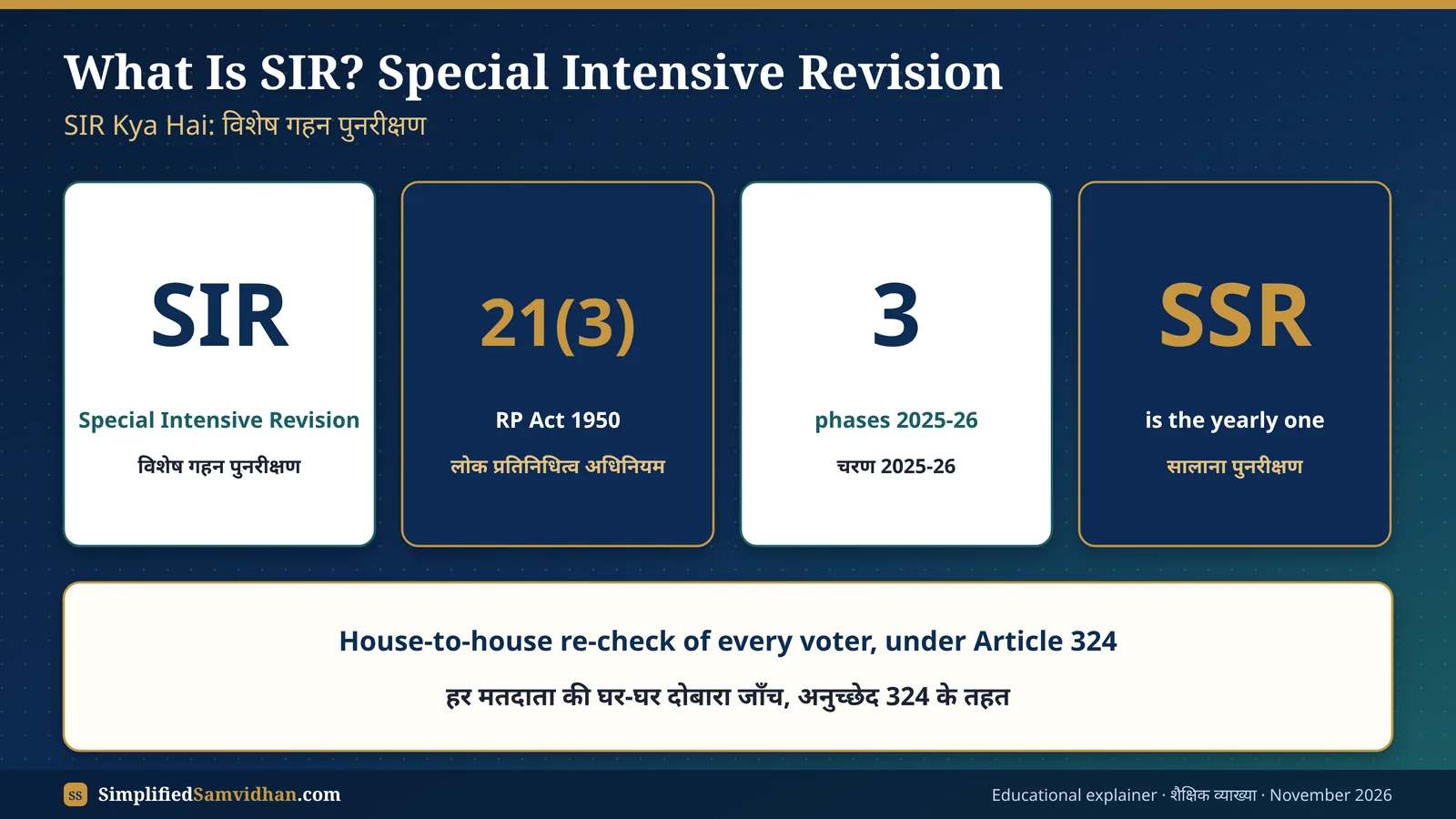
SIR is the biggest re-check of India's voter list in twenty years. Here is what it means, why the Election Commission ordered it, how it differs from the yearly revision, and how it spread from Bihar to almost the whole country.
Short answerWhat Is SIR? Special Intensive Revision in Simple Words
Short answer: SIR stands for Special Intensive Revision of electoral rolls. It is a fresh, house-to-house re-check of the whole voter list, ordered by the Election Commission of India (ECI) under Article 324 of the Constitution and Section 21(3) of the Representation of the People Act, 1950. A Booth Level Officer (BLO) gives every listed voter an enumeration form; you fill it, sign it and return it. Those who return it go into the draft roll; names of the dead, the shifted, duplicates and people who did not return the form are left out. Then come claims and objections, notices and hearings, and finally the final roll.
The ordinary yearly clean-up is called SSR (Special Summary Revision): it starts from the old list and only adds or removes names on request. SIR is much bigger: everyone has to come forward again. It began in Bihar in June 2025 and by November 2026 has covered almost the whole country in three phases.
🏠 Everyday analogy
Think of a school that, once in twenty years, asks every student to re-fill the admission form with proof, instead of just promoting the old register to the next class. Students who never return the form are taken off the register until they prove they belong.
🇮🇳 Real Indian example
Ramesh, a mason from Sikar, works in Surat. During Rajasthan's SIR (Nov 2025 to Feb 2026) the BLO visited his village house three times. His wife filled and signed the form for him, so his name stayed in the draft roll. His neighbour's form was never returned, so the neighbour had to file Form 6 with a declaration and a document to get back on the list.
Article 324SIR Full Form and Its Root: Article 324 and Section 21(3)
324. Superintendence, direction and control of elections to be vested in an Election Commission.
(1) The superintendence, direction and control of the preparation of the electoral rolls for, and the conduct of, all elections to Parliament and to the Legislature of every State and of elections to the offices of President and Vice-President held under this Constitution shall be vested in a Commission (referred to in this Constitution as the Election Commission).
(2) The Election Commission shall consist of the Chief Election Commissioner and such number of other Election Commissioners, if any, as the President may from time to time fix and the appointment of the Chief Election Commissioner and other Election Commissioners shall, subject to the provisions of any law made in that behalf by Parliament, be made by the President.
(5) Subject to the provisions of any law made by Parliament, the conditions of service and tenure of office of the Election Commissioners and the Regional Commissioners shall be such as the President may by rule determine:
Provided that the Chief Election Commissioner shall not be removed from his office except in like manner and on the like grounds as a Judge of the Supreme Court and the conditions of service of the Chief Election Commissioner shall not be varied to his disadvantage after his appointment:
Provided further that any other Election Commissioner or a Regional Commissioner shall not be removed from office except on the recommendation of the Chief Election Commissioner.
Notice the first job Article 324 gives the Commission: "the preparation of the electoral rolls". Conducting the election comes after it. The voter list is the foundation; if it is wrong, even a perfectly run poll gives a wrong result. Section 21 of the RP Act 1950 then says the roll is revised before every general election and usually every year, and sub-section (3) adds that the Commission "may at any time, for reasons to be recorded, direct a special revision" in any constituency or part of it. SIR is that special revision, done intensively.
Why SIRWhy the Election Commission Ordered SIR
The Commission gave four reasons for ordering the first SIR in Bihar on 24 June 2025. The last intensive revision in most States was done around 2002-2004, so the rolls had been updated only by small yearly changes for about twenty years.
Dead voters
Deaths often go unreported; names stay for years.
Migration
Crores of people move for work; many are listed in two places.
Duplicates
Same person, two entries, sometimes in two States.
Ineligible names
ECI says only citizens aged 18+ (Art. 326) belong on the roll.
SIR vs SSRDifference Between SIR and SSR (Summary Revision)
SSR: Special Summary Revision
- Routine, usually once a year
- Starts from the existing roll
- You act only if you want a change (Form 6, 7, 8)
- No documents from voters already listed
- Section 21(2), RP Act 1950
SIR: Special Intensive Revision
- Special, ordered for recorded reasons
- House-to-house enumeration of every voter
- Every listed voter must return a signed form
- Some voters must show documents of eligibility
- Section 21(3), RP Act 1950
| Point | SSR | SIR |
|---|---|---|
| Time taken | About 2 months | About 3-4 months per State (often extended) |
| BLO visits | Not door to door (2027 SSR) | Up to three visits to every house |
| If you do nothing | Your name stays | Your name drops from the draft roll |
| Last done | Every year (2027 SSR ordered 15 Oct 2026) | 2002-2004 earlier; again 2025-2026 |
TimelineSIR Timeline 2025-2026 and the History of Intensive Revisions
Intensive revisions are not new. India prepared its first rolls from scratch for the 1951-52 election, and the Commission ran intensive revisions many times after that; most States had their last one in 2002-2004. What is new in 2025-2026 is the scale (about 99 crore electors across the three phases, by reported figures), the speed, and the demand for eligibility documents from voters who could not be linked to the old intensive-revision roll. State-wise dates and numbers are in SIR phases and States list; the step-by-step process is in SIR process step by step.
Quick revisionOne-Line Revision Points (Exam Ready)
- SIR = Special Intensive Revision of electoral rolls.
- Power: Art. 324(1) + s.21(3) RP Act 1950.
- SSR = summary (routine) revision under s.21(2).
- First SIR: Bihar, ordered 24 June 2025.
- Upheld by SC on 27 May 2026 (ADR v ECI).
- Earlier intensive revisions: last around 2002-2004 in most States.
Practice MCQPractice MCQs (with Answers): SIR basics
Which provision lets the Election Commission order a special revision of electoral rolls at any time?
In which State did the first SIR of 2025 take place?
Which is TRUE of a summary revision (SSR) but NOT of SIR?
Under the SIR, Aadhaar is accepted as proof of:
Doubts ClearedFrequently Asked Questions
What is the full form of SIR in elections?
Special Intensive Revision (of electoral rolls). In Hindi it is called vishesh gahan punrikshan.
Is SIR the same as NRC?
No. NRC is a citizenship register under the Citizenship Act and Rules; SIR is a voter-list revision under the RP Act 1950. The Supreme Court has said the Commission may look at citizenship only to decide who belongs on the voter list, and that it cannot take away anyone's citizenship.
Will SIR happen again every year?
No. After SIR, States go back to the routine yearly SSR; the 2027 SSR in 17 States and UTs was ordered on 15 October 2026 without door-to-door visits or documents.
Sources and further readingSources We Checked
Checked on 12 November 2026 against the Constitution, the RP Act 1950 and the news reports below. Numbers of electors are as reported; check your State CEO's website for official figures.
- Constitution of India, Part XV, Articles 324-326 (Legislative Department)
- Representation of the People Act, 1950 (India Code)
- Election Commission of India: Voters' Service Portal (forms, name search, SIR enumeration form online)
- Outlook: Supreme Court upholds Bihar electoral roll revision, backs EC's power to conduct SIR (27 May 2026)
- The Federal: SIR trims voter rolls by 10 per cent in 12 States and UTs; over 5.18 crore names scrapped
- Business Today: SIR Phase 3 announced: list of States where electoral rolls will be revised (14 May 2026)