SIR Controversy: Arguments For and Against, Explained
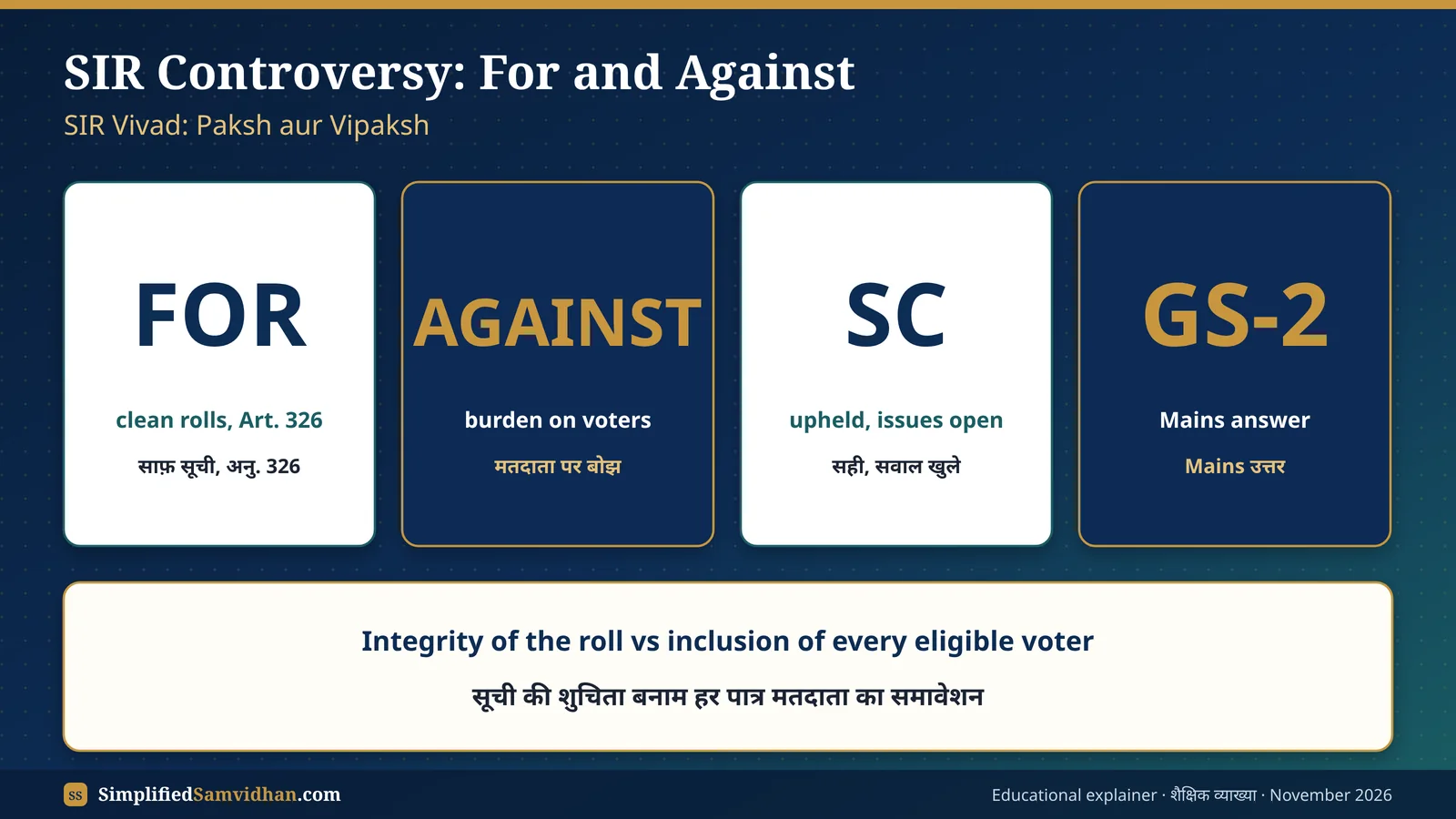
Clean rolls or mass exclusion? Both sides of India's fiercest voter-list debate, the problems on the ground, a fair way forward, and a ready UPSC Mains structure.
Short answerWhy Is SIR Controversial? The Short Answer
Short answer: almost everyone agrees India's voter lists needed cleaning: dead people, people who moved, and duplicate entries had piled up for twenty years. The fight is about how. Supporters say SIR is the Commission doing its constitutional duty under Articles 324 and 326, and the Supreme Court has upheld it. Critics say SIR turned the system upside down: instead of the State proving a name is wrong, the voter has to prove it is right, in a few weeks, with papers many poor families do not have. Both sides cite the same number, about 5.18 crore names removed in Phase 2: one side reads it as proof of how dirty the rolls were, the other as proof of mass exclusion.
🏠 Everyday analogy
Cleaning a crowded godown: everyone agrees the expired stock must go. But if the manager throws out every box without a fresh label, good stock goes in the bin too. The question is not whether to clean, but how carefully.
For and againstSIR: Arguments For and Against
Arguments FOR SIR
- Rolls had dead, shifted and duplicate voters; about 66.88 lakh dead electors alone were removed in Phase 2
- Article 326 limits the vote to citizens; the ECI must ensure only the eligible are listed
- No intensive revision for about 20 years despite huge migration and urbanisation
- Clean rolls reduce bogus voting and disputes after results
- Upheld by the Supreme Court (27 May 2026) with safeguards: notice, hearing, appeal
Arguments AGAINST SIR
- Burden of proof shifted to voters already on the roll
- Poor, migrants, women who moved after marriage, and the elderly are most likely to lack documents or miss the BLO
- Timelines of a few weeks for crores of people; repeated extensions show the strain
- Citizenship checks through the voter list feel like an 'NRC by the back door'
- Process changed State to State (e.g. 'logical discrepancy' in Bengal), hurting trust
Ground issuesBLO Workload, Women, Migrants and Transparency
BLO workload
BLOs, mostly school teachers, handled hundreds of houses in weeks. Media reported deaths of several BLOs during Phase 2 (counts differ; opposition parties claimed more than a dozen); the ECI denied any link to SIR.
Women and marriage migration
A woman who moved after marriage may not find her parents in the new State's old roll, so she is more likely to get a notice.
Migrant workers
Away from home during enumeration; risk of being marked 'shifted' at home and not enrolled where they work.
Readable rolls and transparency
After disputes, the ECI agreed in October 2026 to give parties text-readable rolls in the 2027 SSR, which the opposition had long demanded.
Way forwardWay Forward: How to Keep Rolls Clean Without Excluding Voters
- Presume the listed voter valid; ask for papers only where there is specific doubt, with reasons in writing.
- Longer windows and camps at panchayat and ward level, especially for migrants, women and the elderly.
- Publish every deletion booth-wise with reasons in readable form, as the Court ordered in Bihar.
- Use a correction route (Form 8) rather than the new-voter form for long-time voters dropped by mistake.
- Fair BLO workload: more staff, realistic targets and honorarium.
- Link death and migration data (civil registration) so rolls stay clean without mass drives.
Mains answerUPSC Mains Answer Frame on SIR (GS-2)
| Part of answer | What to write (150-250 words) |
|---|---|
| Introduction | Define SIR; Art. 324(1) + s.21(3) RP Act 1950; Bihar 2025 to Phase 3 2026. |
| Need | Dead, shifted, duplicate names; 20-year gap; Art. 326 eligibility. |
| Concerns | Burden of proof, exclusion of vulnerable groups, time, BLO strain, citizenship overlap, trust. |
| Judiciary | Interim orders (deleted lists, Aadhaar); ADR v ECI (27 May 2026) upheld; Form 6 and logical-discrepancy questions open. |
| Way forward | Presumption of validity, reasoned notices, readable lists, Form 8 route, civil-registration linkage. |
| Conclusion | A clean roll and a complete roll are both part of 'free and fair elections', a basic feature of the Constitution. |
Quick revisionOne-Line Revision Points (Exam Ready)
- Core issue: integrity of rolls vs inclusion of voters.
- Main criticism: burden of proof shifted to voters.
- Most at risk: poor, migrants, married women, elderly.
- Supporters: dead, shifted, duplicate names; Art. 326.
- Upheld by SC; Form 6 and logical discrepancy still open.
Practice MCQPractice MCQs (with Answers): SIR debate
The main criticism that SIR 'reverses the burden of proof' means:
'Free and fair elections' has been recognised by the Supreme Court as:
Doubts ClearedFrequently Asked Questions
Is SIR the same as NRC by the back door?
Legally no: the Supreme Court said the ECI may check citizenship only to decide registration and cannot strip anyone of citizenship. Critics say the practical effect on people without papers can be similar, which is why they want stronger safeguards.
Did SIR find many foreigners on the rolls?
The large categories in published figures were dead, shifted, absent and duplicate voters. No official nationwide count of non-citizens removed has been published so far, as per reports we checked.
Sources and further readingSources We Checked
Arguments are summarised from court hearings, the ECI's stated reasons and published criticism, checked on 12 November 2026. Numbers are as reported; claims by political parties are labelled as claims.
- The Federal: SIR trims voter rolls by 10 per cent in 12 States and UTs; over 5.18 crore names scrapped
- Siasat: over 10 BLO deaths during nationwide SIR, EC denies any link
- ThePrint: SC's SIR interventions: many questions to ECI, few clear answers
- Outlook: Supreme Court upholds Bihar electoral roll revision, backs EC's power to conduct SIR (27 May 2026)
- The Week (PTI), 8 Nov 2026: nearly 30 lakh voters missing from Rajasthan's final SIR roll but on local poll lists, says activist