Legal Basis of SIR: Articles 324-326 and the RP Act, 1950
Where does the Election Commission get the power to make every voter re-enrol? The Articles, the sections, the citizenship question and the cases, in one place.
Short answerLegal Basis of SIR: The Short Answer
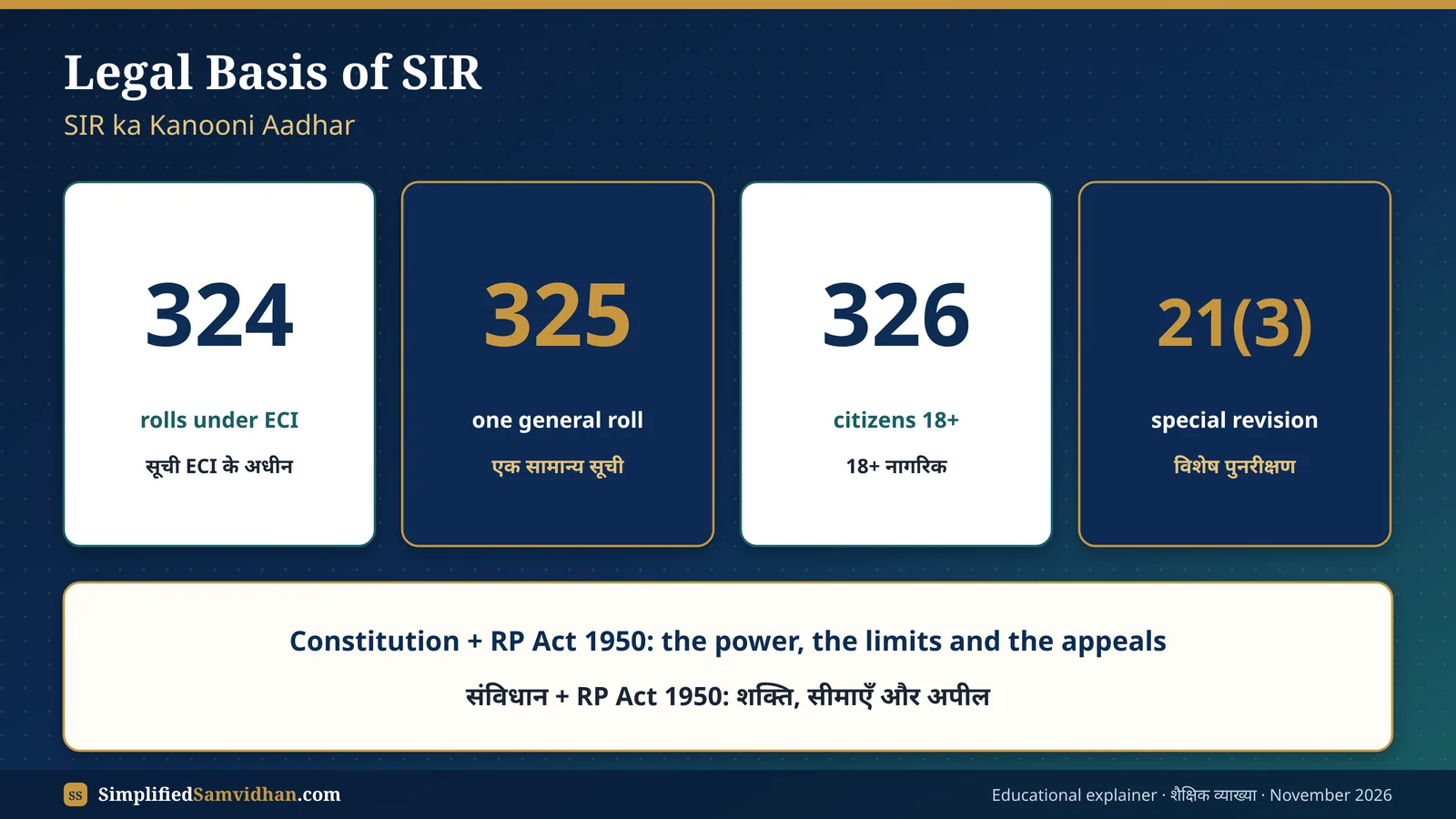
Short answer: SIR rests on five legal bricks. (1) Article 324(1) puts the preparation of electoral rolls under the Election Commission's control. (2) Article 325 promises one general roll per constituency, with nobody excluded only for religion, race, caste or sex. (3) Article 326 says every citizen aged 18 or more, ordinarily resident and not disqualified, is entitled to be registered. (4) Section 21(3) of the Representation of the People Act, 1950 lets the Commission order a special revision at any time, for recorded reasons. (5) Sections 22-24 and the Registration of Electors Rules, 1960 give the procedure: the ERO decides, and appeals go to the District Magistrate and then the Chief Electoral Officer.
On 27 May 2026 the Supreme Court (ADR v ECI) held that these provisions together give the Commission the power to run SIR, including the power to check citizenship for the limited purpose of the voter list.
🏠 Everyday analogy
A cricket board (the Commission) has the power to pick and check the team list (Article 324). The rule book (RP Act) says it may hold a special fitness test any time it records a reason (Section 21(3)). But the selection criteria are fixed by the Constitution itself (Article 326): only those eligible can be in the squad, and nobody can be dropped for their caste or religion (Article 325).
Articles 325-326Articles 325, 326 and the RP Act 1950: The Text Behind SIR
325. No person to be ineligible for inclusion in, or to claim to be included in a special, electoral roll on grounds of religion, race, caste or sex.
There shall be one general electoral roll for every territorial constituency for election to either House of Parliament or to the House or either House of the Legislature of a State and no person shall be ineligible for inclusion in any such roll or claim to be included in any special electoral roll for any such constituency on grounds only of religion, race, caste, sex or any of them.
326. Elections to the House of the People and to the Legislative Assemblies of States to be on the basis of adult suffrage.
The elections to the House of the People and to the Legislative Assembly of every State shall be on the basis of adult suffrage; that is to say, every person who is a citizen of India and who is not less than eighteen years of age on such date as may be fixed in that behalf by or under any law made by the appropriate Legislature and is not otherwise disqualified under this Constitution or any law made by the appropriate Legislature on the ground of non-residence, unsoundness of mind, crime or corrupt or illegal practice, shall be entitled to be registered as a voter at any such election.
Representation of the People Act, 1950 (key sections, summarised)
Section 14(b): "qualifying date" means the 1st day of January, the 1st day of April, the 1st day of July and the 1st day of October of the year in which the roll is prepared or revised (four dates since the Election Laws (Amendment) Act, 2021).
Section 16: a person is disqualified for registration if he is not a citizen of India, or is of unsound mind and stands so declared by a competent court, or is disqualified from voting under any law relating to corrupt practices and other offences in connection with elections.
Section 19: every person who is not less than eighteen years of age on the qualifying date and is ordinarily resident in a constituency shall be entitled to be registered in the electoral roll for that constituency.
Section 21: the roll shall be revised before each general election and, unless the Election Commission otherwise directs, annually in the prescribed manner; under sub-section (3) the Commission may at any time, for reasons to be recorded, direct a special revision.
Sections 22 and 23: correction of entries and inclusion of names by the Electoral Registration Officer; Section 24: appeals to the District Magistrate and then to the Chief Electoral Officer.
Read Article 326 slowly: the right is to be registered, and it belongs to a citizen. That single word is why SIR asked some voters for documents: the Commission argued it must be satisfied that people on the roll are citizens. Article 325 is the guard rail on the other side: the roll must be one general roll, and the process cannot single out any religion, caste or sex.
All provisionsEvery Provision Used in SIR, in One Table
| Provision | What it says | Role in SIR |
|---|---|---|
| Art. 324(1) | ECI controls preparation of rolls | Source of the order itself |
| Art. 325 | One general roll; no exclusion only on religion, race, caste, sex | Limit on how SIR is done |
| Art. 326 | Adult suffrage for citizens 18+ | Why eligibility is checked |
| s.16 RPA 1950 | Non-citizens disqualified for registration | Basis for removing ineligible names |
| ss.19-20 | 18+ on qualifying date; ordinarily resident | Shifted voters removed from old place |
| s.21(3) | Special revision any time, reasons recorded | The direct legal hook for SIR |
| ss.22-23 | ERO corrects entries, includes names | Claims and notices decided |
| s.24 | Appeal to DM, then CEO | Remedy if your name is cut |
| RER 1960 (r.21A) | Deletion only after due process | Safeguard the Court checked |
CitizenshipCan the Election Commission Check Citizenship in SIR?
What the ECI CAN do (as held on 27 May 2026)
- Ask for proof of eligibility when it has doubts
- Examine citizenship only to decide inclusion in the roll
- Use a procedure different from the routine revision
- Rebut the presumption that a listed voter is valid
What it CANNOT do
- Declare anyone a foreigner or take away citizenship
- Delete a name without notice and a chance to be heard
- Treat Aadhaar as proof of citizenship (it is identity only)
- Target any religion, caste or sex (Art. 325)
Citizenship is decided by the Citizenship Act, 1955 and its authorities (and, for suspected foreigners, Foreigners Tribunals in Assam). The voter list only needs the answer to one question: is this person eligible to be registered? The Court drew this line, but critics say the line blurs in practice, because a poor family that cannot find a 1987 document may still be pushed out of the list. For the citizenship law itself, see Citizenship Act, CAA and SIR.
Key casesKey Cases: Lal Babu Hussein, Mohinder Singh Gill and ADR v ECI
| Case | Year | Point for SIR |
|---|---|---|
| Lal Babu Hussein v ERO | 1995 | A listed voter cannot be struck off as a foreigner without notice, inquiry and a fair chance; the ERO cannot just presume. |
| Mohinder Singh Gill v CEC | 1978 | Article 324 is a reservoir of power where the law is silent, but it must be used fairly. |
| ADR v ECI (Bihar SIR) | 2026 | SIR valid; Art. 324 + s.21(3) give the power; not disproportionate; applies across India. |
Quick revisionOne-Line Revision Points (Exam Ready)
- Rolls: RP Act 1950; elections: RP Act 1951.
- Special revision: s.21(3); routine revision: s.21(2).
- Non-citizen cannot be registered: s.16.
- Appeals: s.24 (DM, then CEO).
- One general roll: Art. 325; adult suffrage: Art. 326.
- Lal Babu Hussein (1995): notice and hearing before deletion.
Practice MCQPractice MCQs (with Answers): Law behind SIR
Electoral rolls in India are prepared under which law?
'No person shall be ineligible for inclusion in the electoral roll on grounds only of religion, race, caste or sex' is in:
Appeal against an ERO's decision on the roll lies under:
Which case held that a listed voter cannot be deleted as a foreigner without notice and hearing?
Doubts ClearedFrequently Asked Questions
Is voting a fundamental right?
No. Courts treat the right to vote as a statutory right under the RP Acts, flowing from Article 326; the freedom to express a choice while voting is linked to Article 19(1)(a).
Did Parliament pass a new law for SIR?
No. SIR uses the existing Section 21(3) of the RP Act 1950 and Article 324. The Supreme Court held that Parliament's law in the field does not stop the Commission from using Article 324.
Who is the 'ERO'?
The Electoral Registration Officer, usually an SDM-level officer for each Assembly constituency, who legally decides every addition and deletion. The BLO only collects and verifies.
Sources and further readingSources We Checked
Checked on 12 November 2026 against the Constitution, the RP Act 1950 and reports on the 27 May 2026 judgment. Summaries of the judgment come from news and legal-news reports; read the judgment (2026 INSC 564) for exact holdings. The Hindi text of the RP Act is a simple rendering.
- Constitution of India, Part XV, Articles 324-326 (Legislative Department)
- Representation of the People Act, 1950 (India Code)
- Supreme Court Observer: ADR v Election Commission of India (Bihar SIR case page)
- Vision IAS: Supreme Court upholds Election Commission's power to conduct SIR (28 May 2026)
- Outlook: Supreme Court upholds Bihar electoral roll revision, backs EC's power to conduct SIR (27 May 2026)