Citizenship Act 1955, CAA and SIR: RAS Notes
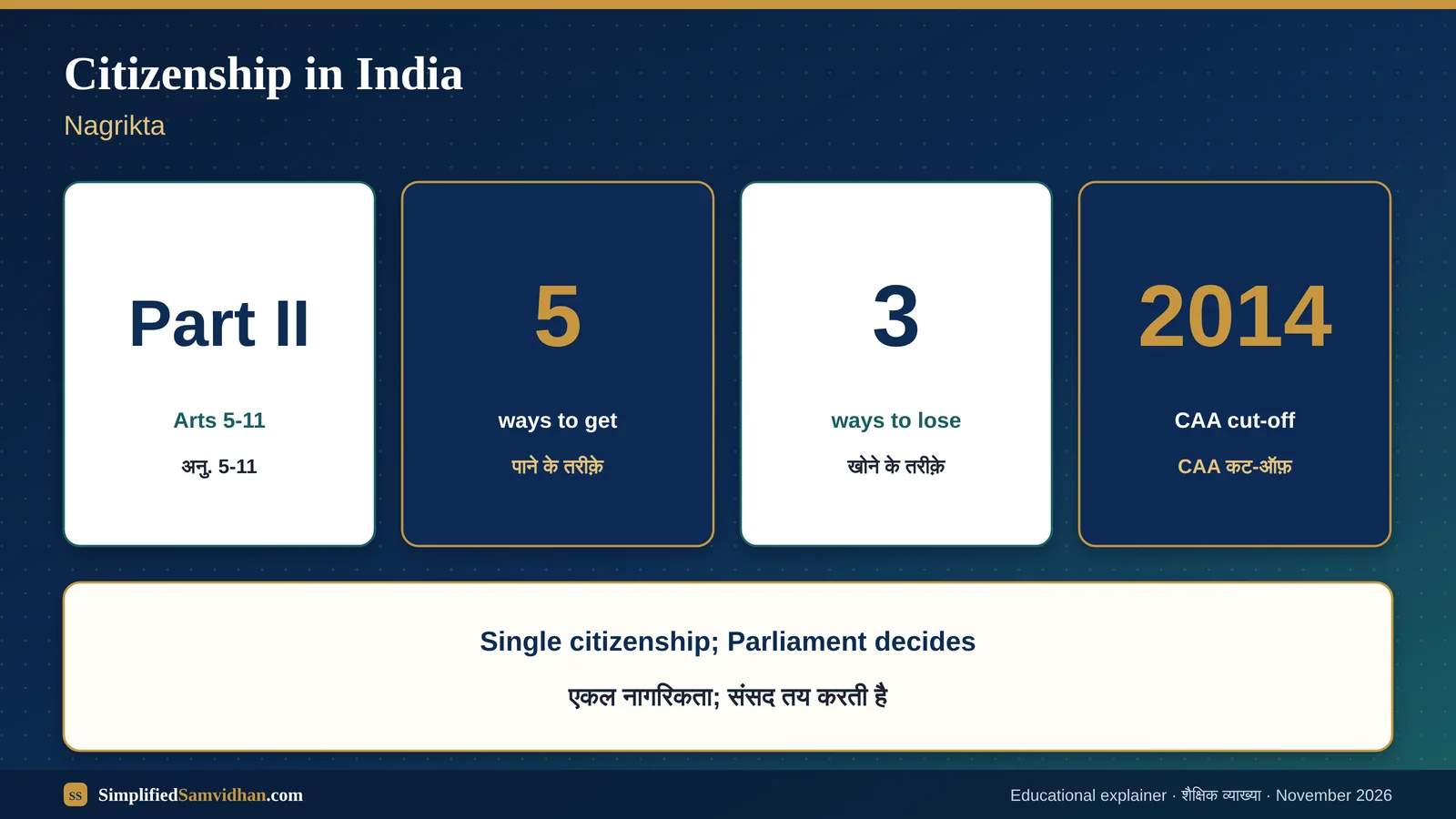
Part II of the Constitution, the 1955 Act, OCI, CAA and its rules, Section 6A, the 2025 immigration law and the SIR judgment, with practice MCQs.
Short answerCitizenship in Simple Words
Short answer: Citizenship is in Part II (Articles 5-11). Articles 5-10 decided who was a citizen on 26 January 1950; Article 11 lets Parliament make all later law, which it did through the Citizenship Act, 1955. India has single citizenship (no separate state citizenship). Citizenship is gained by birth, descent, registration, naturalisation or incorporation of territory, and lost by renunciation, termination (taking another country's citizenship) or deprivation. The CAA 2019 gives a faster path to Hindu, Sikh, Buddhist, Jain, Parsi and Christian migrants from Afghanistan, Bangladesh and Pakistan who came by 31 December 2014; its rules came on 11 March 2024.
🏠 Everyday analogy
Citizenship is the membership card of the nation: the Constitution printed the first cards in 1950, and Parliament runs the office that issues new ones.
🇮🇳 Real Indian example
Many Hindu migrants from Pakistan live in Jodhpur, Jaisalmer and Barmer; CAA and earlier MHA orders letting district collectors grant citizenship matter most to them.
Prelims: Articles 5-11 one-line each; modes of acquiring and losing citizenship; CAA cut-off date, countries, communities
Mains: single citizenship and federalism; CAA debate: Article 14 and secularism; NRC, SIR and proof of citizenship
Constitution textWhat the Constitution Says
Article 11. Nothing in the foregoing provisions of this Part shall derogate from the power of Parliament to make any provision with respect to the acquisition and termination of citizenship and all other matters relating to citizenship.
Articles 5-11Articles 5 to 11 in One Table
| Article | What it says |
|---|---|
| 5 | Citizenship at the commencement of the Constitution (domicile + birth/parents/5 years' residence) |
| 6 | Persons who migrated from Pakistan (before/after 19 July 1948) |
| 7 | Persons who migrated to Pakistan after 1 March 1947 (not citizens, unless they returned with a permit) |
| 8 | Persons of Indian origin living abroad |
| 9 | Voluntarily taking a foreign citizenship ends Indian citizenship |
| 10 | Continuance of citizenship, subject to Parliament's law |
| 11 | Parliament to regulate citizenship by law |
Get and loseHow Citizenship Is Gained and Lost
Acquiring citizenship (Act of 1955)
- Birth (Sec 3): after 3 Dec 2004 one parent citizen and the other not an illegal migrant
- Descent (Sec 4): born abroad to an Indian parent, registered
- Registration (Sec 5), e.g. persons of Indian origin, spouses
- Naturalisation (Sec 6): 11 years' residence (5 years for CAA groups)
- Incorporation of territory (Sec 7), e.g. Goa, Sikkim
Losing citizenship
- Renunciation (Sec 8): by declaration
- Termination (Sec 9): on voluntarily taking another citizenship
- Deprivation (Sec 10): by the Government for fraud, disloyalty etc. (only for registered or naturalised citizens)
CAA and new lawsCAA, Section 6A and the 2025 Immigration Law
- 1CAA 2019
Six communities from three countries who entered on or before 31 December 2014 are not 'illegal migrants'; naturalisation in 5 years.
- 2Exempted areas
Sixth Schedule tribal areas of Assam, Meghalaya, Mizoram, Tripura and Inner Line Permit areas.
- 3Rules (11 March 2024)
Online applications; empowered committee in each state and district-level committees verify.
- 4Section 6A upheld (17 October 2024)
Supreme Court (4:1) upheld the Assam Accord provision: migrants to Assam up to 25 March 1971 can become citizens.
- 5Immigration and Foreigners Act 2025
One law replaced four old ones (Foreigners Act 1946, Passport (Entry into India) Act 1920, Registration of Foreigners Act 1939, Immigration (Carriers' Liability) Act 2000).
Current affairsCurrent Affairs of the Last One Year
- SIR judgment (May 2026): the Supreme Court upheld the Election Commission's special intensive revision of voter lists, but held that Aadhaar is not proof of citizenship and that the Election Commission cannot itself decide citizenship (that remains with the Citizenship Act authorities).
- Why it matters for Art 326: only citizens aged 18+ can vote, so voter lists depend on citizenship; the debate is about who must prove it and with which documents.
- Already on this site: Article 5: Citizenship at commencement · Article 9: Foreign citizenship · Article 11: Parliament's power on citizenship · Election Commission of India
- Related: Supreme Court and judicial activism · RAS polity syllabus
Mains answerRAS Mains: How to Write the Answer
- Q. Examine the Citizenship Amendment Act, 2019 in the light of Article 14. (10 marks) Frame: what CAA does (3 countries, 6 communities, 31 Dec 2014, 5 years) → government view (persecuted minorities, reasonable classification) → critics (religion as basis, secularism, exclusion of some groups) → status (rules 2024, cases pending) → Rajasthan angle (Pakistani Hindu migrants in border districts) → balanced conclusion.
Quick revisionOne-Line Revision Points (Exam Ready)
- Part II, Arts 5-11; Act of 1955.
- Single citizenship (borrowed from UK).
- Gain: birth, descent, registration, naturalisation, territory.
- Lose: renunciation, termination, deprivation.
- CAA: 31 Dec 2014; rules 11 Mar 2024.
- Sec 6A upheld 17 Oct 2024 (Assam, 25 Mar 1971).
Practice MCQPractice MCQs (with Answers): Citizenship
Citizenship is dealt with in which Part of the Constitution?
Which Article empowers Parliament to regulate citizenship by law?
Which is NOT a mode of acquiring citizenship under the 1955 Act?
The cut-off date of entry under the CAA 2019 is:
Which country is NOT covered by the CAA 2019?
CAA rules were notified on:
Deprivation of citizenship by the Government applies to:
An OCI cardholder can:
In October 2024 the Supreme Court upheld Section 6A of the Citizenship Act, which concerns:
The Immigration and Foreigners Act, 2025 replaced which of these?
Doubts ClearedFrequently Asked Questions
Does India allow dual citizenship?
No. Taking a foreign citizenship voluntarily ends Indian citizenship (Art 9, Sec 9). OCI is only a lifelong visa facility.
Is Aadhaar proof of citizenship?
No. The Aadhaar Act itself says so, and the Supreme Court repeated it in the SIR judgment of May 2026.
Sources and further readingSources We Checked
Checked on 11 November 2026 against the Constitution (Part II), the Citizenship Act 1955 and Rules, MHA notifications and Supreme Court judgments.