Delimitation Commission of India: Composition, Powers and Every Commission Since 1952
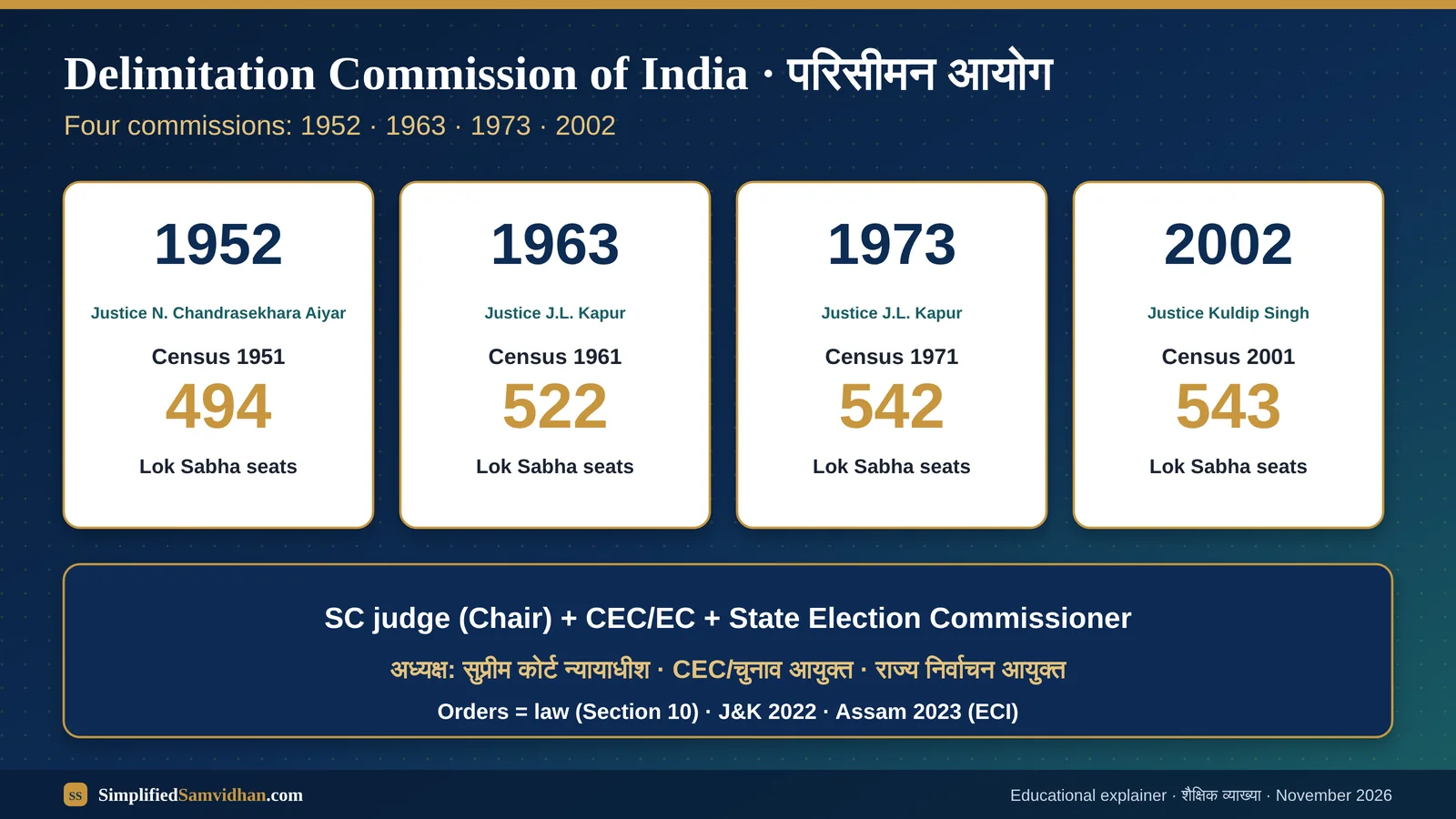
In short: a three-member body led by a Supreme Court judge, created by Parliament only when the map is redrawn. Its orders become law the day they are printed in the Gazette. India has had four such Commissions (1952, 1963, 1973, 2002), plus special exercises in Jammu and Kashmir and Assam.
Who sits on itDelimitation Commission of India: Composition and Members
The Delimitation Commission is a temporary, high-powered body that Parliament creates by law each time India's electoral map is to be redrawn. It is not a permanent constitutional body like the Election Commission: it is born under a Delimitation Act, does its job, and is wound up.
Under the Delimitation Act, 2002 it has three members: a serving or retired Supreme Court judge as Chairperson (appointed by the Central Government), the Chief Election Commissioner or an Election Commissioner nominated by the CEC, and the State Election Commissioner of the State being worked on. Five MPs and five MLAs of each State sit as associate members without voting rights.
🏠 Everyday analogy
Like a referee team called in only for a final: a senior judge in charge, the election umpire beside him, and a local official who knows the ground. Club captains (MPs and MLAs) may speak, but cannot blow the whistle.
Delimitation Act, 2002, Section 3. Constitution of Delimitation Commission.— As soon as may be after the commencement of this Act, the Central Government shall constitute a Commission to be called the Delimitation Commission which shall consist of three members as follows:—
(a) one member who is a person who is or has been a Judge of the Supreme Court, to be appointed by the Central Government, who shall be the Chairperson of the Commission;
(b) the Chief Election Commissioner or an Election Commissioner nominated by the Chief Election Commissioner, ex officio; and
(c) the State Election Commissioner of the concerned State, ex officio.
Official textPowers of the Delimitation Commission: Rules, Force of Law and Courts
Delimitation Act, 2002, Section 9(1) [extract]. Delimitation of constituencies.— (a) all constituencies shall, as far as practicable, be geographically compact areas, and in delimiting them regard shall be had to physical features, existing boundaries of administrative units, facilities of communication and public convenience;
(b) every assembly constituency shall be so delimited as to fall wholly within one parliamentary constituency;
(c) constituencies in which seats are reserved for the Scheduled Castes shall be distributed in different parts of the State and located, as far as practicable, in those areas where the proportion of their population to the total is comparatively large; and
(d) constituencies in which seats are reserved for the Scheduled Tribes shall, as far as practicable, be located in areas where the proportion of their population to the total is the largest.
Delimitation Act, 2002, Section 10(2). Upon publication in the Gazette of India, every such order shall have the force of law and shall not be called in question in any court.
The Commission must keep seats compact, follow district and tehsil lines, rivers and hills, roads and public convenience, and fit every Assembly seat inside one Lok Sabha seat. SC seats go where the SC share of population is comparatively large but spread across the State; ST seats go where the ST share is largest. Once its orders appear in the Gazette they are law: no Parliament vote is needed and Parliament or a State Assembly can only discuss them, not amend them.
HistoryList of Delimitation Commissions in India: 1952 to 2002, J&K and Assam
| Year | Law | Chairperson | Census | Lok Sabha seats after |
|---|---|---|---|---|
| 1952 | Delimitation Commission Act, 1952 | Justice N. Chandrasekhara Aiyar | 1951 | 494 |
| 1963 | Delimitation Commission Act, 1962 | Justice J.L. Kapur | 1961 | 522 |
| 1973 | Delimitation Act, 1972 | Justice J.L. Kapur | 1971 | 542 (543 with Sikkim) |
| 2002 | Delimitation Act, 2002 | Justice Kuldip Singh | 2001 | 543 (unchanged) |
- 1
1️⃣ 1952: the first map
The 1951-52 election was fought on a Presidential order. The first Commission under Justice N. Chandrasekhara Aiyar drew the map for 1957, still with some two-member seats (abolished in 1961).
- 2
2️⃣ 1963 and 1973: Justice J.L. Kapur, twice
Seats grew with population: 522 after the 1961 Census, 542 after 1971, 543 once Sikkim joined. These were the last commissions to change State seat shares.
- 3
3️⃣ 2002-2008: Justice Kuldip Singh
Set up on 12 July 2002. Seat totals stayed frozen, but boundaries inside States were redrawn on the 2001 Census and SC/ST seats re-fixed (Lok Sabha SC 79 to 84, ST 41 to 47). The new map came into force in 2008; Assam, Arunachal, Manipur and Nagaland were left out.
- 4
🏔️ 2020-2022: Jammu and Kashmir
After the 2019 reorganisation, a Commission under Justice Ranjana Prakash Desai raised the Assembly from 83 to 90 seats (Jammu 43, Kashmir 47) and reserved 9 seats for STs for the first time. Final order: 5 May 2022. Critics said Jammu gained more than its population share; the Supreme Court upheld the exercise.
- 5
🌿 2023: Assam, done by the Election Commission
Using Section 8A of the Representation of the People Act, 1950, the ECI redrew Assam on the 2001 Census (final order 11 August 2023). Totals stayed at 126 Assembly and 14 Lok Sabha seats; ST Assembly seats rose from 16 to 19. Opposition parties said the map reduced seats where minorities could decide results.
- 6
⏭️ Next: the fifth Commission
A new Delimitation Act and Commission are expected once Census 2027 figures are published. It will be the first since 1973 that can change each State's share of Lok Sabha seats, and its map will also carry women's reservation.
CompareDelimitation Commission vs Election Commission
Delimitation Commission
- Created by a Delimitation Act (Arts 82, 170, 327)
- Temporary: wound up after the job
- Chair: Supreme Court judge
- Draws boundaries and reserves SC/ST seats
- Orders = law, not open to ordinary court challenge
Election Commission of India
- Created by the Constitution (Art 324)
- Permanent body since 25 January 1950
- Chair: Chief Election Commissioner
- Conducts elections on the map it is given
- CEC sits on the Delimitation Commission as a member
Connect the dotsRead Next: Delimitation Notes
- Start here: What is delimitation (Articles 82, 170, 327).
- The body whose chief sits on it: Election Commission of India.
- Why the next Commission is a big fight: Seat freeze and the North-South debate.
- What an unfair map looks like: Gerrymandering: cracking and packing.
- News overview: Delimitation Commission India (Legal Update).
Quick revisionOne-Line Revision Points (Exam Ready)
- Members: SC judge (chair) + CEC/EC + State Election Commissioner.
- Associate members: 5 MPs + 5 MLAs per State, no vote.
- Orders have force of law (Section 10, Delimitation Act 2002).
- Commissions: 1952 (Chandrasekhara Aiyar), 1963 and 1973 (J.L. Kapur), 2002 (Kuldip Singh).
- J&K: Justice Ranjana Prakash Desai, 90 seats, order 5 May 2022.
- Assam 2023 was done by the ECI under Section 8A, RP Act 1950.
- Rathod (2024): manifestly arbitrary orders can be reviewed.
Practice MCQPractice MCQs (with Answers): Delimitation Commission
Who chaired the Delimitation Commission set up in 2002?
Which of these is NOT a member of the Delimitation Commission under the 2002 Act?
How many Delimitation Commissions has India had under Delimitation Acts?
Who chaired the Jammu and Kashmir Delimitation Commission (2020-22)?
The 2023 delimitation of Assam was carried out by:
Doubts ClearedFrequently Asked Questions
Is the Delimitation Commission a constitutional body?
No. It is a statutory body created by a Delimitation Act that Parliament passes under Articles 82, 170 and 327. It is wound up after its work.
Who appoints the Delimitation Commission?
The Central Government appoints the Chairperson (a serving or retired Supreme Court judge). The CEC (or a nominee) and the State Election Commissioner are members by virtue of office.
Can Parliament change the orders of the Delimitation Commission?
No. The orders are laid before the Lok Sabha and the State Assembly, but they cannot modify them. Only a new law can start a new exercise.
Who is the chairman of the Delimitation Commission now?
As of November 2026 no national Delimitation Commission is working. A new one is expected after Census 2027 figures are published.
Sources and further readingSources We Checked
Facts checked on 12 November 2026. Hindi text of the Delimitation Act is a simple rendering; the English text is authoritative. Seat figures for J&K and Assam are from the final orders as reported.
- The Delimitation Act, 2002 (India Code)
- Constitution of India, Part XV (Legislative Department)
- Election Commission of India: Delimitation 2008 orders and Assam delimitation 2023
- Election Commission of India: J&K Delimitation Commission final order (5 May 2022)
- Supreme Court of India: Kishorchandra Chhanganlal Rathod v. Union of India, 2024 INSC 579 (23 Jul 2024)