Gerrymandering Meaning: Cracking, Packing, US Examples and How India Guards Against It
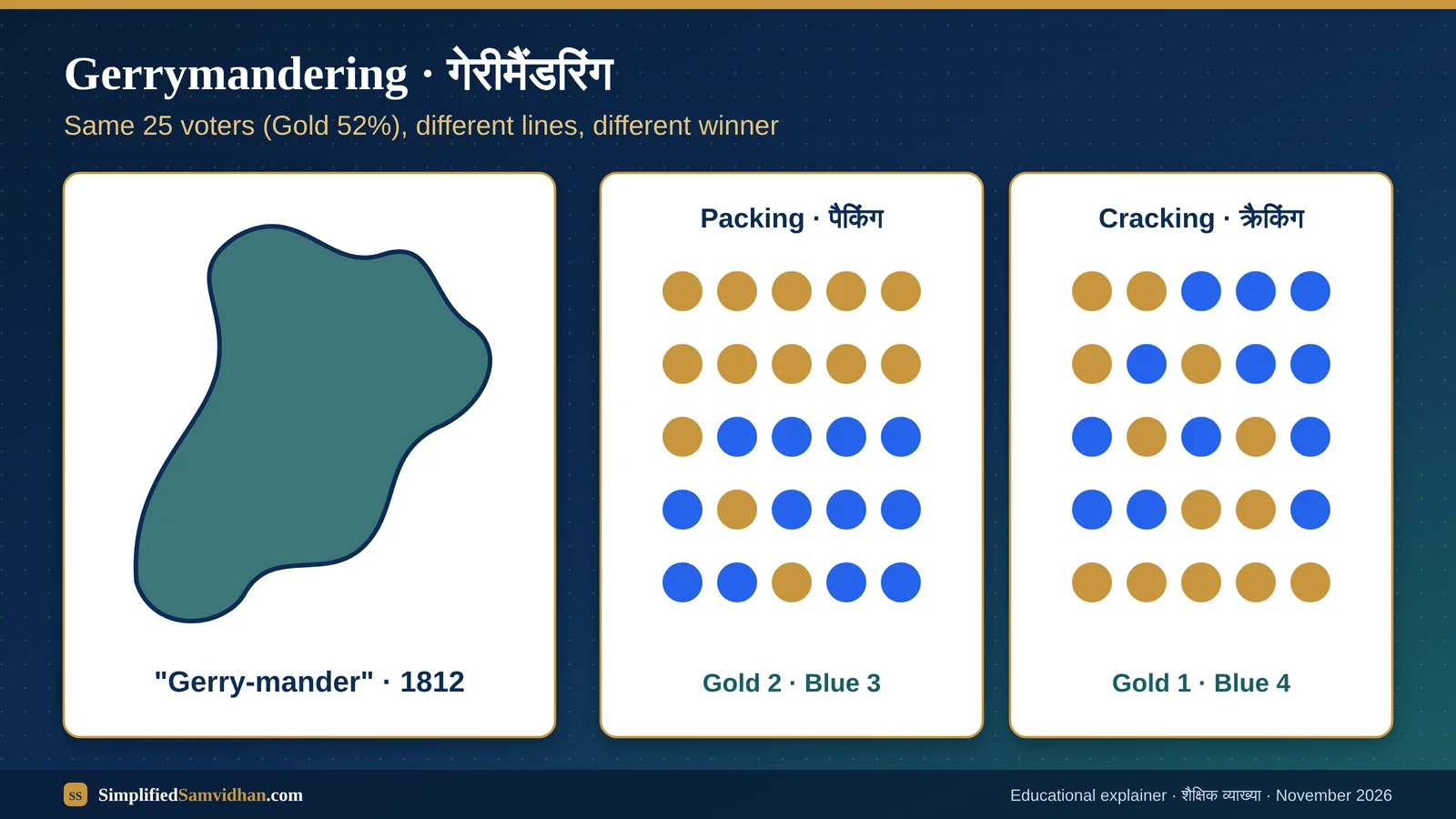
In short: gerrymandering is drawing constituency lines to help one side. By cracking (splitting) or packing (crowding) the other side's voters, a party with fewer votes can win more seats. The US has fought over it since 1812 and is still fighting in 2026; India avoids most of it by giving the pen to a judge-led Delimitation Commission.
The basicsGerrymandering Meaning in Simple Words, and Where the Word Comes From
Gerrymandering is drawing constituency boundaries on purpose to help one party or group and hurt another. The voters stay the same; only the lines move, and the result changes.
It is the dark twin of delimitation. Fair delimitation asks: where do people live? Gerrymandering asks: where do my voters live, and how do I waste my opponent's votes?
🏠 Everyday analogy
A cricket captain who picks the teams for a gully match: he puts all the good batsmen of the other side in one team that wins by 200 runs, and spreads the rest so his team wins the other four matches. Same players, rigged teams.
🇮🇳 Real Indian example
In March 1812, Massachusetts Governor Elbridge Gerry signed a map with one twisted district that looked like a salamander. The Boston Gazette drew it with claws and wings and called it the "Gerry-mander". The name stuck.
How it is doneCracking and Packing: How Gerrymandering Works, With a Map
Gold has more votes and wins more seats. Seats roughly follow votes.
Gold voters are stuffed into 2 districts and win them by huge margins. Their extra votes are wasted, so Blue takes 3 of 5 with fewer votes.
Gold voters are split across 4 districts where they are always a minority (2 of 5). Blue wins 4 of 5 seats with only 48% of the votes.
| Technique | What is done | Effect |
|---|---|---|
| Cracking | Split the opponent's voters across many seats | They lose narrowly everywhere |
| Packing | Crowd the opponent's voters into a few seats | They win those hugely; extra votes are wasted |
| Kidnapping | Move a rival MP's home into a tough seat | They must fight on unknown ground |
| Hijacking | Put two sitting rivals in one seat | One of them must go |
| Type | Meaning |
|---|---|
| Partisan | Lines drawn to help a political party |
| Racial / communal | Lines drawn to dilute or concentrate a race, caste or religion |
| Incumbent protection | Both parties agree to give every sitting member a safe seat |
| Malapportionment (cousin) | Seats of very unequal population, so some votes weigh more |
US examplesGerrymandering in the USA: Key Cases and the 2025-26 Redistricting War
- 1
🦎 1812
Elbridge Gerry's salamander district in Massachusetts gives the practice its name.
- 2
⚖️ 1962-1964
Baker v. Carr lets courts hear map cases; Reynolds v. Sims sets "one person, one vote": districts must have nearly equal population. - 3
🧩 1993
Shaw v. Reno: a district drawn mainly on race can be struck down as a racial gerrymander. - 4
🚪 2019
Rucho v. Common Cause (5-4): partisan gerrymandering is a "political question" that federal courts will not decide. State courts and voters must fix it. - 5
✊ 2023
Allen v. Milligan: Alabama must draw a second district where Black voters can elect their choice, under Section 2 of the Voting Rights Act. - 6
📉 29 April 2026
Louisiana v. Callais (6-3): Louisiana's second Black-majority district is struck down; Section 2 is now violated only on a strong inference of intentional discrimination. Critics say it makes minority districts easy to dismantle. - 7
🗺️ 2025-2026 map war
Texas redrew mid-decade to gain five Republican seats; California answered with Proposition 50 (4 Nov 2025) to gain five Democratic seats; Missouri and North Carolina added one Republican seat each. Early November 2026 reports say Democrats won all five California targets while Republicans won only one of the five redrawn Texas seats, so the two big moves largely cancelled out.
Indian modelGerrymandering in India: Safeguards and Weak Spots
🛡️ India's safeguards
- An independent Commission led by a Supreme Court judge draws maps, not the ruling party
- Written rules: compact seats, administrative boundaries, public convenience (Section 9)
- Draft maps published; public objections and open hearings in every State
- MPs and MLAs only advise; they cannot vote
- Maps are redrawn rarely (2008 was the last), so no mid-term redraws like the US
⚠️ Weak spots
- The Central Government picks the chair and decides when a Commission is set up
- Courts can rarely intervene (Article 329), only for manifestly arbitrary orders (Rathod, 2024)
- SC reserved seats stay fixed for decades instead of rotating
- Opposition parties alleged a tilt in the J&K (2022) and Assam (2023) maps
Delimitation Act, 2002, Section 9(1) [extract]. Delimitation of constituencies.— (a) all constituencies shall, as far as practicable, be geographically compact areas, and in delimiting them regard shall be had to physical features, existing boundaries of administrative units, facilities of communication and public convenience;
(b) every assembly constituency shall be so delimited as to fall wholly within one parliamentary constituency;
(c) constituencies in which seats are reserved for the Scheduled Castes shall be distributed in different parts of the State and located, as far as practicable, in those areas where the proportion of their population to the total is comparatively large; and
(d) constituencies in which seats are reserved for the Scheduled Tribes shall, as far as practicable, be located in areas where the proportion of their population to the total is the largest.
India has had very few gerrymandering scandals because maps are drawn by a judge-led body using written rules and public hearings, not by the party in power. The risk returns whenever the next Commission is set up, which is why its chair, its rules and its transparency after Census 2027 matter so much.
Connect the dotsRead Next: Delimitation Notes
- Fair map-making first: What is delimitation.
- India's map-makers: Delimitation Commission of India.
- The fight over seats after Census 2027: Seat freeze and North-South debate.
- How the US elects its House: US election system.
- News overview with the cracking and packing demo: Delimitation and gerrymandering (Legal Update).
Quick revisionOne-Line Revision Points (Exam Ready)
- Gerrymandering = drawing boundaries to favour a party or group.
- Named after Elbridge Gerry, Massachusetts, 1812.
- Cracking splits rival voters; packing crowds them.
- Efficiency gap measures wasted votes.
- Rucho v. Common Cause (2019): partisan gerrymandering non-justiciable in US federal courts.
- Louisiana v. Callais (29 Apr 2026) narrowed the Voting Rights Act.
- India's guard: judge-led Delimitation Commission + Section 9 rules.
Practice MCQPractice MCQs (with Answers): Gerrymandering
The term 'gerrymandering' comes from:
Spreading the opposition's voters thinly across many constituencies is called:
In which case did the US Supreme Court hold that partisan gerrymandering claims are beyond federal courts?
Which provision of Indian law requires constituencies to be geographically compact?
California's Proposition 50 (2025) was about:
Doubts ClearedFrequently Asked Questions
What is gerrymandering in simple words?
Drawing election boundaries to help your own side win more seats than its votes deserve.
What is the difference between cracking and packing?
Cracking splits a group's voters across many seats so they lose everywhere; packing crowds them into a few seats so their extra votes are wasted.
Is there gerrymandering in India?
India's design makes it hard: an independent, judge-led Commission draws maps under written rules with public hearings. But opposition parties have alleged bias in the Jammu and Kashmir (2022) and Assam (2023) exercises.
Why is gerrymandering asked in UPSC?
Because the next delimitation after Census 2027 will redraw India's map, and Mains questions often ask how India can keep it fair, comparing with the US.
Sources and further readingSources We Checked
Facts checked on 12 November 2026. US 2026 election effects are from early news reports and may change when results are certified. The cracking and packing map is an illustration with 25 imaginary voters.
- The Delimitation Act, 2002 (India Code)
- Constitution of India, Part XV (Legislative Department)
- Supreme Court of India: Kishorchandra Chhanganlal Rathod v. Union of India, 2024 INSC 579 (23 Jul 2024)
- Supreme Court of the United States: Rucho v. Common Cause, 588 U.S. 684 (2019)
- Congressional Research Service, 14 May 2026: High Court Narrows Voting Rights Act in Louisiana v. Callais
- Ballotpedia: Redistricting ahead of the 2026 elections
- The Hill, Nov 2026: How the 2026 midterm redistricting wars played out