What Is Delimitation in India? Articles 82, 170, 327 and the Process in Simple Words
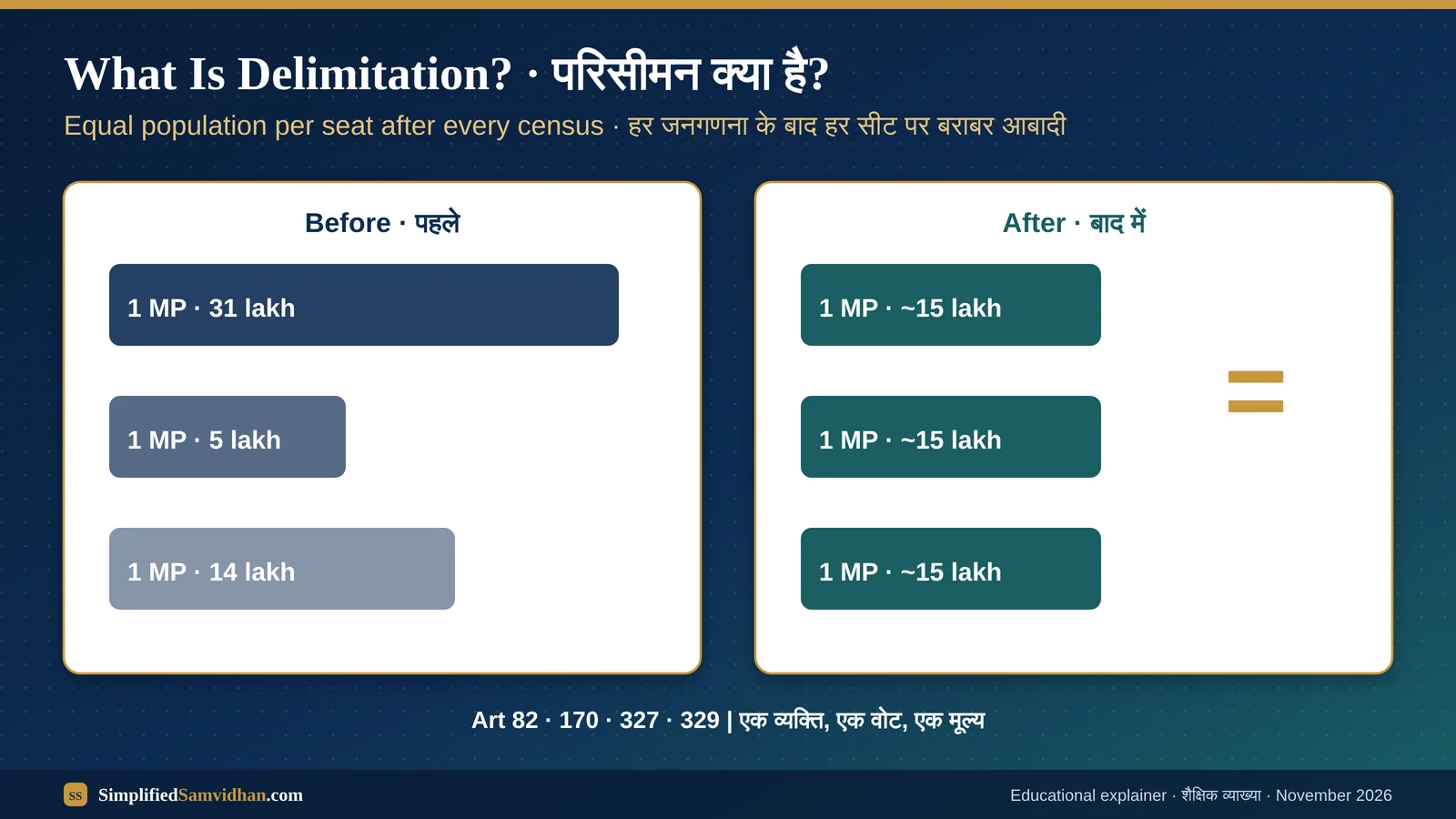
Delimitation decides how many MPs your State gets and where your constituency's boundary runs. In short: after a census, a Commission led by a Supreme Court judge redraws seats so each one has about the same population; its orders are law and courts normally cannot touch them.
The basicsWhat Is Delimitation? Meaning in Simple Words
Delimitation (परिसीमन) means fixing how many seats each State gets and drawing the boundary of every Lok Sabha and Vidhan Sabha constituency, so that each MP or MLA speaks for roughly the same number of people. It is how the promise of "one person, one vote, one value" is kept: your vote in a crowded city should count as much as a vote in a small hill district.
Delimitation does three jobs: (1) shares Lok Sabha seats among States by population; (2) divides each State into constituencies of nearly equal population; and (3) decides which seats are reserved for Scheduled Castes and Scheduled Tribes.
🏠 Everyday analogy
Think of a school with 10 classrooms. If one class has 80 children and another has 20, each class still gets one monitor. Fair? No. So every few years the principal reshuffles sections so each has about 40. Delimitation is that reshuffle, done for voters after every census.
🇮🇳 Real Indian example
Malkajgiri (Telangana) had about 31.5 lakh voters in 2019 while Lakshadweep had about 55,000. Both elect one MP. Boundaries last redrawn on the 2001 Census have not kept up with fast-growing cities.
Official textDelimitation Articles 81, 82, 170, 327 and 329: The Exact Words
81. Composition of the House of the People.— (1) Subject to the provisions of article 331, the House of the People shall consist of—
(a) not more than five hundred and thirty members chosen by direct election from territorial constituencies in the States, and
(b) not more than twenty members to represent the Union territories, chosen in such manner as Parliament may by law provide.
(2) For the purposes of sub-clause (a) of clause (1),—
(a) there shall be allotted to each State a number of seats in the House of the People in such manner that the ratio between that number and the population of the State is, so far as practicable, the same for all States; and
(b) each State shall be divided into territorial constituencies in such manner that the ratio between the population of each constituency and the number of seats allotted to it is, so far as practicable, the same throughout the State:
Provided that the provisions of sub-clause (a) of this clause shall not be applicable for the purpose of allotment of seats in the House of the People to any State so long as the population of that State does not exceed six millions.
82. Readjustment after each census.— Upon the completion of each census, the allocation of seats in the House of the People to the States and the division of each State into territorial constituencies shall be readjusted by such authority and in such manner as Parliament may by law determine:
Provided that such readjustment shall not affect representation in the House of the People until the dissolution of the then existing House:
Provided further that such readjustment shall take effect from such date as the President may, by order, specify and until such readjustment takes effect, any election to the House may be held on the basis of the territorial constituencies existing before such readjustment:
Provided also that until the relevant figures for the first census taken after the year 2026 have been published, it shall not be necessary to readjust—
(i) the allocation of seats in the House of the People to the States as readjusted on the basis of the 1971 census; and
(ii) the division of each State into territorial constituencies as may be readjusted on the basis of the 2001 census,
under this article.
170(3) [extract, third proviso] Provided also that until the relevant figures for the first census taken after the year 2026 have been published, it shall not be necessary to readjust— (i) the total number of seats in the Legislative Assembly of each State as readjusted on the basis of the 1971 census; and (ii) the division of such State into territorial constituencies as may be readjusted on the basis of the 2001 census, under this clause.
170. Composition of the Legislative Assemblies.— (1) Subject to the provisions of article 333, the Legislative Assembly of each State shall consist of not more than five hundred, and not less than sixty, members chosen by direct election from territorial constituencies in the State.
(2) For the purposes of clause (1), each State shall be divided into territorial constituencies in such manner that the ratio between the population of each constituency and the number of seats allotted to it shall, so far as practicable, be the same throughout the State.
(3) Upon the completion of each census, the total number of seats in the Legislative Assembly of each State and the division of each State into territorial constituencies shall be readjusted by such authority and in such manner as Parliament may by law determine ...
327. Power of Parliament to make provision with respect to elections to Legislatures.— Subject to the provisions of this Constitution, Parliament may from time to time by law make provision with respect to all matters relating to, or in connection with, elections to either House of Parliament or to the House or either House of the Legislature of a State including the preparation of electoral rolls, the delimitation of constituencies and all other matters necessary for securing the due constitution of such House or Houses.
329. Bar to interference by courts in electoral matters.— Notwithstanding anything in this Constitution—
(a) the validity of any law relating to the delimitation of constituencies or the allotment of seats to such constituencies, made or purporting to be made under article 327 or article 328, shall not be called in question in any court;
Delimitation Act, 2002, Section 10(2): Upon publication in the Gazette of India, every such order shall have the force of law and shall not be called in question in any court.
Article 81 sets the size of the Lok Sabha (up to 530 from States, 20 from UTs) and the rule of equal population per seat. Article 82 says the seats must be readjusted after every census by an authority Parliament chooses; Article 170 says the same for State Assemblies (between 60 and 500 members). Article 327 lets Parliament write that law, which it has done through Delimitation Acts. And Article 329(a) stops courts from questioning such laws, so that elections are not held hostage to endless litigation.
The catch: a proviso added in 1976 and extended in 2001 says the readjustment is not needed until the first census after 2026. That freeze is explained in Note 19.
Step by stepDelimitation Process in India: From Census to New Map
- 1Census figures come out
Population of every State, district and village is published. Delimitation always uses census data, not voter counts.
- 2Parliament passes a Delimitation Act
Under Articles 82, 170 and 327. So far: 1952, 1962, 1972 and 2002.
- 3The Commission is set up
A Supreme Court judge (serving or retired) as chair, the CEC or an Election Commissioner, and the State Election Commissioner of each State.
- 4Associate members join
Five MPs and five MLAs from each State, nominated by the Speakers, advise the Commission but cannot vote or sign its orders.
- 5Draft proposals are published
In the Gazette and local newspapers, inviting objections from the public.
- 6Public sittings in each State
Citizens, parties and groups argue for or against a boundary. The Commission may change the draft.
- 7Final orders in the Gazette
They get the force of law (Section 10) and no court can question them in the ordinary way.
- 8President fixes the start date
The new map is used from the next general election; the sitting House is not disturbed (Article 82, first proviso).
Quick tableDelimitation Articles and All Delimitation Commissions at a Glance
| Article | What it says about delimitation |
|---|---|
| Article 81 | Lok Sabha size; equal population per seat among and within States |
| Article 82 | Readjust Lok Sabha seats after each census; freeze till first census after 2026 |
| Article 170 | Assembly size 60-500; readjust after each census; same freeze |
| Article 327 / Article 328 | Parliament (and, subject to it, the State Legislature) makes election laws, including delimitation |
| Article 329 | Delimitation laws cannot be questioned in court; election disputes only by election petition |
| Article 330 / Article 332 | SC/ST seats in Lok Sabha and Assemblies in proportion to their population |
| Article 334A | Women's reservation (one-third) starts only after the delimitation that follows the first census after 2023 |
| Year | Law | Chair | Census used | Lok Sabha seats |
|---|---|---|---|---|
| 1952 | Delimitation Commission Act, 1952 | Justice N. Chandrasekhara Aiyar | 1951 | 494 |
| 1963 | Delimitation Commission Act, 1962 | Justice J.L. Kapur | 1961 | 522 |
| 1973 | Delimitation Act, 1972 | Justice J.L. Kapur | 1971 | 542 (543 with Sikkim) |
| 2002 | Delimitation Act, 2002 | Justice Kuldip Singh | 2001 | 543 (unchanged) |
Connect the dotsRead Next: Delimitation Notes 18 to 20
- Who sits on the Commission and how it works: Delimitation Commission of India.
- Why seats are frozen and the North-South fight: Lok Sabha seat freeze and North-South debate.
- When boundaries are drawn to cheat: Gerrymandering explained.
- The 2026 news in one page: Delimitation Commission and seat freeze (Legal Update).
- Disputes after the vote: Election petition and Article 329.
Quick revisionOne-Line Revision Points (Exam Ready)
- Delimitation = fixing seats and boundaries of constituencies by population.
- Article 82 (Lok Sabha) and Article 170 (Assemblies): readjust after every census.
- Article 327: Parliament makes the law; 329(a): courts cannot question it.
- Commissions: 1952, 1963, 1973, 2002.
- Assembly size: min 60, max 500 (Art 170).
- Each Assembly seat lies wholly inside one Lok Sabha seat.
- Women's reservation (Art 334A) waits for the next delimitation.
Practice MCQPractice MCQs (with Answers): Delimitation
Which Article provides for readjustment of Lok Sabha seats after each census?
Under Article 170, a State Assembly can have:
Which Article bars courts from questioning laws on delimitation of constituencies?
Delimitation of constituencies is based on:
Associate members of the Delimitation Commission (MPs and MLAs):
Doubts ClearedFrequently Asked Questions
What is delimitation in simple words?
Redrawing the number and boundaries of Lok Sabha and Assembly constituencies after a census so that each seat has roughly the same population.
Who does delimitation in India?
A Delimitation Commission set up by the Central Government under a Delimitation Act passed by Parliament. In special cases Parliament has asked the Election Commission to do it, as in Assam in 2023.
When was the last delimitation in India?
The Justice Kuldip Singh Commission (2002-2008), using the 2001 Census. Its map has been used since the 2008-09 elections.
Does delimitation change the number of Lok Sabha seats?
It can. The total has been 543 since 1977 because of the freeze. The failed 131st Amendment Bill of April 2026 proposed up to 850 seats.
Sources and further readingSources We Checked
Facts checked on 12 November 2026. Hindi text of Articles 81, 170 and 327 is a simple rendering; the English text is authoritative. Malkajgiri and Lakshadweep voter numbers are rounded 2019 figures.