Lok Sabha Seat Freeze and the North-South Delimitation Debate: Who Gains, Who Loses
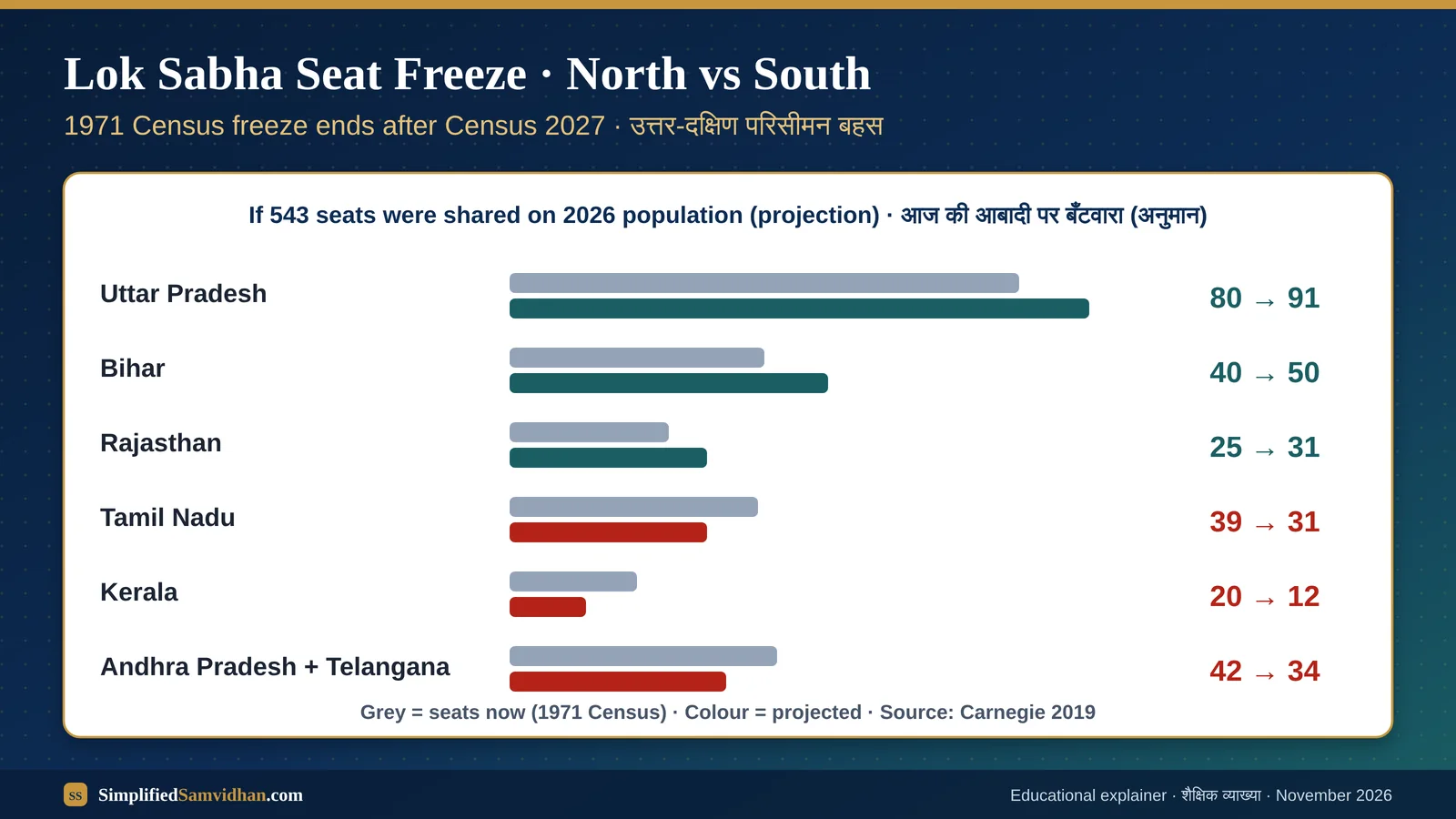
In short: each State's Lok Sabha seats are still based on the 1971 Census. The freeze ends once the first census after 2026 (Census 2027) is published. Re-sharing seats by today's population would add seats to UP and Bihar and cut them for Kerala and Tamil Nadu, which is why the April 2026 Bill failed and the fight is not over.
Why frozenWhy Lok Sabha Seats Are Frozen on the 1971 Census
Article 82 says Lok Sabha seats should be re-shared among States after every census. But in 1976 India was pushing family planning hard. If seats followed population, States that controlled births (mostly in the South) would lose seats and States with fast growth would gain. That would punish good behaviour.
So the 42nd Amendment (1976) froze each State's share on the 1971 Census. The freeze was meant to last till 2000; the 84th Amendment (2001) extended it to the first census after 2026. Boundaries inside States were allowed to be redrawn on the 2001 Census (87th Amendment, 2003), but the number of seats per State has not changed for 50 years.
🏠 Everyday analogy
Like a joint family that splits pocket money by the number of children in 1971. One brother had two children and educated them well; another had six. Re-splitting today by headcount would give the first brother far less, though he followed the family's own advice.
🇮🇳 Real Indian example
Fertility today (NFHS-5, 2019-21): Bihar 2.98 and Uttar Pradesh 2.35 children per woman, Kerala 1.79 and Tamil Nadu 1.80.
82. Readjustment after each census.— Upon the completion of each census, the allocation of seats in the House of the People to the States and the division of each State into territorial constituencies shall be readjusted by such authority and in such manner as Parliament may by law determine:
Provided that such readjustment shall not affect representation in the House of the People until the dissolution of the then existing House:
Provided further that such readjustment shall take effect from such date as the President may, by order, specify and until such readjustment takes effect, any election to the House may be held on the basis of the territorial constituencies existing before such readjustment:
Provided also that until the relevant figures for the first census taken after the year 2026 have been published, it shall not be necessary to readjust—
(i) the allocation of seats in the House of the People to the States as readjusted on the basis of the 1971 census; and
(ii) the division of each State into territorial constituencies as may be readjusted on the basis of the 2001 census,
under this article.
170(3) [extract, third proviso] Provided also that until the relevant figures for the first census taken after the year 2026 have been published, it shall not be necessary to readjust— (i) the total number of seats in the Legislative Assembly of each State as readjusted on the basis of the 1971 census; and (ii) the division of such State into territorial constituencies as may be readjusted on the basis of the 2001 census, under this clause.
TimelineSeat Freeze Timeline: 42nd, 84th, 87th Amendments to the 2026 Bill
- 1
1️⃣ 1976
42nd Amendment: State seat shares frozen on the 1971 Census till the 2000 Census. Lok Sabha stays at 543 (with Sikkim) from 1977. - 2
2️⃣ 2001
84th Amendment: freeze extended till the first census after 2026, to give population policy more time. - 3
3️⃣ 2003-2008
87th Amendment lets boundaries inside States follow the 2001 Census; the Kuldip Singh Commission's map is used from 2008. - 4
4️⃣ 2023
106th Amendment (women's reservation, Art 334A): one-third seats for women, but only after a delimitation based on the first census after 2023. - 5
5️⃣ 16-17 April 2026
Constitution (131st Amendment) Bill and Delimitation Bill: up to 850 seats, redraw on the 2011 Census without waiting. Vote 298-230, short of two-thirds; the Bill fails and the Delimitation Bill is withdrawn. - 6
6️⃣ November 2026
Parliament has not been prorogued since the Monsoon Session ended on 13 August (88 days on 9 November). The Congress says this keeps a special session for fresh delimitation Bills open and has asked four times for an all-party meeting; the government has announced nothing.
- 7
7️⃣ After Census 2027
Once its figures are published, the freeze in Articles 82 and 170 ends by itself and a new Delimitation Act can follow.
The big debateNorth-South Delimitation Debate: Who Gains, Who Loses Seats
| State | Seats now (1971) | 2026 projection (543) | Change |
|---|---|---|---|
| Uttar Pradesh | 80 | 91 | +11 |
| Bihar | 40 | 50 | +10 |
| Rajasthan | 25 | 31 | +6 |
| Tamil Nadu | 39 | 31 | -8 |
| Kerala | 20 | 12 | -8 |
| Andhra Pradesh + Telangana | 42 | 34 | -8 |
📈 Case for re-sharing seats
- Equal value of every vote: today an MP in Rajasthan or UP speaks for far more people than one in Kerala
- Article 81 itself asks for the same population-to-seat ratio in all States
- Women's reservation cannot start without a fresh delimitation
- A 50-year freeze cannot go on forever in a democracy
⚖️ Fears of southern and smaller States
- Punishment for success in population control and human development
- A few Hindi-belt States could form a Lok Sabha majority by themselves
- Southern States pay more in taxes and could get less voice
- Federal balance: India is a 'Union of States', not just a headcount
Way forwardSolutions Proposed for Delimitation After Census 2027
- Bigger House, no State loses: raise the total so southern States keep at least today's seats (the 2026 Bill's idea of up to 850).
- Extend the freeze again for 25 years, as Tamil Nadu's Joint Action Committee demanded in March 2025.
- Redraw only inside States: equalise constituencies within each State, keep State shares as they are.
- Strengthen the Rajya Sabha as the House of States, or give States more equal seats there, to balance a population-based Lok Sabha.
- Weighted formula: count population plus factors like development or tax share. Critics say this breaks 'one person, one vote'.
Connect the dotsRead Next: Delimitation Notes
- Basics first: What is delimitation.
- Who will draw the new map: Delimitation Commission of India.
- Drawing lines to win: Gerrymandering.
- The April 2026 Bill in detail: Delimitation and the 131st Amendment Bill (Legal Update).
- How amendments need two-thirds: Important Amendments of the Constitution.
- Centre-State balance: Centre-State relations and Finance Commission.
Quick revisionOne-Line Revision Points (Exam Ready)
- State seat shares frozen on the 1971 Census.
- 42nd (1976) froze till 2000; 84th (2001) till first census after 2026.
- 87th (2003): boundaries inside States on the 2001 Census.
- 131st Amendment Bill failed 17 Apr 2026 (298-230).
- Women's reservation (106th Amendment) waits for the next delimitation.
- New Lok Sabha chamber seats 888.
- US House fixed at 435 but re-shared every census.
Practice MCQPractice MCQs (with Answers): Seat freeze
Which amendment first froze the allocation of Lok Sabha seats among States on the 1971 Census?
The 84th Amendment (2001) extended the freeze until:
Boundaries of constituencies within States today are based on which census?
Why did the Constitution (131st Amendment) Bill, 2026 fail in the Lok Sabha?
Women's reservation under Article 334A will come into effect:
Doubts ClearedFrequently Asked Questions
When will the Lok Sabha seat freeze end?
When the relevant figures of the first census taken after 2026 are published. Census 2027 is expected to be that census.
Why do southern States oppose delimitation?
Because their population grew slowly after they controlled births. Seats shared on today's population would cut their share and add seats to northern States with faster growth.
What was the 131st Amendment Bill 2026?
A Bill to raise the Lok Sabha to up to 850 seats and redraw seats on the 2011 Census without waiting for the next census. It failed on 17 April 2026.
Is a new delimitation Bill coming?
Nothing is announced as of 12 November 2026. The Congress alleges the government is keeping Parliament unprorogued to call a special session for new delimitation Bills.
Sources and further readingSources We Checked
Facts checked on 12 November 2026. Seat projections are from one study (Carnegie, 2019) and are rounded; they are not official figures. The November 2026 claims about a special session are the opposition's, not confirmed by the government.
- Constitution of India, Part XV (Legislative Department)
- LiveLaw, 17 Apr 2026: Lok Sabha rejects Constitution (131st Amendment) Bill; Centre withdraws Delimitation Bill
- ANI, 9 Nov 2026: Parliament not prorogued for 88 days; Congress alleges push for delimitation Bills
- Carnegie Endowment (Vaishnav and Hintson, 2019): India's Emerging Crisis of Representation (seat projections)