Approaches of Public Administration and Principles of Organisation (RAS)
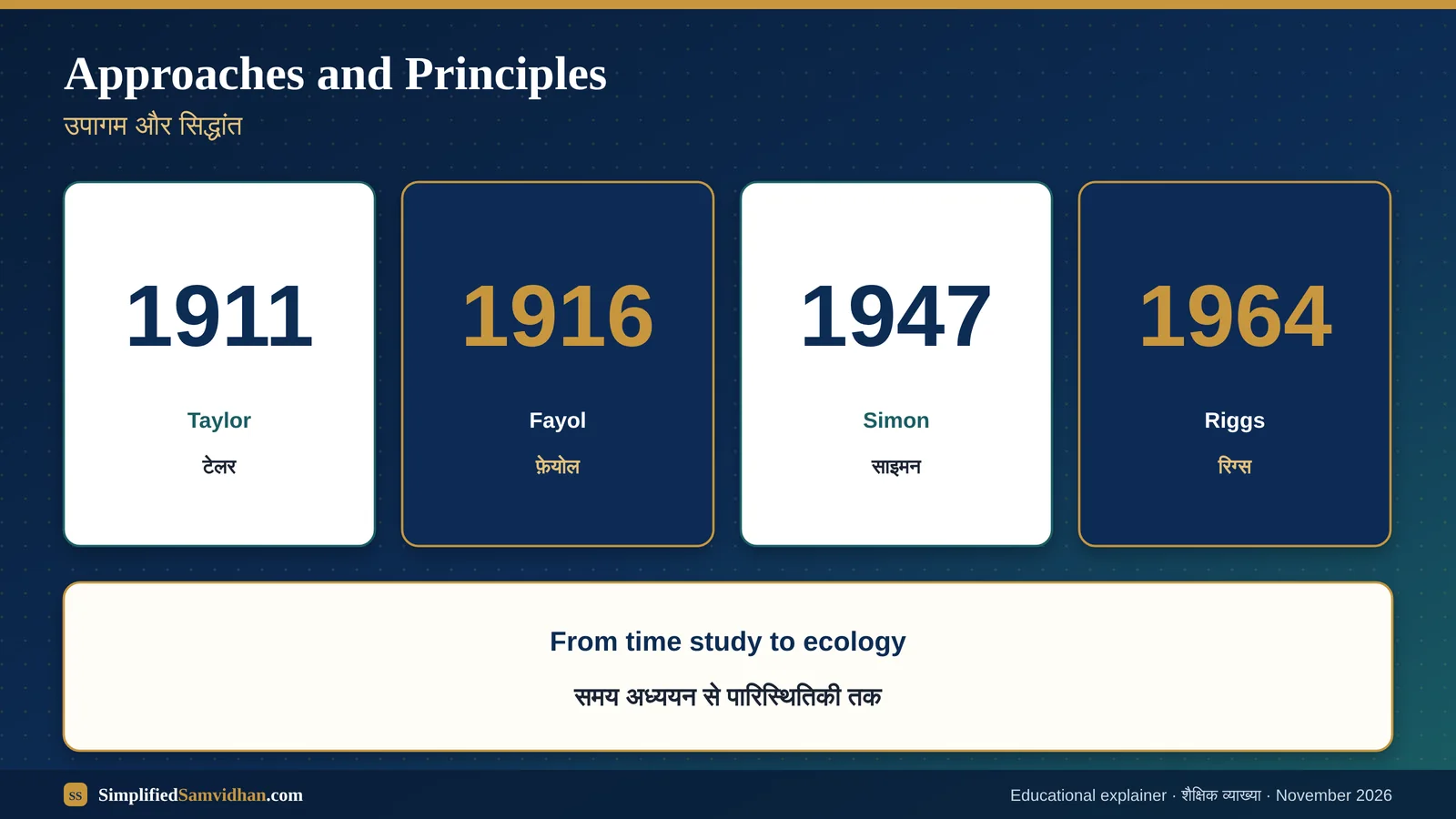
Taylor, Fayol, Weber, Mayo, Simon and Riggs in one table, the principles of organisation with Rajasthan examples, and administrative behaviour, with practice MCQs.
Short answerApproaches of Public Administration in Simple Words
Short answer: An approach is the lens through which a thinker looks at administration. The story runs like this: Taylor looked at the worker's speed (scientific management, 1911); Fayol looked at the manager (14 principles, 1916); Weber looked at rules and offices (bureaucracy); Mayo found that feelings and groups matter (Hawthorne, 1924-32); Simon looked at how decisions are really made (bounded rationality, 1947); and Riggs said administration depends on its society and culture (ecological approach, prismatic-sala model). From these came the principles of organisation: hierarchy, unity of command, span of control, delegation, centralisation, coordination.
🏠 Everyday analogy
Think of a district hospital: Taylor fixes how long each test should take, Weber writes the rules and posts, Mayo makes sure nurses feel valued, Simon studies how the doctor decides fast with half the information, and Riggs reminds you that a village hospital in Barmer is not a hospital in Boston.
🇮🇳 Real Indian example
A Collector in Rajasthan is a perfect example of hierarchy and unity of command: Tehsildars and SDMs report to one boss, while the Collector coordinates dozens of departments.
Prelims: not in Prelims polity list; Mains Paper II (Administration)
Mains: thinker + book + year matching; Weber's bureaucracy, Hawthorne, Simon, Riggs short notes; principles of organisation with Indian examples
ApproachesSeven Approaches: Thinker, Book, Year, Idea
| Approach | Thinker, work, year | Core idea in one line |
|---|---|---|
| Scientific management | F.W. Taylor, 'Principles of Scientific Management', 1911 | One best way; time and motion study; functional foremanship |
| Classical / administrative | Henri Fayol, 'General and Industrial Management', 1916; Gulick and Urwick | 14 principles; scalar chain; 'gang plank' for quick horizontal contact |
| Bureaucratic | Max Weber (German sociologist) | Rational-legal authority; hierarchy, written rules, impersonality, merit, career |
| Human relations | Elton Mayo, Hawthorne studies 1924-32 (Western Electric, Chicago) | Social and emotional needs, informal groups raise output |
| Behavioural / decision-making | Herbert Simon, 'Administrative Behavior', 1947 (Nobel 1978) | Bounded rationality; 'satisficing' not maximising; fact-value split |
| Ecological / comparative | Fred Riggs, 'Administration in Developing Countries', 1964 | Fused, prismatic, diffracted societies; 'sala' model fits developing countries |
| Systems | David Easton, Chester Barnard | Organisation = input → process → output → feedback |
Weber and RiggsWeber's Bureaucracy and Riggs' Prismatic-Sala Model
Weber's 3 types of authority
- Traditional: king, chief by custom
- Charismatic: personal magic of a leader
- Rational-legal: authority of the post and law
Features of ideal bureaucracy
- Hierarchy and fixed jurisdiction
- Written records and rules
- Impersonal, merit-based, salaried career
- Office separate from the person
- Riggs in simple words: a fused society does everything in one structure (a tribal chief); a diffracted society has a separate structure for each job (modern West); a prismatic society is in between: formal rules exist, but family, caste and money still decide. Its office is the 'sala'. Features: heterogeneity, formalism (gap between rule and practice) and overlapping.
PrinciplesPrinciples of Organisation with Rajasthan Examples
| Principle | Meaning | Indian / Rajasthan example |
|---|---|---|
| Hierarchy (scalar chain) | Superior-subordinate ladder from top to bottom | Chief Secretary → Divisional Commissioner → Collector → SDM → Tehsildar → Patwari |
| Unity of command | One employee, one boss (Fayol) | Broken in 'dual control' of district officers by department and Collector |
| Span of control | How many subordinates one boss can supervise well; Graicunas (1933) showed relationships rise very fast | Urwick: 5-6 at the top for interlocking work |
| Delegation | Passing authority, not responsibility, downward | Financial powers delegated to Collectors and BDOs |
| Centralisation vs decentralisation | Where decisions are taken: top or field | 73rd/74th Amendments; Rajasthan Panchayati Raj |
| Coordination | Making units work as one; Mooney called it the 'first principle' | District coordination committee chaired by the Collector |
| Line and staff | Line does the work, staff advises | Ministry departments = line; PMO, Cabinet Secretariat = staff |
BehaviourAdministrative Behaviour: Leadership, Motivation, Communication
- 1Leadership
Trait, behavioural and situational theories; Likert's 4 systems; leaders motivate without only giving orders.
- 2Motivation
Maslow's need hierarchy (1943); McGregor's Theory X and Y (1960); Herzberg's hygiene and motivator factors (1959).
- 3Communication
Downward, upward, horizontal; formal and informal ('grapevine'); barriers: hierarchy, language, red tape.
- 4Decision-making
Simon: intelligence → design → choice; 'administrative man' satisfices.
Current affairsCurrent Affairs of the Last One Year
- Lateral entry and specialists: the debate on bringing domain experts into government (the 2024 UPSC lateral-entry advertisement was withdrawn after a reservation row) is a live test of Weber's merit-career model; see Civil services.
- Related: Meaning, NPA, NPM, good governance · Comparative Public Administration · RAS polity syllabus
Mains answerRAS Mains: How to Write the Answer
- Q. Is Weber's model of bureaucracy still relevant in India? (10 marks) Frame: 3 types of authority → 6 features → relevance (rule of law, merit via UPSC/RPSC, impartiality) → criticism (red tape, Merton, Riggs' formalism) → reforms (e-governance, Citizen Charter, Mission Karmayogi) → conclusion: relevant as a skeleton, needs a citizen-friendly heart.
- Q. Explain 'unity of command' and 'span of control'. (5 marks) Define both → Fayol / Graicunas → one district example each → limits (dual control, technical departments).
Quick revisionOne-Line Revision Points (Exam Ready)
- Taylor = scientific management, 1911.
- Fayol = 14 principles, gang plank.
- Weber = rational-legal authority, bureaucracy.
- Mayo = Hawthorne, human relations.
- Simon = bounded rationality, satisficing.
- Riggs = ecology, prismatic-sala.
Practice MCQPractice MCQs (with Answers): Approaches of Public Administration
'Principles of Scientific Management' (1911) was written by:
Fayol gave how many principles of management?
Which is NOT one of Weber's types of authority?
The Hawthorne experiments are linked with:
'Bounded rationality' and 'satisficing' were given by:
The 'prismatic-sala' model belongs to:
'One employee should get orders from only one superior' is the principle of:
Theory X and Theory Y were given by:
Which of these is a 'staff' agency?
Mathematical work on span of control was done by:
Doubts ClearedFrequently Asked Questions
Which approach should I write for 'administration in India'?
Use Riggs' ecological view (formalism, caste and family pressure) plus Weber for structure; end with good governance reforms.
Is delegation the same as decentralisation?
No. Delegation passes authority to a subordinate who stays answerable; decentralisation gives power to separate local bodies such as panchayats.
Sources and further readingSources We Checked
Checked on 14 November 2026 against standard Public Administration texts and the RPSC RAS Mains syllabus.