NHRC, NCW and NCPCR: RAS Notes
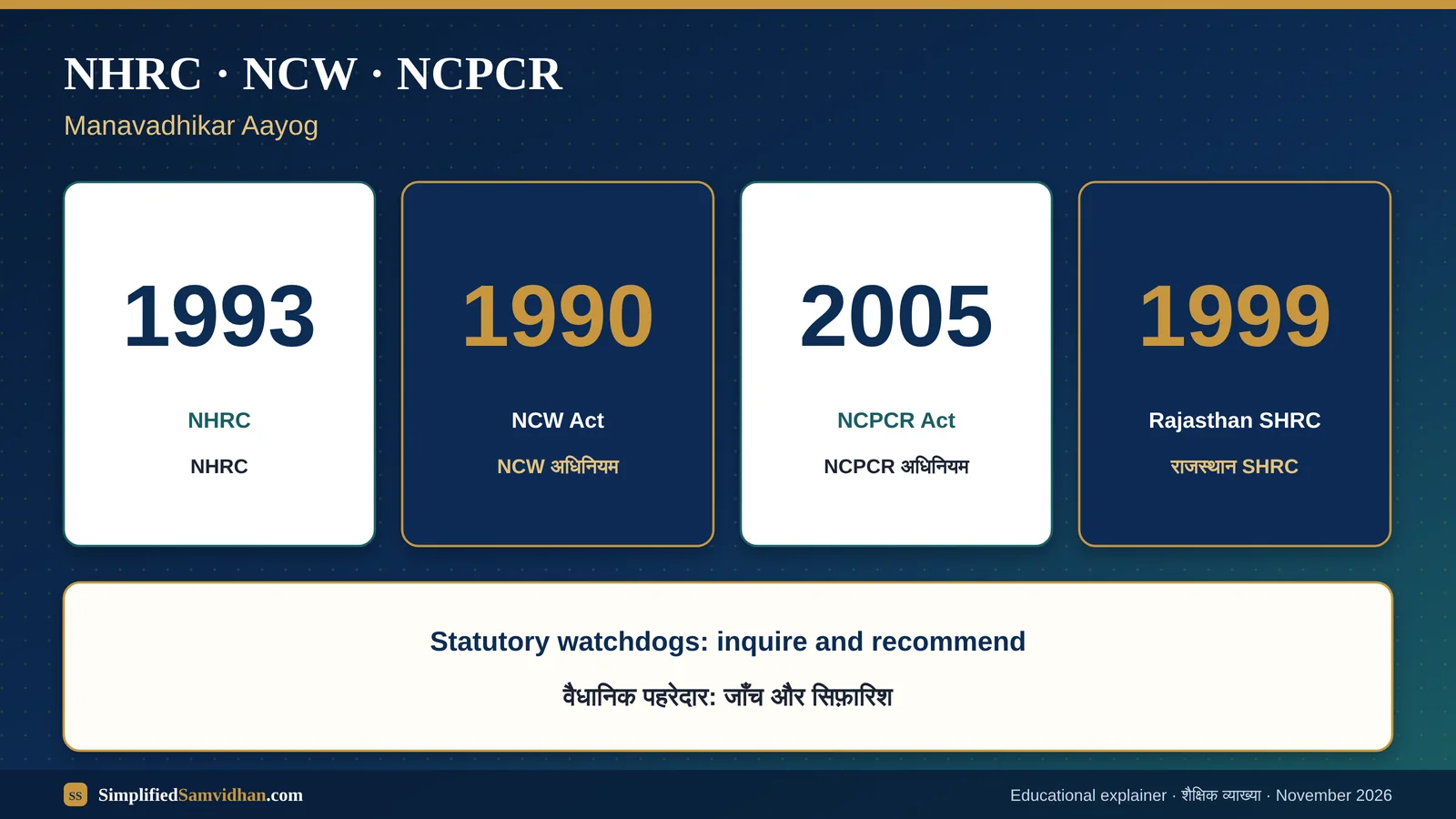
Three statutory watchdogs for human rights, women and children: law, composition, chairpersons, powers, limits and Rajasthan's state commissions, with practice MCQs.
Short answerNHRC, NCW and NCPCR in Simple Words
Short answer: all three are statutory bodies (made by an Act of Parliament, not by the Constitution). The NHRC was set up on 12 October 1993 under the Protection of Human Rights Act, 1993; its chairperson is a former Chief Justice of India or a former Supreme Court judge (now Justice V. Ramasubramanian, since December 2024). The NCW came under the NCW Act, 1990 and started on 31 January 1992 (chair Vijaya Rahatkar, since October 2024). The NCPCR works under the Commissions for Protection of Child Rights Act, 2005 and began in March 2007. All three can inquire and recommend, but they cannot punish anyone themselves. Rajasthan has its own State Human Rights Commission (1999), Women Commission and Child Rights Commission.
🏠 Everyday analogy
These commissions are like a watchdog with a loud bark but no bite: they investigate and report, and the government or courts act on their reports.
🇮🇳 Real Indian example
A custodial death in a Rajasthan police station must be reported to the NHRC within 24 hours (NHRC guidelines); the State Human Rights Commission can also take it up.
Prelims: statutory, not constitutional; Act and year of each; composition, chairperson qualification, term; present chairpersons
Mains: Is NHRC a 'toothless tiger'?; role of NCW/NCPCR in women and child protection
ComparisonNHRC vs NCW vs NCPCR in One Table
| Point | NHRC | NCW | NCPCR |
|---|---|---|---|
| Law | PHRA 1993 | NCW Act 1990 | CPCR Act 2005 |
| Started | 12 Oct 1993 | 31 Jan 1992 | March 2007 |
| Chairperson | Former CJI or SC judge | Woman committed to women's cause | Eminent person working for children |
| Appointed by | President, on a committee led by the PM | Central Government | Central Government |
| Term | 3 years or 70 years of age | Up to 3 years | 3 years |
| Now | Justice V. Ramasubramanian | Vijaya Rahatkar | Valeti Premchand |
NHRCHow the NHRC Works
- 1Selection committee
PM (chair), Lok Sabha Speaker, Home Minister, Deputy Chairman of Rajya Sabha, Leaders of Opposition in both Houses.
- 2Members
Chairperson + members; chairpersons of NCW, NCSC, NCST, NCM, NCBC, NCPCR and the Chief Commissioner for Persons with Disabilities are deemed members.
- 3Powers
Powers of a civil court while inquiring; can visit jails; can approach the SC/HC; recommends compensation.
- 4Limits
Cannot look into cases more than 1 year old; limited role over armed forces; recommendations not binding.
- 5Removal
By the President on proved misbehaviour or incapacity after a Supreme Court inquiry (also insolvency, unsound mind etc.).
RajasthanRajasthan's Own Commissions
- Rajasthan State Human Rights Commission: constituted in 1999 under the PHRA; first chairperson Justice Kanta Kumari Bhatnagar (2000). Chair = retired Chief Justice or judge of a High Court; appointed by the Governor on a committee led by the Chief Minister; removed by the President.
- Rajasthan State Commission for Women (1999 Act) and Rajasthan State Commission for Protection of Child Rights (under the 2005 Act) work at state level. See Rajasthan State Commission for Women.
Current affairsCurrent Affairs of the Last One Year
- NCPCR: Valeti Premchand took charge as chairperson in December 2025, after the post was held on additional charge during 2025.
- NCW: Vijaya Rahatkar completed two years as chairperson in October 2026.
- NHRC: Justice V. Ramasubramanian, a former Supreme Court judge, has headed it since December 2024 (after the post was vacant from June 2024).
- Already on this site: POCSO special prosecutor ruling · Law and Awareness guides
- Related: Lokpal, CVC and CIC · CAG and UPSC · RAS polity syllabus
Mains answerRAS Mains: How to Write the Answer
- Q. 'The NHRC is a toothless tiger.' Critically examine. (10 marks) Frame: role under PHRA 1993 → strengths (civil-court powers, custodial-death guidelines, jail visits, compensation recommendations) → weaknesses (advisory only, 1-year limit, armed forces excluded, vacancies, retired-judge dominance) → reforms (binding recommendations with reasons for rejection, own investigation staff, wider membership) → conclusion.
Quick revisionOne-Line Revision Points (Exam Ready)
- NHRC: PHRA 1993, set up 12 Oct 1993.
- NHRC chair: former CJI or SC judge (2019 amendment).
- Term 3 years or age 70.
- NCW: Act 1990, started 31 Jan 1992.
- NCPCR: CPCR Act 2005, started 2007.
- Rajasthan SHRC: 1999; first chair Kanta Bhatnagar.
Practice MCQPractice MCQs (with Answers): NHRC, NCW, NCPCR
The NHRC is a:
Who heads the committee that recommends the NHRC chairperson?
After the 2019 amendment, the term of the NHRC chairperson is:
The NCW was set up under an Act of:
NCPCR works under which law?
The NHRC cannot inquire into a matter after how long from the act?
Present NHRC chairperson (2026):
Who appoints the chairperson of the Rajasthan State Human Rights Commission?
First chairperson of the Rajasthan SHRC:
Present NCW chairperson (2026):
Doubts ClearedFrequently Asked Questions
Are NHRC recommendations binding?
No. The government must inform the NHRC of action taken within one month, but it is not bound to accept.
Can I complain to NCW directly?
Yes, online or by post; NCW can also take suo motu notice.
Sources and further readingSources We Checked
Checked on 13 November 2026 against the PHRA 1993, NCW Act 1990, CPCR Act 2005 and the commissions' websites and news on appointments.