BNS 2023: Sections in the RAS Syllabus
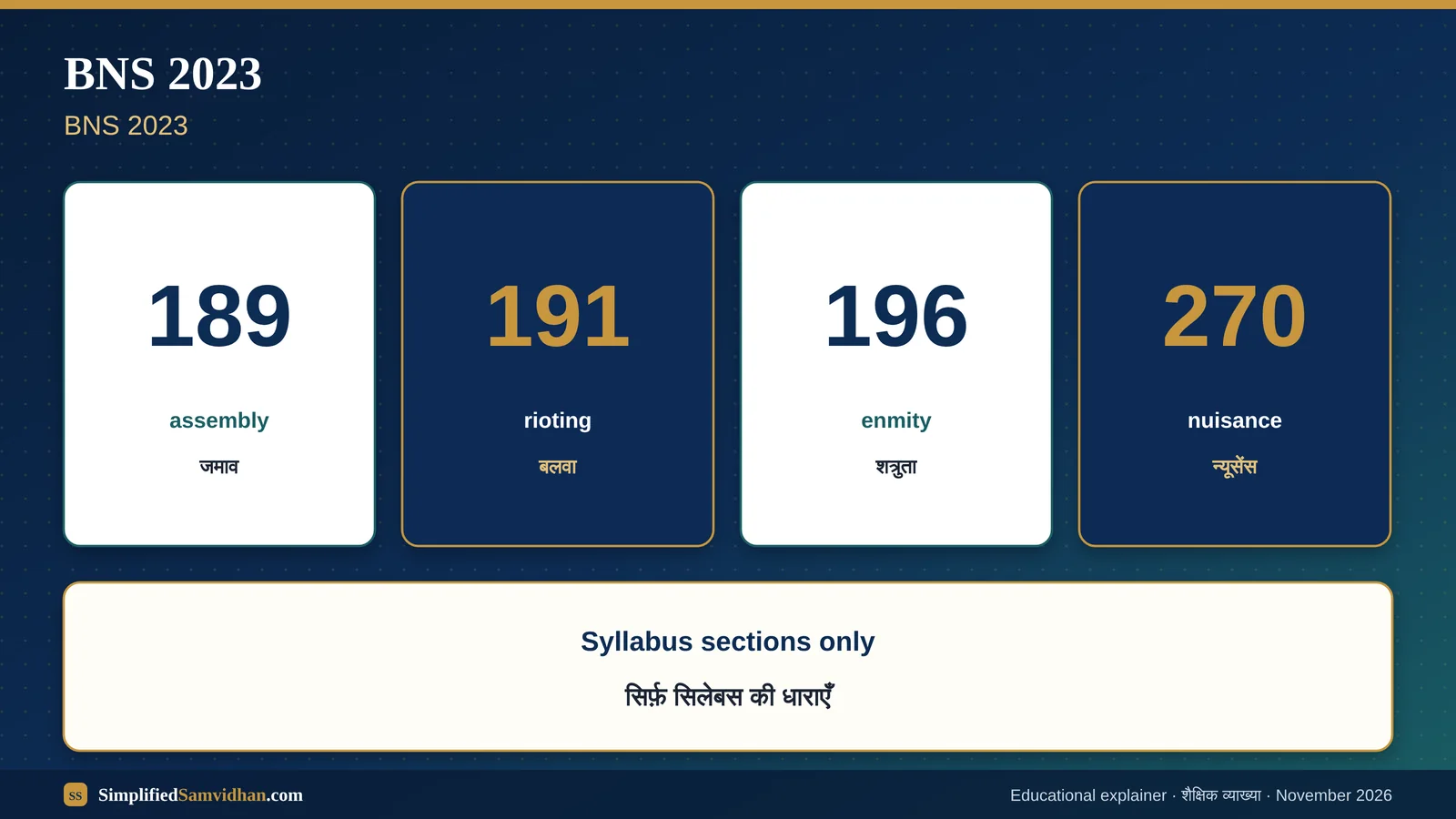
Only the BNS sections RAS asks, with meanings, punishments and the old IPC numbers side by side, plus practice MCQs.
Short answerBNS Syllabus Sections in Simple Words
Short answer: the Bharatiya Nyaya Sanhita, 2023 (BNS) replaced the Indian Penal Code, 1860 from 1 July 2024. It has 358 sections in 20 chapters. RAS Mains asks only a few: Section 2 definitions; 189-191 (unlawful assembly of 5 or more persons, liability of every member, rioting); 194-197 (affray, assault on a public servant suppressing a riot, promoting enmity between groups, imputations against national integration); 270 public nuisance; 294-296 obscene books, sale to children and obscene acts or songs. These are the sections an Executive Magistrate or SDM deals with in law and order.
🏠 Everyday analogy
Think of a mela: 5 people with a common illegal aim = unlawful assembly; if they use force = rioting; two people fighting in public = affray; loudspeakers blocking a road for days = public nuisance.
🇮🇳 Real Indian example
An RAS officer posted as SDM handles exactly these cases: dispersing an unlawful assembly, binding over trouble-makers and removing nuisances (see BNSS).
Prelims: not in the Prelims list; Mains law paper (Paper III)
Mains: define public servant, good faith, valuable security; unlawful assembly vs rioting vs affray; old IPC equivalents
DefinitionsSection 2: Syllabus Definitions
| Section 2 term | Meaning in short |
|---|---|
| Child | Any person below 18 years |
| Court / Judge | A Judge or body of Judges empowered to act judicially; Judge includes one who gives a definitive judgment |
| Document | Any matter expressed on any substance by letters, figures or marks, including electronic and digital records |
| Gender | 'He' and its derivatives apply to any person, male, female or transgender |
| Good faith | Nothing is in good faith if done without due care and attention |
| Government | Central Government or a State Government |
| Person / Public | Person includes a company, association or body of persons; public includes any class or community |
| Public servant | Government officers, judges, police, members of tribunals, arbitrators, election staff, officers of local bodies and government companies etc. |
| Valuable security | A document creating, extending or extinguishing a legal right (e.g. a cheque, bond, receipt) |
SectionsSyllabus Sections with Old IPC Numbers
| BNS | Old IPC | Offence | Punishment (max) |
|---|---|---|---|
| 189 | 141-145, 151 | Unlawful assembly: 5 or more with a common object (resist law, commit offence, force etc.); joining or continuing after order to disperse | 6 months (more if armed) |
| 190 | 149 | Every member is guilty of an offence committed in prosecution of the common object | Same as the offence |
| 191 | 146-148 | Rioting: force or violence used by an unlawful assembly | 2 years; with deadly weapon 5 years |
| 194 | 159-160 | Affray: two or more persons fighting in a public place, disturbing public peace | 1 month or ₹1,000 or both |
| 195 | 152 | Assaulting or obstructing a public servant suppressing a riot | 3 years, or fine of at least ₹25,000, or both |
| 196 | 153A | Promoting enmity between groups on grounds of religion, race, place of birth, language etc. | 3 years; in a place of worship 5 years |
| 197 | 153B | Imputations, assertions prejudicial to national integration; also false or misleading information jeopardising sovereignty, unity, integrity or security | 3 years; in a place of worship 5 years |
| 270 | 268 | Public nuisance: act or illegal omission causing common injury, danger or annoyance to the public | Punished under Sec 292: fine up to ₹1,000 |
| 294 | 292 | Sale, distribution or display of obscene books, objects (including electronic content) | 2 years + ₹5,000; repeat 5 years + ₹10,000 |
| 295 | 293 | Sale of obscene objects to a child | 3 years + ₹2,000; repeat 7 years + ₹5,000 |
| 296 | 294 | Obscene acts or songs in a public place to the annoyance of others | 3 months or ₹1,000 or both |
Assembly vs riotUnlawful Assembly vs Rioting vs Affray
Unlawful assembly (189)
- 5 or more persons
- Common unlawful object is enough
- No force needed
Rioting (191)
- An unlawful assembly
- Uses force or violence
- Can be in any place
Current affairsCurrent Affairs of the Last One Year
- New laws, new numbers: since 1 July 2024 FIRs use BNS sections; old IPC numbers apply only to offences committed before that date. Sedition (IPC 124A) is gone; BNS 152 punishes acts endangering sovereignty, unity and integrity.
- Already on this site: FIR and Zero FIR (BNSS 173) · Rights of an arrested person (BNSS) · Cyber crime sections: BNS + IT Act
- Related: BNSS: Executive Magistrate's powers · District administration · RAS polity syllabus
Mains answerRAS Mains: How to Write the Answer
- Q. Distinguish between unlawful assembly, rioting and affray under the BNS, 2023. (5 marks) Frame: 189 (5+, common object, punishment) → 191 (force by assembly, 2/5 years) → 194 (2+, public place, 1 month/₹1,000) → table of differences → note old IPC numbers.
Quick revisionOne-Line Revision Points (Exam Ready)
- BNS in force 1 July 2024; 358 sections.
- 189: unlawful assembly, 5 or more.
- 190 = old 149 (common object liability).
- 191 rioting: 2 years; armed 5 years.
- 196 = old 153A; 197 = old 153B.
- 270 = old 268 public nuisance.
Practice MCQPractice MCQs (with Answers): BNS 2023
Minimum number of persons for an unlawful assembly under BNS 189:
Affray under BNS is in Section:
BNS 196 corresponds to old IPC Section:
Public nuisance is defined in BNS Section:
'Child' under BNS means a person below:
Rioting with a deadly weapon is punishable up to:
'Nothing is done in good faith which is done without due care and attention' defines:
Which BNS section makes every member of an unlawful assembly guilty of the offence committed for the common object?
Obscene acts and songs in a public place: BNS Section:
The BNS came into force on:
Doubts ClearedFrequently Asked Questions
Is affray the same as rioting?
No. Rioting needs an unlawful assembly of 5+ using force; affray needs only 2+ persons fighting in a public place.
Which law applies to an offence of June 2024?
The IPC, because the BNS applies only to offences committed on or after 1 July 2024.
Sources and further readingSources We Checked
Checked on 13 November 2026 against the bare text of the Bharatiya Nyaya Sanhita 2023 (India Code) and MHA comparison tables.