CAG and UPSC: Articles 148-151 and 315-323 (RAS Notes)
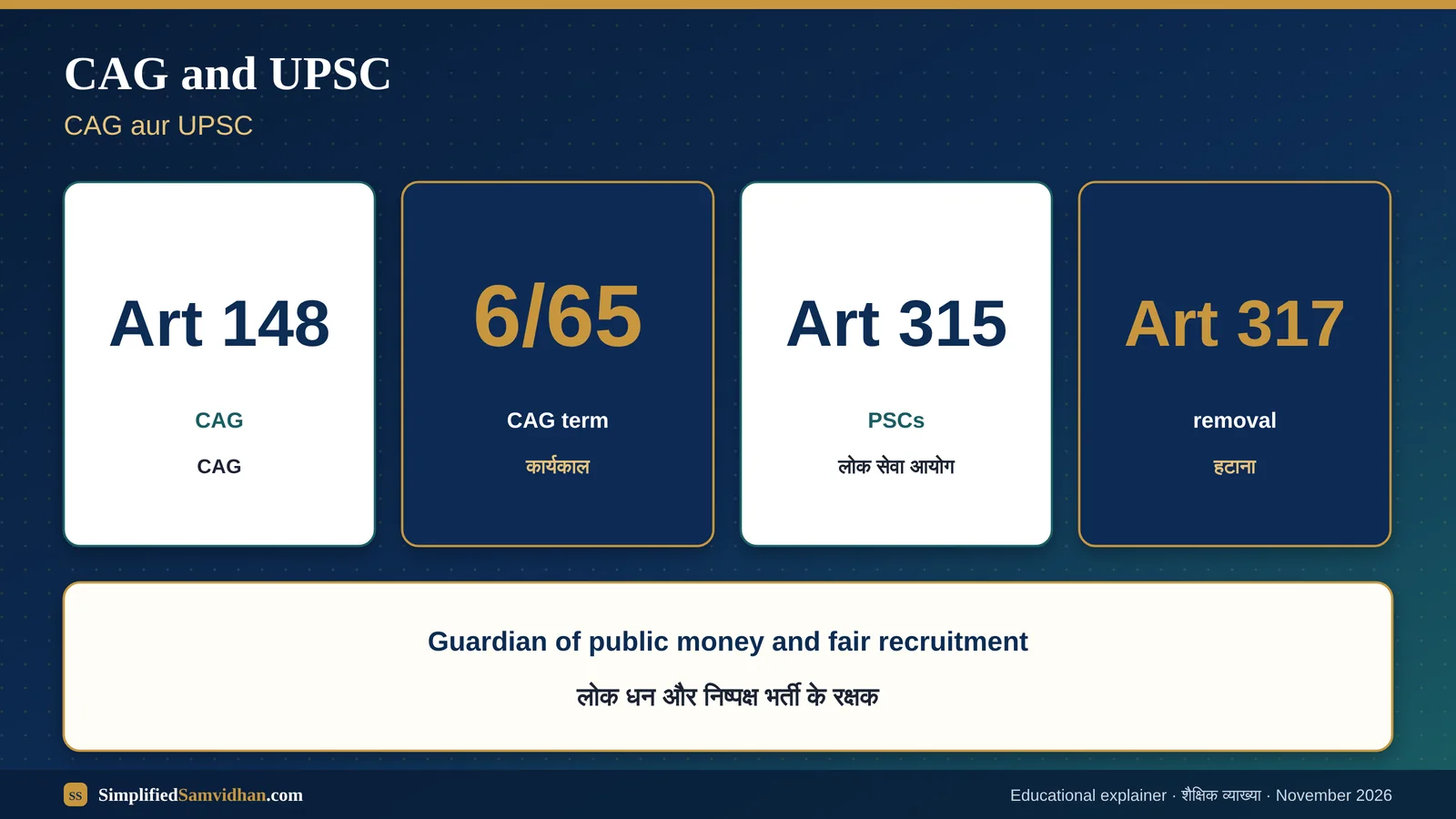
Two constitutional bodies that keep money and recruitment clean: articles, term, removal, audit types, PAC and Public Service Commissions, with practice MCQs.
Short answerCAG and UPSC in Simple Words
Short answer: the CAG (Arts 148-151) is the guardian of public money: he audits the accounts of the Union, the states and government companies. He is appointed by the President, holds office for 6 years or till 65, and can be removed only like a Supreme Court judge. His reports go to the President (Union) and the Governor (state) and are examined by the Public Accounts Committee. Present CAG: K. Sanjay Murthy (since November 2024). The UPSC (Arts 315-323) recruits for all-India and central services; its chairman and members serve 6 years or till 65 (State PSC: 62). UPSC chairman: Ajay Kumar (since May 2025). Rajasthan's commission is the RPSC, Ajmer.
🏠 Everyday analogy
Parliament sanctions the money, the government spends it, and the CAG is the auditor who checks later whether it was spent lawfully and wisely.
🇮🇳 Real Indian example
The CAG's state audit reports on Rajasthan are laid in the Rajasthan Vidhan Sabha after the Governor receives them (Art 151(2)).
Prelims: Arts 148-151, term, removal, salary charged; Arts 315-323: term 65/62, removal under 317, bar under 319; present CAG and UPSC chairman
Mains: CAG as 'friend, philosopher and guide' of the PAC; independence of PSCs and exam integrity
Constitution textWhat the Constitution Says
Article 148(1). There shall be a Comptroller and Auditor-General of India who shall be appointed by the President by warrant under his hand and seal and shall only be removed from office in like manner and on the like grounds as a Judge of the Supreme Court.
Article 315(1). Subject to the provisions of this article, there shall be a Public Service Commission for the Union and a Public Service Commission for each State.
CAG ArticlesCAG: Articles 148-151
| Article | CAG: what it says |
|---|---|
| 148 | Appointment by the President; removal like an SC judge; not eligible for any further office under the Union or a state; salary charged on the Consolidated Fund |
| 149 | Duties and powers as laid down by Parliament (CAG's (DPC) Act, 1971) |
| 150 | Form of accounts of the Union and states as the President prescribes on the CAG's advice |
| 151 | Audit reports: Union to the President (laid before Parliament), state to the Governor (laid before the legislature) |
Audit and PACTypes of Audit and the PAC
- 1Compliance audit
Were rules and sanctions followed?
- 2Financial audit
Are the accounts correct?
- 3Performance audit
Was the money used with economy, efficiency and effectiveness?
- 4PAC examines
Public Accounts Committee (chaired by an Opposition MP by convention) studies the reports; the CAG is its 'friend, philosopher and guide'.
UPSC ArticlesUPSC and State PSCs: Articles 315-323
| Article | UPSC / State PSC |
|---|---|
| 315 | UPSC for the Union, a PSC for each state; Joint PSC for two or more states by Parliament's law on their request |
| 316 | Appointment: UPSC by the President, State PSC by the Governor; term 6 years or 65 (UPSC) / 62 (State) |
| 317 | Removal by the President only, after a Supreme Court inquiry for misbehaviour (or insolvency, paid outside work, infirmity) |
| 318-319 | Conditions of service; bar on further government jobs (a member may become chairman of UPSC/State PSC) |
| 320 | Functions: conduct exams, advise on recruitment, promotion, transfer and discipline |
| 321-323 | Extra functions by law; expenses charged; annual report (UPSC to President, State PSC to Governor) |
Current affairsCurrent Affairs of the Last One Year
- CAG: K. Sanjay Murthy, a 1989-batch IAS officer, became the 15th CAG in November 2024 after Girish Chandra Murmu.
- UPSC: former Defence Secretary Ajay Kumar became chairman in May 2025, after Preeti Sudan.
- Exam integrity: the Public Examinations (Prevention of Unfair Means) Act 2024 covers UPSC and other central exams; Rajasthan has its own 2022 law. See Rajasthan Public Examination Act 2022 and RPSC.
- Related: Parliament (PAC) · NHRC, NCW, NCPCR · RAS polity syllabus
Mains answerRAS Mains: How to Write the Answer
- Q. Discuss the constitutional safeguards for the independence of the CAG. (5 marks) Frame: appointment by warrant (148) → removal like an SC judge → fixed term 6 years/65 → salary charged, cannot be reduced → no further office → audit reports go to legislature (151) → conclusion: independence makes him the guardian of public purse.
Quick revisionOne-Line Revision Points (Exam Ready)
- CAG: Arts 148-151; 6 years or 65.
- Removed like an SC judge; no further office.
- CAG (DPC) Act 1971.
- UPSC: Arts 315-323; 65 / State PSC 62.
- Removal of PSC members: President only (Art 317).
- CAG K. Sanjay Murthy; UPSC Ajay Kumar.
Practice MCQPractice MCQs (with Answers): CAG and UPSC
The CAG is appointed under Article:
The CAG can be removed:
State audit reports of the CAG are submitted to:
Present CAG of India (2026):
Members of a State Public Service Commission retire at:
Who can remove a member of a State PSC?
A Joint State Public Service Commission is created by:
Which committee examines CAG reports in Parliament?
UPSC chairman since May 2025:
RPSC is located at:
Doubts ClearedFrequently Asked Questions
Is the CAG an officer of Parliament?
He is independent of the executive and reports to Parliament through the President; he is often called the 'guardian of the public purse'.
Are UPSC recommendations binding?
No, its advice is advisory; if the government does not accept it, reasons are given in the report laid before Parliament.
Sources and further readingSources We Checked
Checked on 13 November 2026 against the Constitution (Articles 148-151, 315-323) and the CAG and UPSC websites.