Public Administration: Meaning, Scope, NPA, NPM and Good Governance (RAS)
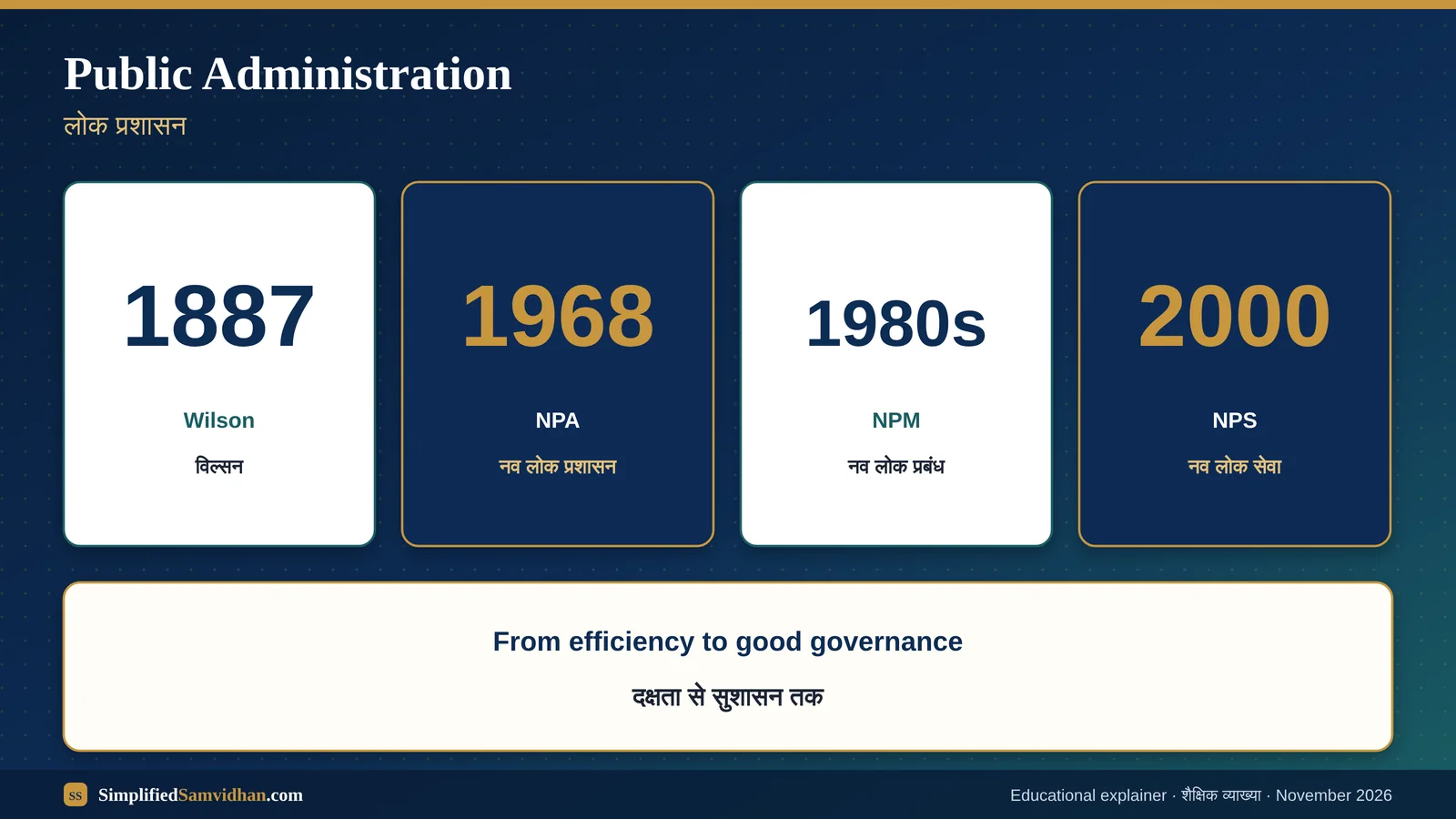
What Public Administration is, how the subject grew from Wilson to good governance, and NPA vs NPM vs NPS in one table, with practice MCQs.
Short answerPublic Administration in Simple Words
Short answer: Public Administration is the work of government in action: turning laws and policies into services such as ration, pension, roads and police help. Woodrow Wilson started it as a separate subject with his essay 'The Study of Administration' (1887), and so he is called the father of Public Administration. The subject then moved through four big ideas: classical efficiency (do it fast and cheap), New Public Administration (1968: do it fairly, with values and social equity), New Public Management (1980s-90s: run it like a business, citizen as customer) and New Public Service / Good Governance (1990s onwards: citizen as owner, transparency, participation, accountability).
🏠 Everyday analogy
If the Constitution is the recipe, Public Administration is the kitchen that actually cooks and serves the food to people.
🇮🇳 Real Indian example
When a Rajasthan farmer gets a Kisan Samman payment in the bank through Jan Aadhaar without visiting any office, that is good governance in action: speed, transparency and no middleman.
Prelims: not in Prelims polity list; Mains Paper II (Administration)
Mains: meaning, nature, scope, public vs private administration; NPA, NPM, NPS, good governance: short notes and comparison
Meaning and scopeMeaning, Scope and Public vs Private Administration
| View | What it says | Thinker |
|---|---|---|
| Narrow (managerial) | Only the executive branch's work | Luther Gulick, Simon |
| Broad (integral) | All activities of all three organs for a public purpose | L.D. White, Pfiffner |
| POSDCORB view | Planning, Organising, Staffing, Directing, Co-ordinating, Reporting, Budgeting | Luther Gulick (1937) |
| Subject-matter view | Scope = the services government gives (health, police, education) | Critics of POSDCORB |
Public administration
- Aim: public welfare, not profit
- Bound by law, rules and Article 14 equality
- Answerable to legislature, courts, CAG, RTI
- Often a monopoly (police, passport)
Private administration
- Aim: profit
- Can choose customers and prices
- Answerable to owners and shareholders
- Faces market competition
EvolutionFive Stages in the Growth of the Subject
- 11887-1926: Politics-administration dichotomy
Wilson (1887), Goodnow (1900): politics decides, administration executes. L.D. White wrote the first textbook (1926).
- 21927-1937: Principles of administration
Universal principles: Fayol, Gulick and Urwick (POSDCORB, 1937), Mooney and Reiley.
- 31938-1947: Challenge
Herbert Simon called the principles 'proverbs' (1946) and wrote Administrative Behavior (1947); Dahl questioned a 'science' of administration.
- 41948-1970: Identity crisis
Comparative and development administration (Riggs), Minnowbrook I (1968) gave New Public Administration.
- 51970s-today: Public policy, NPM, governance
NPM (1980s-90s), New Public Service (2000), good governance, e-governance and digital public infrastructure.
NPA vs NPM vs NPSNPA, NPM and New Public Service in One Table
| Point | New Public Administration (NPA) | New Public Management (NPM) | New Public Service (NPS) |
|---|---|---|---|
| Origin | Minnowbrook Conference I, 1968 (Dwight Waldo) | 1980s UK (Thatcher), USA; Christopher Hood (1991); Osborne and Gaebler 'Reinventing Government' (1992) | Denhardt and Denhardt (2000) |
| Key value | Social equity, relevance, values, change | Efficiency, results, competition, 3 Es (economy, efficiency, effectiveness) | Democratic citizenship, public interest |
| Citizen is | Client who needs justice | Customer | Citizen-owner |
| Government should | Be proactive for the weak | 'Steer, not row'; outsource, privatise, PPP | 'Serve, not steer' |
| Indian example | Reservation, welfare for SC/ST, MGNREGA's rights approach | PPP highways, performance budgets, outcome budgets | Social audit, Gram Sabha, Citizen Charter |
Good governanceGood Governance: Meaning, Features and Indian Tools
- Meaning: The World Bank report 'Governance and Development' (1992) made the term popular. Governance means how power is used to manage a country's economic and social resources; good governance is when this is done well.
- 8 features (UNESCAP): participation, rule of law, transparency, responsiveness, consensus orientation, equity and inclusiveness, effectiveness and efficiency, accountability.
- India: Good Governance Day on 25 December (Atal Bihari Vajpayee's birthday, since 2014); Good Governance Index by DARPG; Second ARC (2005-09, Veerappa Moily) wrote reports on ethics, citizen-centric administration and e-governance.
- Tools: RTI Act 2005, Citizen Charter and social audit, Lokpal and CVC, Rajasthan Public Service Guarantee Act 2011 and Right to Hearing Act 2012.
Current affairsCurrent Affairs of the Last One Year
- Mission Karmayogi and iGOT: the online training platform for civil servants keeps growing; capacity building is the newest face of good governance (see Civil services).
- Good Governance Week (Prashasan Gaon Ki Ore): a yearly December campaign of DARPG to settle public grievances at district level.
- Related: Approaches and principles of organisation · Comparative Public Administration · RAS polity syllabus
Mains answerRAS Mains: How to Write the Answer
- Q. Distinguish between New Public Management and New Public Service. (10 marks) Frame: one-line meaning of each → table on citizen (customer vs owner), role of state (steer vs serve), values (efficiency vs democracy) → Indian examples (PPP, outcome budget vs social audit, Gram Sabha) → conclusion: India uses a mix; efficiency with equity.
- Q. Write a short note on Minnowbrook Conference. (2 marks) 1968, Syracuse University, organised by Dwight Waldo; gave NPA with the 4 Es: relevance, values, equity, change. Minnowbrook II (1988), III (2008).
Quick revisionOne-Line Revision Points (Exam Ready)
- Father of Public Administration: Woodrow Wilson (1887).
- POSDCORB: Luther Gulick, 1937.
- NPA: Minnowbrook I, 1968, Dwight Waldo.
- NPM: citizen as customer; 'steer, not row'.
- NPS: 'serve, not steer' (Denhardts, 2000).
- Good Governance Day: 25 December.
Practice MCQPractice MCQs (with Answers): Public Administration
Who is called the father of Public Administration?
POSDCORB was given by:
In POSDCORB, 'CO' stands for:
The first Minnowbrook Conference (1968) is linked with:
'Reinventing Government' (1992) was written by:
Which approach treats the citizen as a 'customer'?
'Serve, rather than steer' is the slogan of:
Good Governance Day in India is observed on:
Who called the principles of administration 'proverbs'?
The term 'good governance' became popular with a 1992 report of:
Doubts ClearedFrequently Asked Questions
Is Public Administration an art or a science?
Both: it has tested principles (science) but applying them needs judgment and skill (art). Write both sides in Mains.
Is good governance the same as e-governance?
No. E-governance is one tool (technology) for good governance; good governance also needs rule of law, ethics and participation.
Sources and further readingSources We Checked
Checked on 14 November 2026 against standard Public Administration texts, Second ARC reports (DARPG) and the RPSC RAS Mains syllabus.