Indian Foreign Policy and Global Groupings (RAS Notes)
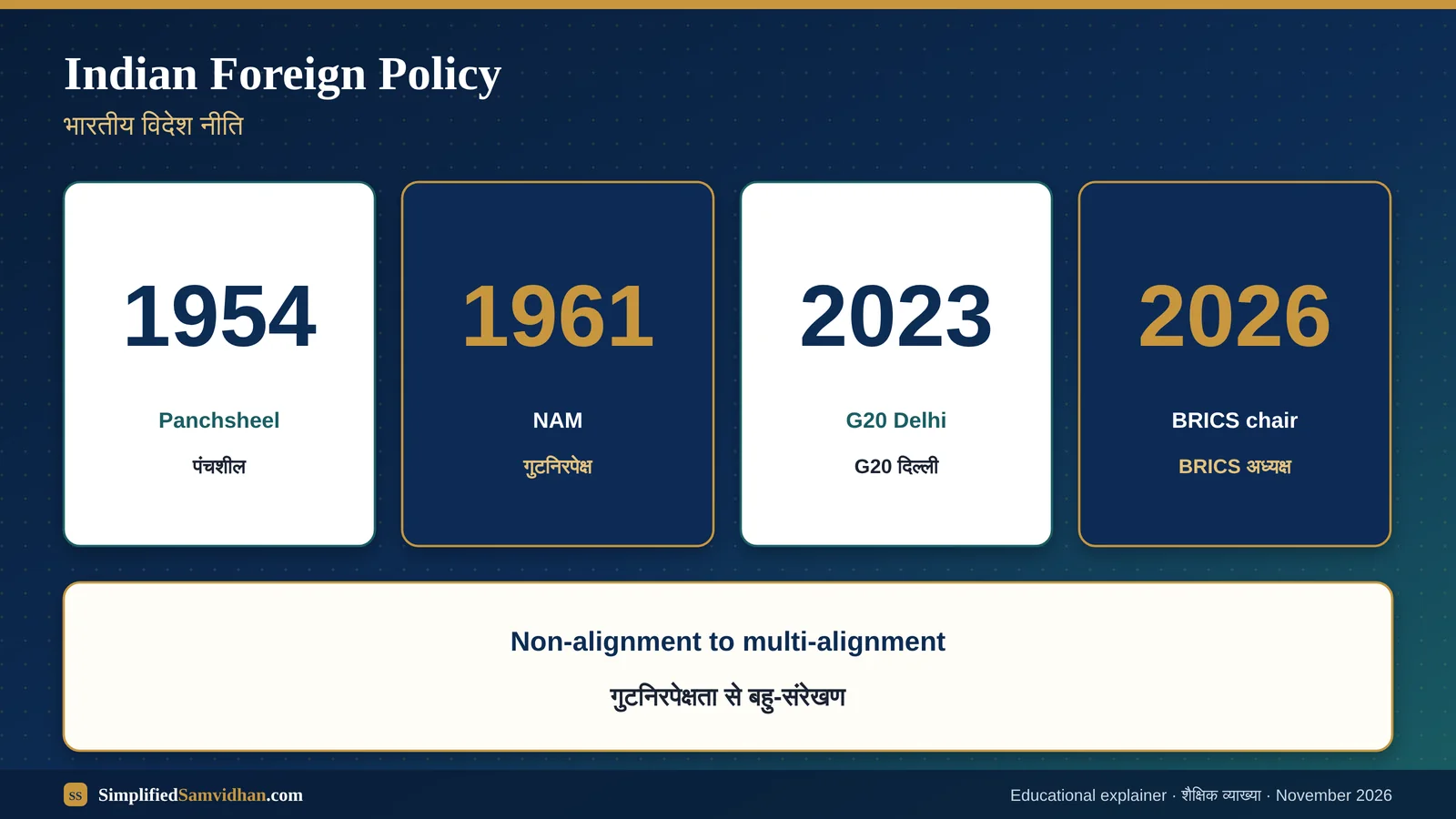
What shapes India's foreign policy, its principles from Panchsheel to multi-alignment, and India's place in BRICS, G20, SCO and the Quad, with practice MCQs.
Short answerIndian Foreign Policy in Simple Words
Short answer: India's foreign policy aims at security, development and a fair world order. Its constitutional base is Article 51 (promote international peace, respect international law) and Article 253 (Parliament can make laws to implement treaties). Its old pillars are Panchsheel (1954) and non-alignment (NAM, 1961); today they have become strategic autonomy and multi-alignment: India works with the USA in the Quad, with Russia and China in BRICS and SCO, and leads the Global South in the G20. Big doctrines: Neighbourhood First, Act East and MAHASAGAR for the Indian Ocean. In 2026 India chairs BRICS and hosted its 18th summit in New Delhi (12-13 September 2026).
🏠 Everyday analogy
India is like a smart student who sits with every group in class: studies maths with one, plays cricket with another, but never lets any group decide what it will do.
🇮🇳 Real Indian example
Rajasthan's 1,070 km border with Pakistan, the Pokhran tests (1974, 1998) and Indira Gandhi Canal water from Punjab rivers under the Indus system show how foreign policy touches the state directly.
Prelims: groupings: members, year, India's role; Panchsheel and NAM dates
Mains: determinants and features of foreign policy, non-alignment to multi-alignment, India in BRICS / G20 / Quad
Determinants and doctrinesDeterminants, Principles and Doctrines
Internal determinants
- Geography: Himalayas, Indian Ocean, long land borders
- History: anti-colonial struggle, Gandhian values
- Economy: energy, trade, technology needs
- Domestic politics, leadership, diaspora
External determinants
- Cold War, then a multipolar world
- China's rise and Pakistan's hostility
- US-Russia relations
- Global issues: climate, terrorism, pandemics, AI
- 1Panchsheel (29 April 1954)
India-China agreement: mutual respect for sovereignty, non-aggression, non-interference, equality and mutual benefit, peaceful coexistence.
- 2Non-alignment (NAM, Belgrade 1961)
Nehru, Tito, Nasser, Sukarno, Nkrumah: not joining either Cold War bloc; not neutrality but independent judgment.
- 3Look East (1991) → Act East (2014)
ASEAN and East Asia; North-East India as the gateway.
- 4Gujral Doctrine (1996-97)
Give more to smaller neighbours without asking for equal return.
- 5Neighbourhood First (2014) and MAHASAGAR (2025)
SAGAR (2015) became MAHASAGAR in March 2025 (Mauritius visit): security and growth across regions in the Indian Ocean and Global South.
- 6Strategic autonomy / multi-alignment
Partnerships with all major powers on issue-based lines, without military alliances.
Global groupingsIndia in Global Groupings: BRICS, G20, SCO, Quad, I2U2
| Grouping | Started | Members / key fact | India's role |
|---|---|---|---|
| BRICS | 2009 summit (South Africa 2010-11) | Expanded 2024: Egypt, Ethiopia, Iran, UAE; Indonesia 2025; New Development Bank (Shanghai) | Chair in 2026 (4th time); 18th summit New Delhi, 12-13 Sep 2026 |
| G20 | 1999 (leaders' summits since 2008) | 19 countries + EU + African Union (permanent member since New Delhi 2023) | 2023 presidency: 'One Earth, One Family, One Future'; 2026 presidency is the USA |
| SCO | 2001 | China, Russia, Central Asian states, India, Pakistan, Iran, Belarus; RATS for terrorism | Full member since 2017; 2026 summit at Bishkek (Kyrgyzstan) |
| Quad | 2007; 2017 | India, USA, Japan, Australia; free and open Indo-Pacific | Not a military alliance for India; Quad page |
| I2U2 | 2021 (first summit July 2022) | India, Israel, UAE, USA: food, water, energy projects | Member |
| AUKUS | 2021 | Australia, UK, USA: nuclear submarines for Australia | India is NOT a member |
| SAARC / BIMSTEC | 1985 / 1997 | SAARC stalled since 2016; BIMSTEC links South and South-East Asia (Bay of Bengal) | India shifted focus to BIMSTEC |
Current affairsCurrent Affairs of the Last One Year
- BRICS 2026: India took over the chair on 1 January 2026 with the theme 'Building for Resilience, Innovation, Cooperation and Sustainability' and hosted the 18th summit at Bharat Mandapam, New Delhi (12-13 September 2026), as BRICS completed 20 years.
- SCO 2026: the annual summit was held at Bishkek, Kyrgyzstan.
- Already on this site: India-USA relations · India-Pakistan relations · UNSC reform and India · India and the International Solar Alliance · International Relations hub
- Related: Comparative administration (USA, UK, France, China) · RAS polity syllabus
Mains answerRAS Mains: How to Write the Answer
- Q. 'India has moved from non-alignment to multi-alignment.' Explain. (10 marks) Frame: NAM meaning and context (1961) → change after 1991 (end of Cold War, economy) → multi-alignment examples (Quad + BRICS + SCO + G20 Global South, Russian oil, US tech) → benefits (autonomy, bargaining) → risks (trust deficit, balancing USA-China) → conclusion: same goal (autonomy), new method.
- Q. Write the five principles of Panchsheel. (2 marks) Use the five points above with the date 29 April 1954.
Quick revisionOne-Line Revision Points (Exam Ready)
- Panchsheel: 29 April 1954 (India-China).
- First NAM summit: Belgrade, 1961.
- Look East 1991 → Act East 2014.
- SAGAR 2015 → MAHASAGAR 2025.
- African Union joined G20 at New Delhi 2023.
- India is not in AUKUS.
Practice MCQPractice MCQs (with Answers): Indian foreign policy
Panchsheel was signed between India and:
The first NAM summit was held at:
Which Article of the Constitution asks the State to promote international peace?
'Look East Policy' was started in:
India's 2026 BRICS summit (18th) was held in:
Which body became a permanent member of the G20 at the New Delhi summit (2023)?
India is NOT a member of:
I2U2 includes India, Israel, UAE and:
India became a full member of the SCO in:
MAHASAGAR, the upgrade of SAGAR, was announced in 2025 during a visit to:
Doubts ClearedFrequently Asked Questions
Is non-alignment dead?
The Cold War blocs ended, but the core idea, strategic autonomy, continues; India now calls it multi-alignment.
Who makes foreign policy in India?
The Union executive (PM, Cabinet, MEA, NSA) under Article 73; Parliament controls through debates, committees and laws under Article 253; foreign affairs is in the Union List.
Sources and further readingSources We Checked
Checked on 14 November 2026 against the Ministry of External Affairs, the BRICS India 2026 portal, PIB and the Constitution (Articles 51, 73, 253).