Panchayati Raj in Rajasthan and the 73rd/74th Amendments: RAS Notes
How it began at Nagaur, what the 73rd and 74th Amendments say, the three tiers in Rajasthan, the committees and the 2026 elections, with practice MCQs.
Short answerPanchayati Raj in Rajasthan in Simple Words
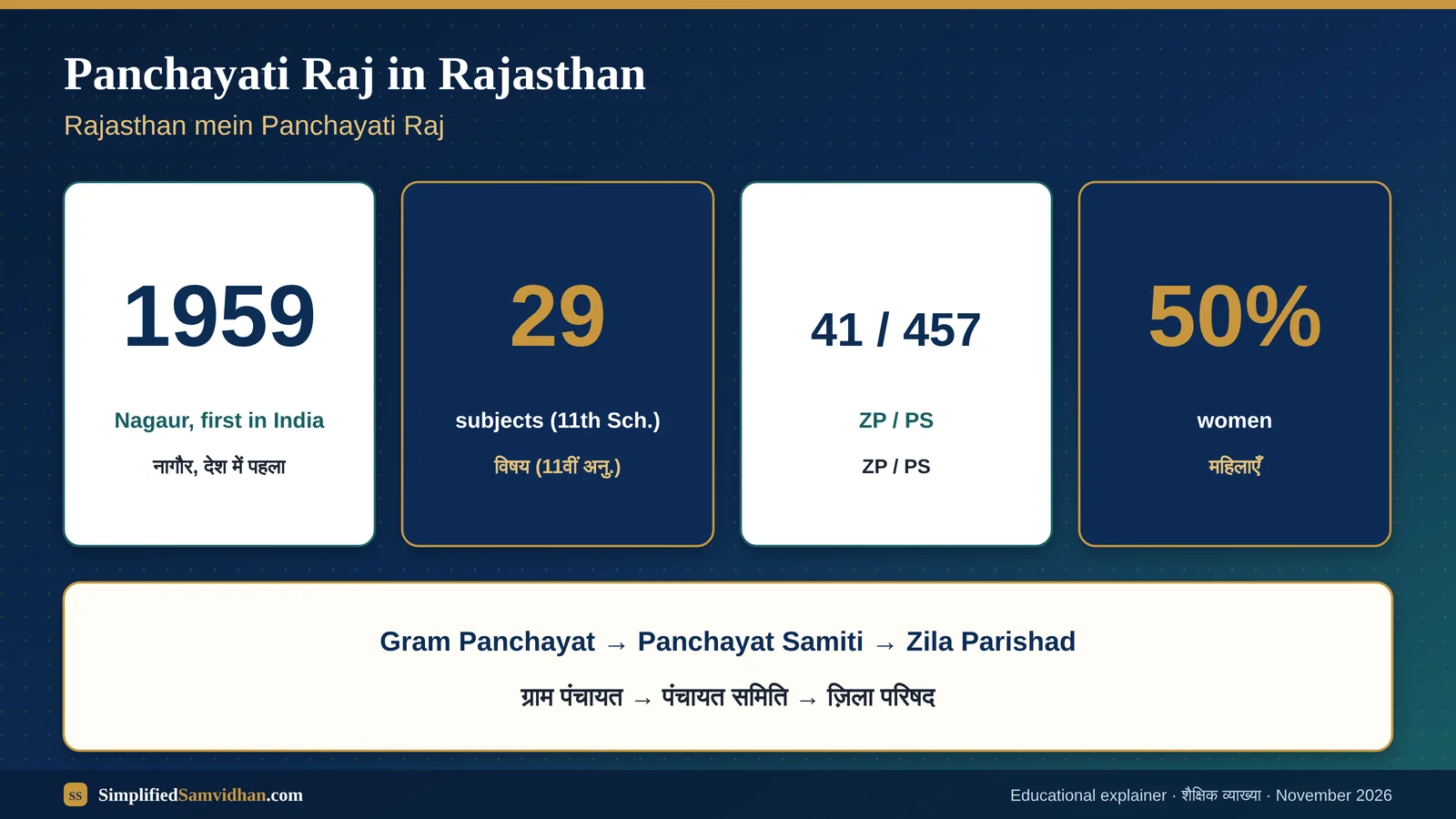
Short answer: Panchayati Raj means villages governing themselves. India's first Panchayati Raj was started in Rajasthan, at Nagaur, by Jawaharlal Nehru on 2 October 1959, on the advice of the Balwant Rai Mehta Committee (1957). The 73rd Amendment (1992) made panchayats constitutional: Part IX, Articles 243-243O, 11th Schedule with 29 subjects, three tiers, 5-year term, SC/ST and one-third women reservation, State Election Commission and State Finance Commission. The 74th Amendment did the same for towns: Part IXA, 243P-243ZG, 12th Schedule with 18 subjects. Rajasthan's law is the Rajasthan Panchayati Raj Act 1994, and it reserves 50% seats for women. In 2026 Rajasthan has 41 Zila Parishads, 457 Panchayat Samitis and 14,403 Gram Panchayats.
🏠 Everyday analogy
Like a house with three floors: Gram Panchayat on the ground floor (village), Panchayat Samiti on the first (block), Zila Parishad on the top (district); the Gram Sabha is the foundation.
🇮🇳 Real Indian example
In 2026 voters chose the sarpanch directly by ballot paper, while the Pradhan and Zila Pramukh are chosen indirectly by elected members.
Prelims: Nagaur 1959, committees (Mehta, Sadiq Ali, G.L. Vyas, Ashok Mehta, L.M. Singhvi); Articles 243-243O and 243P-243ZG, Schedules 11 and 12; numbers of PRIs in Rajasthan, 50% women, two-child rule
Mains: PRIs as instruments of rural development and democratic decentralisation; 3Fs: funds, functions, functionaries; PESA in scheduled areas
Constitution textWhat the Constitution Says
Article 243B(1). There shall be constituted in every State, Panchayats at the village, intermediate and district levels in accordance with the provisions of this Part.
Article 243E(1). Every Panchayat, unless sooner dissolved under any law for the time being in force, shall continue for five years from the date appointed for its first meeting and no longer.
73rd vs 74th73rd vs 74th Amendment
73rd Amendment (rural)
- Part IX, Arts 243-243O
- 11th Schedule: 29 subjects
- In force 24 April 1993 (Panchayati Raj Diwas)
- Rajasthan PR Act 1994
74th Amendment (urban)
- Part IXA, Arts 243P-243ZG
- 12th Schedule: 18 subjects
- In force 1 June 1993
- Rajasthan Municipalities Act 2009
Three tiersThree Tiers in Rajasthan: Who Heads What
| Tier | Head (how chosen) | Officer |
|---|---|---|
| Gram Panchayat (village) | Sarpanch: directly elected | Gram Vikas Adhikari (VDO) |
| Panchayat Samiti (block) | Pradhan: elected by PS members | Block Development Officer (Vikas Adhikari) |
| Zila Parishad (district) | Zila Pramukh: elected by ZP members | Chief Executive Officer (CEO) |
| Gram Sabha | All voters of the panchayat area (Art 243A) | Social audit, approval of plans |
HistoryFrom Nagaur 1959 to 2026
- 11957
Balwant Rai Mehta Committee recommends three-tier democratic decentralisation.
- 22 October 1959
Nehru inaugurates Panchayati Raj at Nagaur (Rajasthan first; Andhra Pradesh next, 11 October 1959).
- 31964 and 1973
Rajasthan's own review committees: Sadiq Ali (1964) and Girdhari Lal Vyas (1973).
- 41978-1986
Ashok Mehta (two-tier), G.V.K. Rao, L.M. Singhvi (constitutional status) committees.
- 51992-1994
73rd/74th Amendments; Rajasthan Panchayati Raj Act 1994.
- 62026
Two-child bar removed; all three tiers polled together in 41 districts.
Current affairsCurrent Affairs of the Last One Year
- Panchayat elections 2026: 41 ZP, 457 PS, 14,403 GP; over 4.03 crore voters; four phases from late October to 17 November; ZP/PS counting on 20 November. Details: Rajasthan Panchayat Election 2026.
- Reorganisation: Zila Parishads rose from 33 to 41 and Panchayat Samitis from 352 to 457 after the redrawing of districts and blocks.
- Two-child bar removed (2026): Rajasthan Panchayati Raj (Amendment) Act 2026. Background: Two-child norm in panchayat polls.
- Practical guides on this site: Gram Sabha powers · Sarpanch powers and duties · Panchayat Samiti and Zila Parishad · Nagar Nigam, Parishad, Palika
- Related: State Election Commission · RAS polity syllabus
Mains answerRAS Mains: How to Write the Answer
- Q. Rajasthan was the first state to adopt Panchayati Raj. Evaluate its working after the 73rd Amendment. (10 marks) Frame: Nagaur 1959 → 73rd Amendment features → Rajasthan Act 1994 + 50% women, SFC, Gram Sabha social audits (MGNREGA, Bhilwara 2009) → problems: 3Fs not fully devolved, sarpanch-pati, delayed polls, low own revenue → 2026 steps (simultaneous polls, two-child bar removed) → reforms (2nd ARC, e-Gram Swaraj) → conclusion.
Quick revisionOne-Line Revision Points (Exam Ready)
- Nagaur, 2 October 1959, Nehru: first in India.
- 73rd: Part IX, 243-243O, 11th Schedule, 29 subjects.
- 74th: Part IXA, 243P-243ZG, 12th Schedule, 18 subjects.
- Rajasthan Panchayati Raj Act 1994; Municipalities Act 2009.
- Rajasthan committees: Sadiq Ali 1964, G.L. Vyas 1973.
- 2026: 41 ZP, 457 PS, 14,403 GP; 50% women.
Practice MCQPractice MCQs (with Answers): Panchayati Raj
Panchayati Raj was first inaugurated in India at:
The 11th Schedule contains how many subjects?
Which committee on Panchayati Raj was set up by the Rajasthan government in 1964?
Part IX of the Constitution deals with:
Who is the head of a Panchayat Samiti in Rajasthan?
What share of seats are reserved for women in Rajasthan's panchayats?
The State Finance Commission for panchayats is provided under Article:
In the 2026 Rajasthan panchayat elections, how many Panchayat Samitis went to the polls?
The 73rd Amendment came into force on:
Choose the CORRECT statement about Rajasthan in 2026:
Doubts ClearedFrequently Asked Questions
Where did Panchayati Raj start in India?
At Nagaur in Rajasthan, inaugurated by Jawaharlal Nehru on 2 October 1959.
How many Gram Panchayats are there in Rajasthan?
14,403 Gram Panchayats went to the polls in the 2026 elections, along with 457 Panchayat Samitis and 41 Zila Parishads.
Sources and further readingSources We Checked
Checked on 10 November 2026 against the Constitution (Parts IX and IXA), the Panchayati Raj Department and State Election Commission of Rajasthan, and news reports of the 2026 elections.