BNSS 2023: Sections in the RAS Syllabus
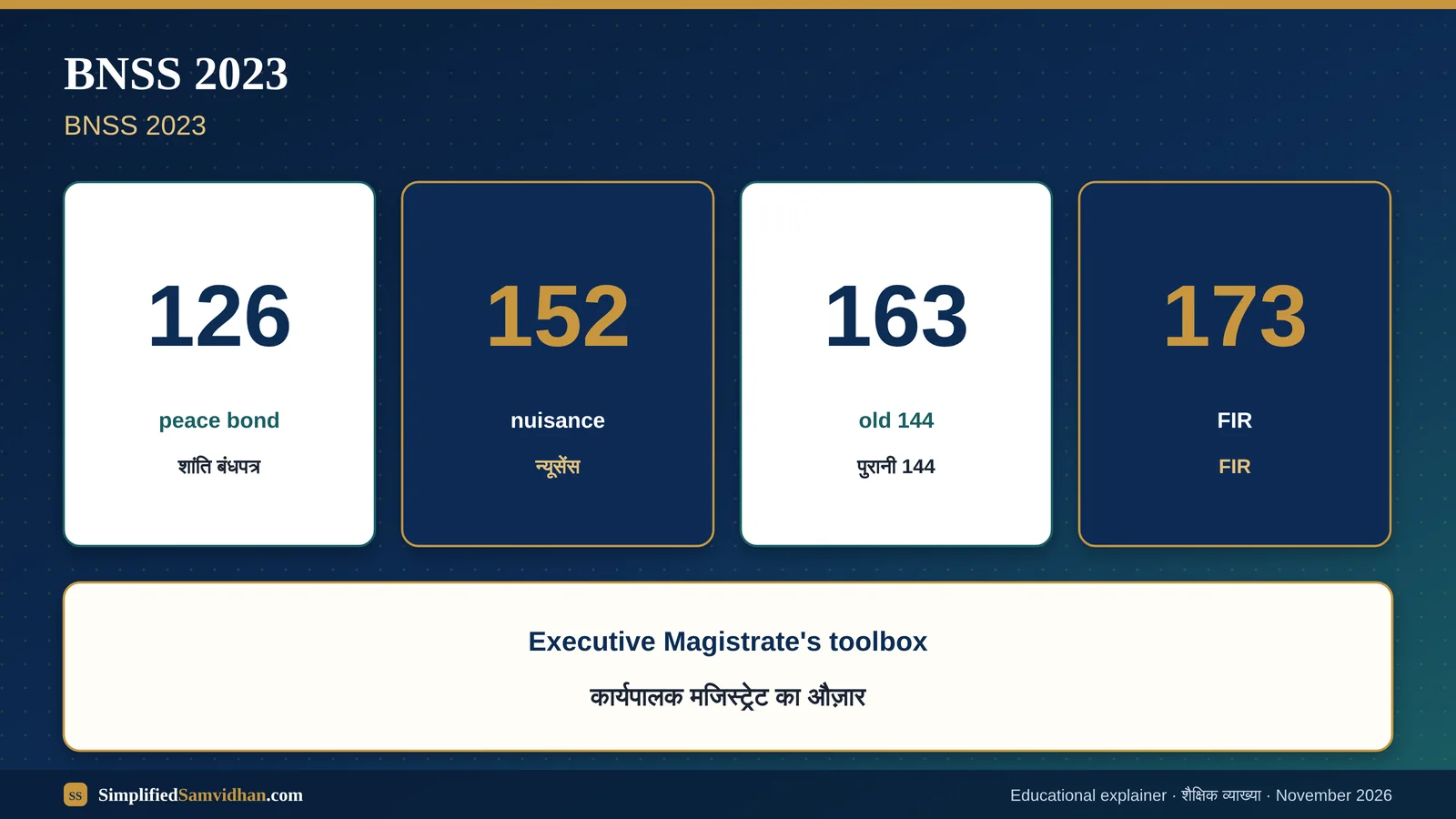
The BNSS sections RAS asks, especially an Executive Magistrate's preventive powers, with old CrPC numbers and police steps, plus practice MCQs.
Short answerBNSS Syllabus Sections in Simple Words
Short answer: the Bharatiya Nagarik Suraksha Sanhita, 2023 (BNSS) replaced the CrPC, 1973 from 1 July 2024; it has 531 sections. It is the 'procedure book' of criminal law. RAS asks the sections an Executive Magistrate (SDM, Tehsildar, DM) uses: who Executive Magistrates are (14-17), arrest by a Magistrate and how arrest is made (41-43), bonds to keep the peace (126-129), dispersing assemblies (148-149), removing nuisances (152), urgent orders under Section 163 (old 144) and property disputes (164-167), plus police steps: FIR (173), non-cognizable cases (174), custody when investigation is not over in 24 hours (187) and death inquiries (194-196).
🏠 Everyday analogy
If BNS is the list of crimes, BNSS is the rulebook of the game: who acts, how fast and with what limits.
🇮🇳 Real Indian example
Before a tense festival in a Rajasthan town, the SDM may issue a Section 163 order banning gatherings and take peace bonds under Section 126 from known trouble-makers.
Prelims: not in the Prelims list; Mains law paper (Paper III)
Mains: define bail, bail bond, cognizable, complaint, warrant case; powers of Executive Magistrates (126-129, 148-152, 163); Zero FIR, e-FIR, preliminary enquiry (173)
DefinitionsSection 2: Syllabus Definitions
| Section 2 term | Meaning in short |
|---|---|
| Audio-video electronic means | Video conferencing and similar means for evidence, identification, search and seizure, trial |
| Bail / bail bond / bond | Bail = release from custody on conditions; bail bond = undertaking with surety; bond = personal undertaking without surety |
| Bailable / non-bailable offence | Bailable = shown bailable in the First Schedule or made so by law; any other is non-bailable |
| Charge | Any head of charge when the charge has more than one head |
| Cognizable / non-cognizable | Cognizable: police may arrest without warrant; non-cognizable: police need a warrant |
| Complaint | Allegation, oral or written, to a Magistrate for action; not a police report |
| Electronic communication | Written, spoken, pictorial or video information sent through an electronic device |
| Inquiry / investigation | Inquiry = any inquiry other than a trial by a Magistrate or Court; investigation = evidence collection by police (or person authorised by a Magistrate) |
| Summons case / warrant case | Warrant case = offence punishable with death, life or more than 2 years; summons case = any other |
| Sub-division | A sub-division of a district (headed by an SDM) |
Magistrate powersExecutive Magistrate's Powers with Old CrPC Numbers
| Section | Old CrPC | What it says |
|---|---|---|
| 3(2) | - | How older references to a second-class or Metropolitan Magistrate are read now (as a Judicial Magistrate of the first class; Chief Metropolitan as Chief Judicial Magistrate) |
| 14-17 | 20-23 | State appoints Executive Magistrates; one is District Magistrate, others ADM, SDM; Special Executive Magistrates; local jurisdiction; all subordinate to the DM |
| 41-43 | 44-46 | Arrest by a Magistrate; protection of armed forces members from arrest without government consent; how arrest is made (touch/confine; handcuffs only for listed serious cases; no arrest of a woman after sunset and before sunrise except with a Judicial Magistrate's permission) |
| 126 | 107 | Security for keeping the peace: Executive Magistrate can take a bond for up to 1 year |
| 127-128 | 108-109 | Good behaviour from persons spreading matter punishable under certain BNS sections, and from suspected persons: up to 1 year |
| 129 | 110 | Good behaviour from habitual offenders: up to 3 years |
| 148 | 129 | Dispersal of an unlawful assembly by civil force (Executive Magistrate or police officer in charge) |
| 149 | 130 | Use of armed forces to disperse, on the order of the highest Executive Magistrate present |
| 152 | 133 | Conditional order to remove a public nuisance (DM, SDM or empowered Executive Magistrate) |
| 163 | 144 | Urgent order in nuisance or apprehended danger; valid 2 months; State may extend up to 6 months |
| 164-167 | 145-148 | Disputes over land or water likely to breach peace: inquiry, attachment, right of use, local inquiry |
Police stepsFIR, Custody and Death Inquiries
- 1FIR (173, old 154)
Oral or electronic information at any police station (Zero FIR); e-FIR to be signed within 3 days; for offences punishable 3-7 years, a preliminary enquiry within 14 days is allowed; free copy to the informant.
- 2Non-cognizable (174, old 155)
Entry in the station register and the informant is referred to the Magistrate; police investigate only with his order.
- 3Custody (187, old 167)
If investigation is not complete in 24 hours: police custody up to 15 days in total, which may be taken in parts within the first 40 or 60 days; overall limit 60 or 90 days depending on the offence.
- 4Death inquiries (194-196, old 174-176)
Police report on suicide or unnatural death within 24 hours; police can summon persons (not women, children under 15, persons above 60 or disabled away from home); Judicial Magistrate inquires into deaths or rape in custody.
Current affairsCurrent Affairs of the Last One Year
- Two years of new criminal laws (1 July 2026): e-FIRs, Zero FIRs and video-conferencing hearings are now routine; Rajasthan Police registers cases only under BNS/BNSS for offences after 1 July 2024.
- Already on this site: FIR and Zero FIR (BNSS 173) · Rights of an arrested person (BNSS) · Peace bond, Section 126 BNSS · Detained by police: what to do · 24-hour rule
- Related: BNS syllabus sections · District administration · RAS polity syllabus
Mains answerRAS Mains: How to Write the Answer
- Q. Explain the preventive powers of an Executive Magistrate under the BNSS, 2023. (10 marks) Frame: who is an Executive Magistrate (14-17) → security for peace and good behaviour (126-129, time limits 1/3 years) → dispersal of assemblies (148-149) → nuisance (152) → Section 163 urgent orders (2 months, 6 months) → land/water disputes (164-167) → safeguards (reasons in writing, judicial review) → conclusion.
Quick revisionOne-Line Revision Points (Exam Ready)
- BNSS in force 1 July 2024; 531 sections.
- Warrant case: punishable with more than 2 years.
- 126 (old 107): peace bond up to 1 year.
- 129 (old 110): habitual offenders, up to 3 years.
- 163 (old 144): 2 months, extendable to 6.
- 173: Zero FIR, e-FIR, 14-day preliminary enquiry.
Practice MCQPractice MCQs (with Answers): BNSS 2023
Old CrPC Section 144 is now BNSS Section:
An order under BNSS 163 normally remains in force for:
Security for good behaviour from habitual offenders can be for up to:
A 'warrant case' relates to an offence punishable with imprisonment of more than:
Conditional order for removal of a public nuisance is under BNSS:
Zero FIR and e-FIR are provided in BNSS Section:
A 'bond' under BNSS means:
Use of armed forces to disperse an assembly is ordered under BNSS:
Under BNSS 173, a preliminary enquiry is allowed for offences punishable with:
Executive Magistrates are appointed by:
Doubts ClearedFrequently Asked Questions
Who issues a Section 163 order?
The District Magistrate, a Sub-Divisional Magistrate or any Executive Magistrate empowered by the State Government.
Is an Executive Magistrate a judge?
No. Executive Magistrates (DM, SDM, Tehsildar) handle preventive and order matters; trials are done by Judicial Magistrates.
Sources and further readingSources We Checked
Checked on 13 November 2026 against the bare text of the Bharatiya Nagarik Suraksha Sanhita 2023 (India Code) and MHA comparison tables.