Supreme Court of India and Judicial Activism: RAS Notes
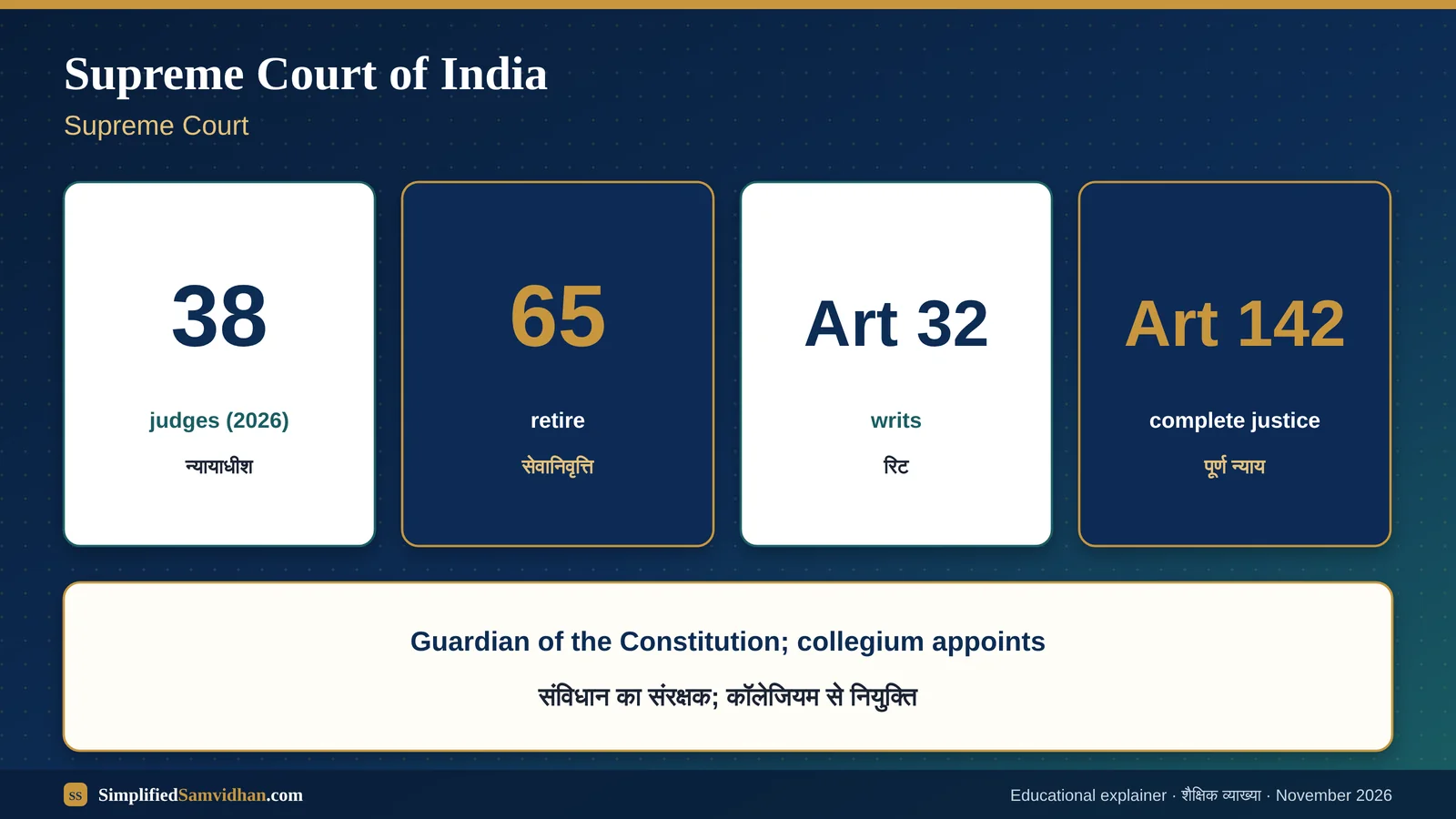
Structure, appointment and removal of judges, jurisdictions, the collegium story, activism vs overreach and the 2025-26 changes, with practice MCQs.
Short answerSupreme Court in Simple Words
Short answer: the Supreme Court (Arts 124-147) is India's highest court and the guardian of the Constitution. It was inaugurated on 28 January 1950. From 2026 it can have 38 judges including the Chief Justice (up from 34). Judges are appointed by the President on the recommendation of the collegium (CJI + 4 senior-most judges), retire at 65, and can be removed only by Parliament with a special majority for proved misbehaviour or incapacity (Art 124(4)). It has original (Art 131: Centre-State disputes), writ (Art 32), appellate (Arts 132-136, including SLP) and advisory (Art 143) jurisdiction. Its law binds all courts (Art 141) and it can do 'complete justice' (Art 142). Present CJI: Surya Kant (since 24 November 2025).
🏠 Everyday analogy
Parliament makes the rules of the game, the government plays it, and the Supreme Court is the umpire who checks that the rules themselves follow the Constitution.
🇮🇳 Real Indian example
A letter about undertrial prisoners in Bihar became a PIL (Hussainara Khatoon, 1979) and led to the right to speedy trial under Art 21.
Prelims: Articles 124-147; jurisdictions; collegium and Judges cases (1981, 1993, 1998, 2015); number of judges (38), present CJI
Mains: judicial activism vs judicial overreach; PIL: merits and misuse; pendency and judicial reforms
Constitution textWhat the Constitution Says
Article 124(1). There shall be a Supreme Court of India consisting of a Chief Justice of India and ... other Judges.
Article 141. The law declared by the Supreme Court shall be binding on all courts within the territory of India.
Article 142(1). The Supreme Court in the exercise of its jurisdiction may pass such decree or make such order as is necessary for doing complete justice in any cause or matter pending before it...
JurisdictionJurisdiction of the Supreme Court
| Jurisdiction | Article | Meaning |
|---|---|---|
| Original | 131 | Disputes between Centre and states or between states |
| Writ | 32 | Enforce Fundamental Rights (itself a Fundamental Right) |
| Appellate | 132-134 | Appeals in constitutional, civil and criminal cases |
| Special Leave Petition | 136 | Discretion to hear appeal from any court or tribunal (not military) |
| Advisory | 143 | Opinion to the President; not binding |
| Review | 137 | Can review its own judgments; curative petition (Rupa Hurra 2002) |
| Court of record | 129 | Can punish for its contempt |
CollegiumHow the Collegium Came: Four Judges Cases
- 1First Judges case (S.P. Gupta, 1981)
'Consultation' does not mean concurrence; executive had primacy.
- 2Second Judges case (1993)
Collegium born: CJI's opinion has primacy.
- 3Third Judges case (1998)
Collegium = CJI + 4 senior-most judges for SC.
- 4Fourth Judges case (2015)
99th Amendment and NJAC struck down; collegium continues.
Activism vs overreachJudicial Activism vs Judicial Overreach
Judicial activism
- Fills gaps when the executive fails (Vishaka 1997 guidelines on workplace harassment)
- PIL opens courts to the poor
- Expands Art 21 (food, shelter, environment)
Judicial overreach
- Courts doing policy work (e.g. running bodies, banning by order)
- Weakens separation of powers
- Frivolous PILs add to pendency
Current affairsCurrent Affairs of the Last One Year
- Supreme Court strength 34 → 38 (2026): after CJI Surya Kant's letter of 11 May 2026 citing 92,000+ pending cases, an ordinance (16 May 2026) and then the Supreme Court (Number of Judges) Amendment Act 2026 raised the strength; first increase since 2019.
- CJI Surya Kant (since 24 November 2025): succeeded B.R. Gavai. Kant served earlier as Chief Justice of the Himachal Pradesh High Court.
- Art 143 opinion (20 November 2025): no court-fixed timelines for Governors/President. See Powers of the President.
- SIR judgment (May 2026): the Court upheld the special intensive revision of voter lists, but said Aadhaar is not proof of citizenship and the Election Commission cannot decide citizenship. See Citizenship.
- Already on this site: 5 Writs (Art 32 and 226) · Basic Structure doctrine · Contempt of court · Separation of powers · Landmark Supreme Court judgments
- Related: Rajasthan High Court · RAS polity syllabus
Mains answerRAS Mains: How to Write the Answer
- Q. Distinguish between judicial activism and judicial overreach with examples. (10 marks) Frame: define both → roots (Art 32, 142, PIL, Maneka 1978) → activism examples (Vishaka, Hussainara, environment cases) → overreach concerns (policy by court, separation of powers) → pendency (92,000+ in SC; 2026 increase to 38 judges) → conclusion: restraint with vigilance.
Quick revisionOne-Line Revision Points (Exam Ready)
- Arts 124-147; inaugurated 28 Jan 1950.
- Strength 38 incl. CJI (2026 Act).
- Retire 65; removal 124(4) by special majority.
- Original 131, writ 32, SLP 136, advisory 143.
- Collegium: 1993 and 1998 cases; NJAC struck down 2015.
- CJI Surya Kant since 24 Nov 2025.
Practice MCQPractice MCQs (with Answers): Supreme Court
After the 2026 Act, the sanctioned strength of the Supreme Court including the CJI is:
Disputes between the Centre and a state go to the Supreme Court under:
The collegium system was created by:
Who is the Chief Justice of India (November 2026)?
Which Article lets the Supreme Court pass any order for 'complete justice'?
PIL in India was pioneered mainly by:
A Supreme Court judge retires at the age of:
Vishaka guidelines (1997) were about:
Special Leave Petition is filed under Article:
In May 2026 the Supreme Court held about Aadhaar in the SIR case that:
Doubts ClearedFrequently Asked Questions
How many judges are there in the Supreme Court?
Up to 38 including the Chief Justice of India, after the Supreme Court (Number of Judges) Amendment Act 2026.
What is the difference between judicial activism and overreach?
Activism is courts protecting rights when other organs fail; overreach is courts entering the policy domain of the legislature or executive.
Sources and further readingSources We Checked
Checked on 11 November 2026 against the Constitution (Articles 124-147), the Supreme Court website and reports on the 2026 Amendment Act and the SIR judgment.