Constitutional Morality, Transformative Constitutionalism and Article 368 (RAS)
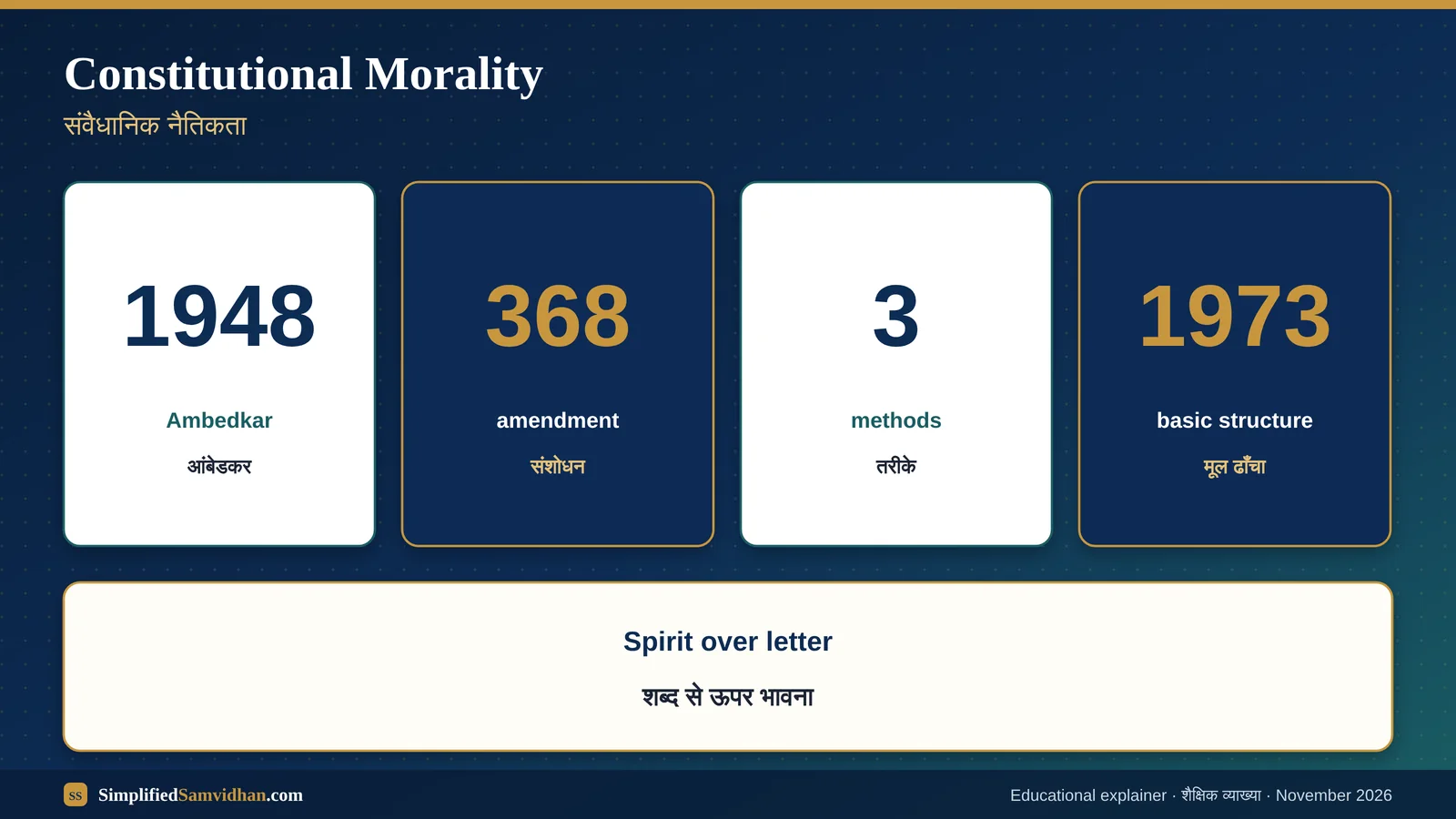
What constitutional morality means, the cases that use it, the Objectives Resolution, and the three ways to amend the Constitution, with practice MCQs.
Short answerConstitutional Morality in Simple Words
Short answer: Constitutional morality means respecting the spirit of the Constitution, not just its words: following rules and processes, respecting institutions, protecting minorities and individual dignity even when the majority disagrees. Dr. Ambedkar said in the Constituent Assembly (4 November 1948) that it 'is not a natural sentiment; it has to be cultivated'. Transformative constitutionalism means using the Constitution to change unjust social customs (Navtej Johar, Joseph Shine, Sabarimala, 2018). Article 368 gives Parliament the power to amend the Constitution by special majority (some parts also need half the states), but since Kesavananda Bharati (1973) it cannot destroy the basic structure.
🏠 Everyday analogy
Following the Constitution's words but not its spirit is like a referee who checks the rulebook but lets one team foul all match: technically legal, morally wrong.
🇮🇳 Real Indian example
A Speaker who sits on a defection petition for years without deciding follows the letter of the Tenth Schedule but breaks constitutional morality; courts have now asked Speakers to decide within a reasonable time.
Prelims: Article 368 procedure, which provisions need state ratification, amendment case laws
Mains: constitutional morality, transformative constitutionalism, philosophy (Objectives Resolution), basic structure
CasesConstitutional Morality in Supreme Court Cases
| Case | Year | What the Court said |
|---|---|---|
| Manoj Narula v Union of India | 2014 | PM and CMs should not pick ministers with serious criminal charges: a matter of constitutional morality, though not a legal bar |
| K.S. Puttaswamy | 2017 | Privacy is a fundamental right (Art 21); dignity at the centre |
| State (NCT of Delhi) v Union of India | 2018 | Constitutional morality requires high functionaries to respect each other's roles |
| Navtej Singh Johar | 2018 | Section 377 read down; constitutional morality over popular (social) morality |
| Joseph Shine | 2018 | Adultery (Section 497 IPC) struck down; wife is not husband's property |
| Indian Young Lawyers Association (Sabarimala) | 2018 | Ban on women aged 10-50 struck down (review referred to a larger bench) |
Constitutional morality
- Based on Constitution's values: liberty, equality, dignity
- Protects the individual and minority
- Courts can use it to test laws
Popular / social morality
- Based on customs and majority views
- Can hurt minorities and women
- Not a ground to limit fundamental rights
PhilosophyObjectives Resolution and Transformative Constitutionalism
- Objectives Resolution: moved by Jawaharlal Nehru on 13 December 1946 and adopted on 22 January 1947; it became the base of the Preamble: an independent sovereign republic, power from the people, justice (social, economic, political), equality, freedoms, safeguards for minorities and backward classes.
- Philosophy of the Constitution: liberal democracy + social justice (Gandhian and socialist ideas in DPSP) + secularism + federalism with a strong centre + rule of law. See Preamble, word by word and Making of the Constitution.
- Transformative constitutionalism: the Constitution is not only a rulebook but a tool to change a hierarchical society (caste, gender, untouchability under Art 17). The term comes from Karl Klare (1998, South Africa) and was used by the Indian Supreme Court in the 2018 cases.
Article 368Amendment Process under Article 368 in Simple Words
| Type | Majority needed | Examples |
|---|---|---|
| 1. Simple majority (outside Art 368) | Like an ordinary law; not counted as an amendment under Art 368 | New states (Arts 2, 3, 4), Legislative Councils (Art 169), Fifth and Sixth Schedules, quorum, salaries |
| 2. Special majority | Majority of total membership + 2/3 of members present and voting, in each House separately | Fundamental Rights, DPSP and most provisions |
| 3. Special majority + half the states | As above + ratification by half the state legislatures by simple majority | Election of President (54, 55), Union and state executive power (73, 162), Supreme Court and High Courts, Seventh Schedule, states' representation in Parliament, GST Council (279A), Art 368 itself |
- 1Who can start
A Bill only in Parliament (either House), by a minister or a private member; no prior permission of the President; state legislatures cannot start an amendment.
- 2No joint sitting
If the Houses disagree, the Bill fails; Article 108 does not apply.
- 3President must assent
The 24th Amendment (1971) made assent compulsory; no veto.
- 4Limit: basic structure
Shankari Prasad (1951) and Sajjan Singh (1965): FRs can be amended → Golaknath (1967): cannot → 24th Amendment (1971) → Kesavananda Bharati (24 April 1973, 13 judges, 7:6): can amend, but not the basic structure → Minerva Mills (1980), I.R. Coelho (2007), NJAC case (2015, 99th Amendment struck down).
- Already on this site: Basic Structure doctrine · Kesavananda Bharati case · Important Amendments
Current affairsCurrent Affairs of the Last One Year
- Amendment Bills in focus: the 129th Amendment Bill (One Nation One Election) and the 130th Amendment Bill (removal of the PM, CMs and ministers held in custody for 30 days on serious charges) are with Joint Parliamentary Committees; both raise basic-structure questions (federalism, presumption of innocence). See Electoral reforms and ONOE and Prime Minister and Council of Ministers.
- Constitution Day (26 November): 2026 marks 77 years since the Constitution was adopted; a common essay and interview theme.
- Related: Supreme Court and judicial activism · RAS polity syllabus
Mains answerRAS Mains: How to Write the Answer
- Q. What is constitutional morality? Explain its role in Indian democracy with cases. (10 marks) Frame: meaning (Grote → Ambedkar 1948) → letter vs spirit → 4 cases (Manoj Narula, NCT Delhi, Navtej, Joseph Shine) → vs popular morality → criticism (vagueness, overreach) → conclusion: a compass for all three organs, used with restraint.
- Q. Is the Indian Constitution rigid or flexible? (5 marks) Three methods of amendment → partly rigid (state ratification for federal parts) and partly flexible (simple majority) → basic structure as the outer limit.
Quick revisionOne-Line Revision Points (Exam Ready)
- 'Constitutional morality has to be cultivated': Ambedkar, 4 Nov 1948.
- Objectives Resolution: moved 13 Dec 1946, adopted 22 Jan 1947.
- Art 368 is in Part XX.
- No joint sitting for amendment bills.
- 24th Amendment: President's assent compulsory.
- Kesavananda (1973): basic structure.
Practice MCQPractice MCQs (with Answers): Constitutional morality and Article 368
Who said constitutional morality 'has to be cultivated'?
In which case did the Court prefer constitutional morality over social morality while reading down Section 377?
The Objectives Resolution was adopted on:
Article 368 is in which Part of the Constitution?
Special majority under Article 368 means:
Which change needs ratification by half the states?
Which Amendment made the President's assent to amendment bills compulsory?
In which case did the Court hold that Parliament cannot amend Fundamental Rights?
Which amendment was struck down in the NJAC case (2015)?
Which is TRUE of an amendment bill?
Doubts ClearedFrequently Asked Questions
Is constitutional morality written anywhere in the Constitution?
No. The word 'morality' appears in Articles 19, 25 and 26 as a ground for restriction; 'constitutional morality' is a judge-made idea drawn from the Preamble and Ambedkar's speech.
Is the creation of a new state an amendment under Article 368?
No. Article 4 says such laws are not amendments for the purposes of Article 368, so a simple majority is enough.
Sources and further readingSources We Checked
Checked on 14 November 2026 against the Constitution (Article 368), Constituent Assembly Debates and the Supreme Court judgments named on this page.