Party System, Coalition Politics and Pressure Groups in India (RAS)
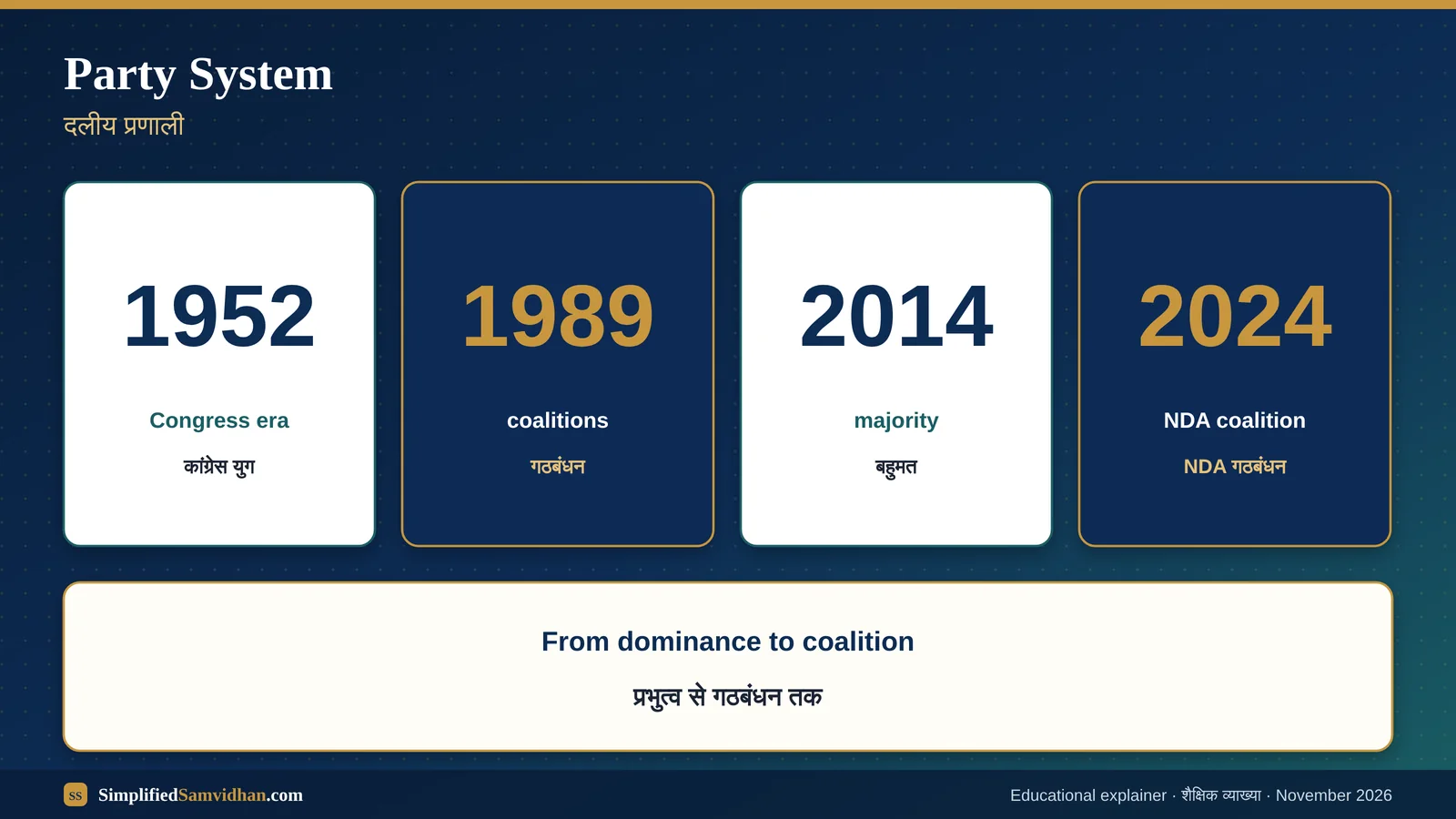
How India moved from Congress dominance to coalitions, majority and coalition again, the rules for parties, pressure groups and the new forces in politics, with practice MCQs.
Short answerIndian Party System in Simple Words
Short answer: India has a multi-party system that has changed shape over time: one-party dominance of the Congress (1952-67, the 'Congress system' of Rajni Kothari), then challenge and the first non-Congress governments (1967 in states, 1977 at the Centre), then the coalition era (1989-2014), then a single-party majority again (BJP, 2014 and 2019), and since 2024 a coalition (NDA) government where the BJP (240 seats) depends on allies. Around parties work pressure groups (farmers, traders, unions, castes), and today's dynamics include regional parties, identity vs development voting, women voters (106th Amendment, 2023) and AI and social media in campaigns.
🏠 Everyday analogy
Indian politics is like cricket formats: first a one-team era, then many teams in a league (coalitions), then one strong team again, and now a strong team that still needs partners to bat through.
🇮🇳 Real Indian example
In Rajasthan two parties dominate, yet regional and caste-based players such as the RLP and the Bharat Adivasi Party won one Lok Sabha seat each in 2024, showing how identity politics shapes results.
Prelims: anti-defection (Tenth Schedule), recognition of parties, 106th Amendment
Mains: features of the Indian party system, coalition politics, role of pressure groups, regionalism
PhasesSix Phases of the Indian Party System
- 11952-1967: One-party dominance
Congress won at the Centre and almost all states; opposition worked as 'parties of pressure' (Rajni Kothari).
- 21967-1977: First challenge
Non-Congress (Samyukta Vidhayak Dal) governments in many states in 1967; Emergency 1975-77.
- 31977-1989: Alternation begins
Janata Party government (1977), first non-Congress at the Centre; Congress back in 1980 and 1984.
- 41989-2014: Coalition era
National Front (1989), United Front (1996), NDA (1998-2004, first coalition to complete a full term 1999-2004), UPA (2004-14); rise of regional and OBC/Dalit parties.
- 52014-2024: Single-party majority
BJP won 282 (2014) and 303 (2019) seats on its own.
- 62024-: Coalition again
BJP 240 seats (short of 272); NDA government with allies such as TDP and JD(U); a stronger opposition (INDIA bloc).
Rules for partiesRecognition, Anti-defection, Funding, Women's Reservation
| Rule | What it says |
|---|---|
| Recognition of parties | Election Symbols (Reservation and Allotment) Order, 1968. National party if, for example, 6% votes in 4 states + 4 Lok Sabha seats, or 2% of Lok Sabha seats from 3 states, or state party in 4 states. ECI list (April 2023): 6 national parties: BJP, INC, BSP, CPI(M), AAP, NPP. |
| Anti-defection | Tenth Schedule (52nd Amendment, 1985); 91st Amendment (2003) removed the 'one-third split' exception, kept merger by 2/3, and capped ministries at 15%. Speaker / Chairman decides, subject to judicial review (Kihoto Hollohan, 1992). |
| Party funding | Electoral bonds scheme struck down by the Supreme Court on 15 February 2024 (ADR v Union of India) for violating the voter's right to know. |
| Women's reservation | 106th Amendment, 2023 (Nari Shakti Vandan Adhiniyam): one-third seats in Lok Sabha, state assemblies and Delhi assembly, for 15 years; starts after delimitation based on the first census after the Act (Census 2027). |
Pressure groupsPressure Groups: Meaning, Types, Party vs Pressure Group
Political party
- Wants to capture power
- Contests elections
- Wide programme on all issues
- Answerable to voters
Pressure group
- Wants to influence policy
- Does not contest elections
- Narrow, specific interest
- Uses lobbying, protests, media, courts
| Type (Almond) | Indian examples |
|---|---|
| Associational (organised interests) | FICCI, CII, AITUC, BMS, Bharatiya Kisan Union, IMA, Bar Council |
| Institutional | Civil service associations, armed forces veterans' bodies |
| Non-associational (caste, religion, region) | Caste mahasabhas, linguistic and regional groups |
| Anomic (spontaneous) | Sudden protests, riots, bandhs |
New dynamicsNew Dynamics: Region, Caste, Welfare Voters, AI
- Regionalism and federal bargaining: regional parties rule several states and bargain in coalitions (special category demands, Finance Commission share).
- Caste and identity: 'Mandal' politics after 1990; caste enumeration is part of Census 2027, which will feed new debates on reservation and representation.
- Welfare and 'labharthi' voters: direct benefit transfers and women-centred schemes have created a new welfare-based voter group.
- AI and social media: deepfakes and AI-made content are now part of campaigns; the Election Commission has issued advisories asking parties to label AI-made material and remove deepfakes quickly, alongside the IT Rules on takedown (3-hour takedown rule).
Current affairsCurrent Affairs of the Last One Year
- Census 2027 with caste enumeration is under way; its numbers will decide delimitation and when the 33% women's quota starts (see delimitation).
- One Nation One Election: the Joint Parliamentary Committee on the 129th Amendment Bill has not yet reported; see Electoral reforms and ONOE.
- Related: Rajasthan politics · Disqualification of MPs and MLAs · NOTA, electoral bonds, funding · RAS polity syllabus
Mains answerRAS Mains: How to Write the Answer
- Q. 'Coalition politics has strengthened Indian federalism.' Discuss. (10 marks) Frame: meaning and phases of coalition era → positives (regional voice, consensus, Common Minimum Programme, NITI-style bargaining) → negatives (instability, policy paralysis, 'coalition dharma', blackmail) → 2024 NDA example → conclusion: coalitions deepen federal dialogue if backed by anti-defection discipline.
- Q. Distinguish between a political party and a pressure group. (5 marks) Use the 4-point table above + two Rajasthan examples (farmers' unions, Gurjar reservation movement).
Quick revisionOne-Line Revision Points (Exam Ready)
- 'Congress system': Rajni Kothari.
- First non-Congress Union govt: Janata, 1977.
- Tenth Schedule: 52nd Amendment, 1985.
- Electoral bonds struck down: 15 Feb 2024.
- 106th Amendment: 33% for women.
- Pressure groups don't contest elections.
Practice MCQPractice MCQs (with Answers): Party system
The term 'Congress system' was used by:
The first non-Congress government at the Centre was formed in:
Anti-defection law was added by which Amendment?
The 91st Amendment (2003) removed which exception?
Recognition of national parties is under:
The Supreme Court struck down electoral bonds on:
Women's reservation in Lok Sabha and assemblies came through the:
Which is TRUE of a pressure group?
Sudden riots and bandhs are which type of pressure group (Almond)?
How many seats did the BJP win in the 2024 Lok Sabha election?
Doubts ClearedFrequently Asked Questions
Is India a two-party or multi-party system?
Multi-party: many national and state parties, but at the Centre two alliances (NDA and INDIA) dominate, and in states like Rajasthan two parties dominate.
When will the 33% women's quota start?
After delimitation based on the first census taken after the 2023 Act, that is, Census 2027; so not before the delimitation exercise is finished.
Sources and further readingSources We Checked
Checked on 14 November 2026 against the Election Commission of India, the Constitution (Tenth Schedule, 106th Amendment) and the Supreme Court's electoral bonds judgment.