Rajasthan State Information Commission: RAS Notes
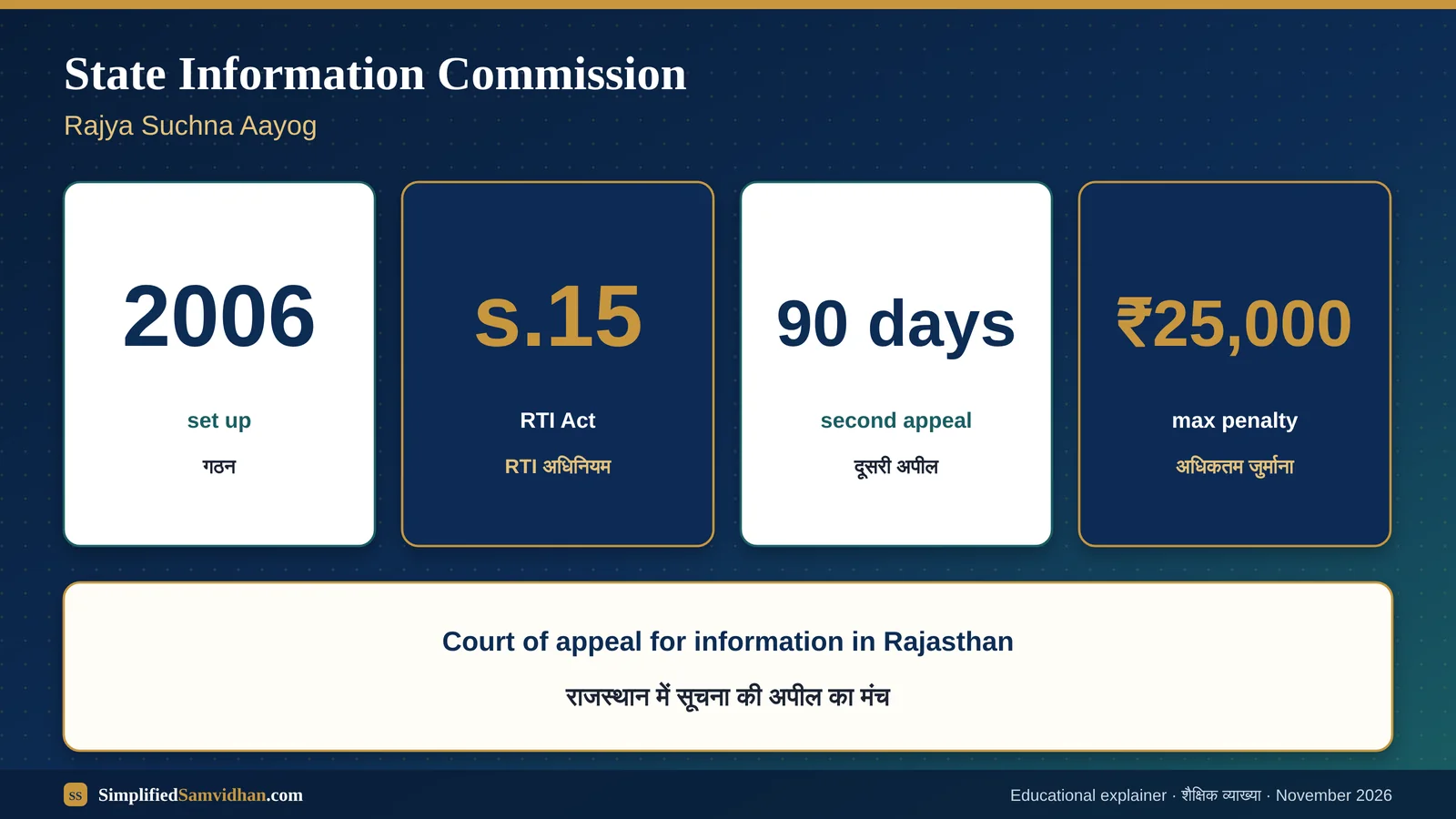
How the Commission is formed, term and removal, the appeal path, penalties, Rajasthan's RTI history and recent changes, with practice MCQs.
Short answerState Information Commission in Simple Words
Short answer: the Rajasthan State Information Commission (RSIC) is a statutory body made under section 15 of the RTI Act 2005. If a government office in Rajasthan does not give you information, you first appeal inside the office, and then file a second appeal or complaint before the Commission. It has a State Chief Information Commissioner and up to 10 Information Commissioners, appointed by the Governor on the recommendation of a committee of the CM, Leader of Opposition and a minister. It can fine a Public Information Officer ₹250 a day, up to ₹25,000. It was set up on 18 April 2006; the present Chief Information Commissioner is M.L. Lathar (since July 2024).
🏠 Everyday analogy
Think of it as a court only for information: it cannot jail anyone, but it can order the file to be shown and fine the officer who sat on it.
🇮🇳 Real Indian example
Rajasthan is the birthplace of the RTI movement: the MKSS dharna at Beawar in 1996 led to Rajasthan's own RTI Act in 2000, five years before the central law.
Prelims: RTI sections 15-20: appointment, term, removal, penalty; date of setting up, present CIC; Rajasthan's RTI history (MKSS, 2000 Act, Jan Soochna Portal)
Mains: RTI as a tool of good governance and transparency; effect of the RTI Amendment 2019 on independence
RTI sectionsRTI Act Sections 15-20 and 25
| RTI section | Rule |
|---|---|
| 15 | Constitution: State CIC + up to 10 ICs; selection committee CM (chair), LoP, a cabinet minister nominated by the CM; appointed by the Governor |
| 16 | Term and salary as prescribed by the Central Government (after the 2019 amendment: 3 years or age 65); no reappointment |
| 17 | Removal by the Governor: misbehaviour/incapacity after Supreme Court inquiry; or insolvency, conviction, paid outside job, unfit |
| 18 | Complaints: no PIO, refusal, delay, high fee, false information; powers of a civil court |
| 19 | First appeal within 30 days to a senior officer; second appeal to the Commission within 90 days |
| 20 | Penalty on PIO ₹250 per day up to ₹25,000; can recommend disciplinary action |
| 25 | Annual report to the State Government, laid before the Vidhan Sabha |
Appeal pathFrom RTI Application to the Commission
- 1RTI application
₹10 fee (BPL free) to the PIO; reply in 30 days (48 hours if life or liberty).
- 2First appeal
Within 30 days to the First Appellate Officer of the same department.
- 3Second appeal
Within 90 days to the Rajasthan State Information Commission, Jaipur.
- 4High Court (writ)
The Commission's order is binding; it can be challenged only by writ.
Rajasthan factsFacts Asked in RAS
| Fact | Answer |
|---|---|
| Set up | 18 April 2006 |
| Chief Information Commissioner | M.L. Lathar, former DGP (July 2024); ICs appointed with him: Suresh Chand Gupta, Mahendra Kumar Parikh, Tikaram Sharma |
| Before him | Post vacant from December 2023 after D.B. Gupta's term |
| Rajasthan's own RTI law | Rajasthan Right to Information Act, 2000 (replaced by the central Act of 2005) |
| Movement | Mazdoor Kisan Shakti Sangathan (MKSS), Aruna Roy; Beawar dharna 1996 |
| Proactive disclosure | Jan Soochna Portal, launched 13 September 2019 (RTI section 4) |
Current affairsCurrent Affairs of the Last One Year
- RTI Act 20 years (October 2025): the Act came fully into force on 12 October 2005; debates on vacancies and pendency in information commissions continued.
- DPDP Act and RTI: section 44(3) of the Digital Personal Data Protection Act 2023 amends RTI section 8(1)(j), widening the 'personal information' exemption; the DPDP Rules were notified in November 2025. See DPDP Act and data privacy.
- Supreme Court on private bodies (October 2026): see RTI and private bodies (Sec 2(f)) for the s.2(f) ruling explained on this site.
- How-to guides: How to file an RTI · RTI first appeal · RAS polity syllabus
Mains answerRAS Mains: How to Write the Answer
- Q. 'Rajasthan gave India the RTI.' Discuss the role of the State Information Commission in transparency. (10 marks) Frame: MKSS story → RTI Act 2005, ss.15-20 → functions with a Rajasthan example → issues (vacancies, pendency, 2019 amendment gives the Centre control of term and salary, DPDP change) → Jan Soochna Portal as a model → conclusion.
Quick revisionOne-Line Revision Points (Exam Ready)
- Statutory body: RTI Act s.15 (not constitutional).
- Committee: CM + LoP + minister; appointment by Governor.
- Term 3 years or 65 (after 2019).
- Penalty ₹250/day, max ₹25,000 (s.20).
- Set up 18 April 2006; CIC M.L. Lathar.
- MKSS, Beawar 1996 → Rajasthan RTI Act 2000.
Practice MCQPractice MCQs (with Answers): State Information Commission
The State Information Commission is constituted under which section of the RTI Act 2005?
Who is NOT a member of the committee that recommends the State Chief Information Commissioner?
Maximum penalty that the Commission can impose on a PIO is:
The Rajasthan State Information Commission was constituted in:
A second appeal before the State Information Commission must be filed within:
After the RTI (Amendment) Act 2019, the term of a State Information Commissioner is decided by:
Which organisation led the RTI movement in Rajasthan?
Who is the Chief Information Commissioner of Rajasthan (appointed July 2024)?
Rajasthan's Jan Soochna Portal is linked to which RTI provision?
Choose the CORRECT statement:
Doubts ClearedFrequently Asked Questions
Who appoints the State Chief Information Commissioner of Rajasthan?
The Governor, on the recommendation of a committee of the Chief Minister, the Leader of Opposition and a cabinet minister nominated by the CM (RTI section 15(3)).
How long do I have to file a second appeal?
90 days from the date the first appeal decision was due or received.
Sources and further readingSources We Checked
Checked on 10 November 2026 against the RTI Act 2005 (as amended in 2019 and by the DPDP Act 2023), the Commission's website and news reports.