Rajasthan High Court, Subordinate Courts and Advocate General: RAS Notes
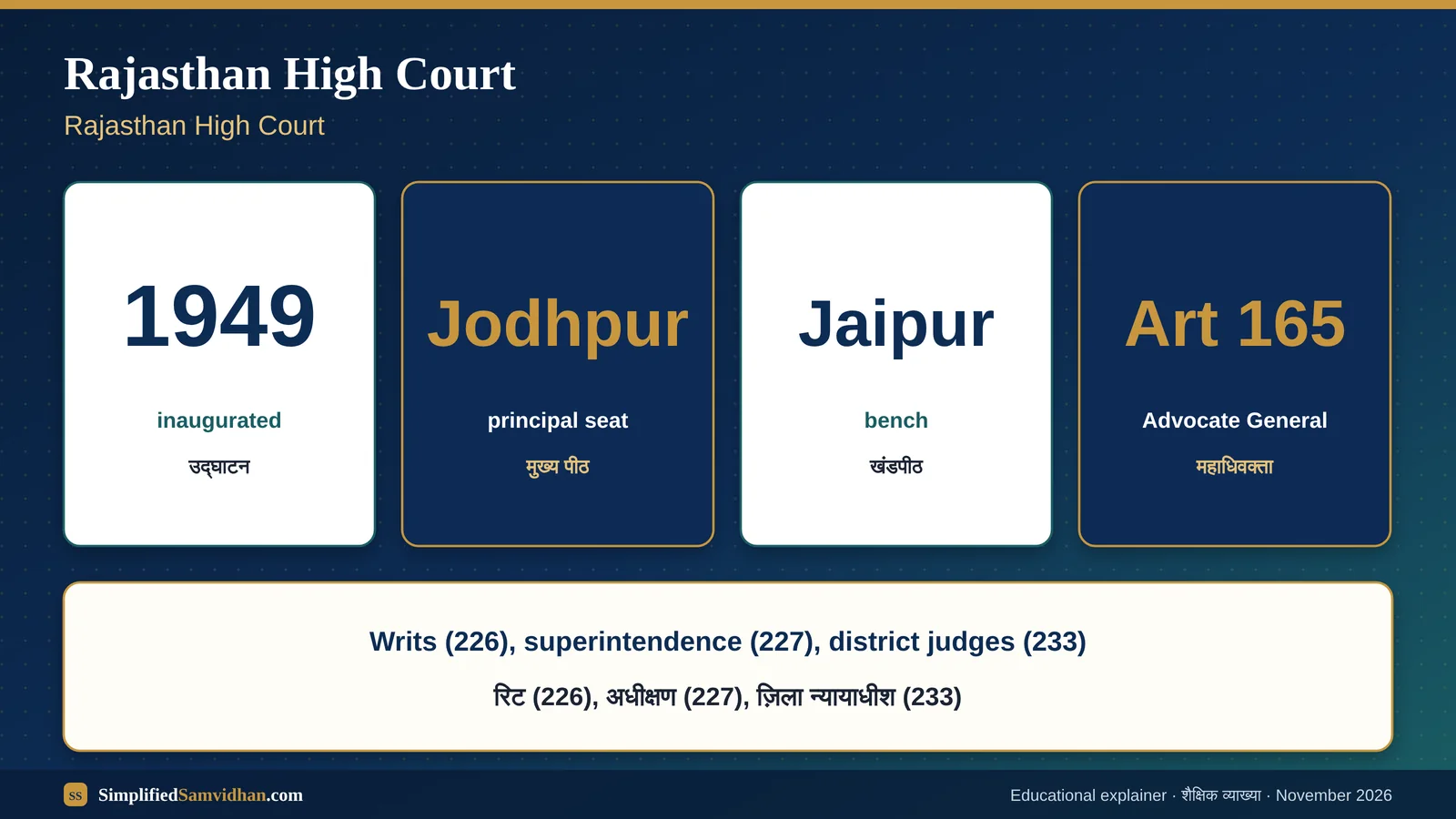
Seat and bench, how judges are appointed and removed, writs, the court ladder in Rajasthan, the Advocate General and the latest changes, with practice MCQs.
Short answerRajasthan High Court in Simple Words
Short answer: Rajasthan's highest court is the Rajasthan High Court. Its principal seat is at Jodhpur and it has a bench at Jaipur. It was inaugurated on 29 August 1949. Its judges are appointed by the President after consulting the CJI and the Governor (Art 217, collegium system) and serve till 62. It can issue writs (Art 226) and supervises all courts below it (Art 227). Below it are the district courts: district judges are appointed by the Governor in consultation with the High Court (Art 233). The government's top lawyer in the state is the Advocate General (Art 165), appointed by the Governor. Present Chief Justice: Sanjay Kumar Agrawal (sworn in 7 September 2026).
🏠 Everyday analogy
Think of a school: district courts are class teachers, the High Court is the principal who can correct any class teacher's decision, and the Supreme Court is the board above all schools.
🇮🇳 Real Indian example
If police detain someone in Kota without producing them before a magistrate, the family can file a habeas corpus petition at the Jaipur bench under Art 226.
Prelims: seat and bench, date of establishment, first CJ; Articles 165, 214-231, 233-237; Art 226 vs Art 32
Mains: role of the High Court in protecting rights (PIL, writs); Advocate General: role and position; pendency and judicial reforms
Constitution textWhat the Constitution Says
Article 214. There shall be a High Court for each State.
Article 226(1). ...every High Court shall have power, throughout the territories in relation to which it exercises jurisdiction, to issue to any person or authority, including in appropriate cases, any Government, within those territories directions, orders or writs, including writs in the nature of habeas corpus, mandamus, prohibition, quo warranto and certiorari, or any of them, for the enforcement of any of the rights conferred by Part III and for any other purpose.
Article 165(1). The Governor of each State shall appoint a person who is qualified to be appointed a Judge of a High Court to be Advocate-General for the State.
Article 233(1). Appointments of persons to be, and the posting and promotion of, district judges in any State shall be made by the Governor of the State in consultation with the High Court exercising jurisdiction in relation to such State.
Key ArticlesHigh Court, Subordinate Courts and Advocate General: Key Articles
| Article | What it says |
|---|---|
| 214 | A High Court for each State |
| 215 | Court of record; can punish for its contempt |
| 217 | Appointment by the President (CJI + Governor consulted); age limit 62; qualification: 10 years as judicial officer or HC advocate |
| 217(1)(b) + 218 | Removal like a Supreme Court judge (Art 124(4)): address of both Houses of Parliament, special majority |
| 219 | Oath given by the Governor |
| 222 | Transfer of judges by the President after consulting the CJI |
| 226 | Writs for Fundamental Rights AND 'any other purpose' (wider than Art 32) |
| 227 | Superintendence over all courts and tribunals in the state (except military) |
| 231 | One common High Court for two or more states possible |
| 233-237 | Subordinate courts: district judges (233), other judicial officers via SPSC + HC (234), HC control over them (235) |
| 165, 177 | Advocate General: appointed by the Governor, holds office during pleasure, can speak in the Vidhan Sabha but cannot vote |
Court ladderCourts in Rajasthan from Top to Bottom
- 1Supreme Court
Appeal from the High Court (Arts 132-136).
- 2Rajasthan High Court
Jodhpur (principal seat) + Jaipur bench.
- 3District and Sessions Judge
Civil side: District Judge; criminal side: Sessions Judge (can give death sentence, subject to HC confirmation).
- 4Civil Judge (Senior / Junior Division) and Judicial Magistrates
Recruited by the High Court through the Rajasthan Judicial Service exam.
- 5Gram Nyayalayas, Lok Adalats, Family Courts
Quick, cheap justice near people; Lok Adalats run by the Rajasthan State Legal Services Authority (RSLSA).
Rajasthan factsRajasthan High Court: Facts Asked in RAS
| Fact | Answer |
|---|---|
| Established / inaugurated | Rajasthan High Court Ordinance 1949; inaugurated 29 August 1949 |
| Principal seat | Jodhpur |
| Bench | Jaipur (working again since 31 January 1977) |
| First Chief Justice | Kamla Kant Verma |
| Present Chief Justice | Sanjay Kumar Agrawal (sworn in 7 September 2026 by Governor Haribhau Bagade) |
| Who gives oath to HC judges | Governor (Art 219) |
| Legal aid body | Rajasthan State Legal Services Authority (Legal Services Authorities Act 1987), patron-in-chief: Chief Justice |
Current affairsCurrent Affairs of the Last One Year
- 7 September 2026: Justice Sanjay Kumar Agrawal took oath as Chief Justice of the Rajasthan High Court; Governor Haribhau Bagade administered the oath at Raj Bhavan (Art 219).
- New criminal laws: since 1 July 2024 all Rajasthan criminal courts apply the BNS, BNSS and BSA in place of IPC, CrPC and Evidence Act; e-summons and video-recorded evidence have grown.
- National Lok Adalats: held every few months across Rajasthan by RSLSA to settle pending and pre-litigation cases in a single day.
- Related: Governor · Vidhan Sabha · RAS polity syllabus
Mains answerRAS Mains: How to Write the Answer
- Q. Explain the writ jurisdiction of the High Court. How is it wider than that of the Supreme Court? (5 marks) Frame: Art 226, five writs in one line each → 'any other purpose' covers legal rights too → Art 32 is itself a Fundamental Right, Art 226 is discretionary → example (habeas corpus, PIL on water/pollution) → conclusion.
- Q. Discuss the position and functions of the Advocate General of Rajasthan. (2 marks / 5 marks) Frame: Art 165 appointment by Governor, qualification like HC judge, pleasure → advises government, appears in courts → Art 177 right to speak in the House, no vote → like the Attorney General at the Centre.
Quick revisionOne-Line Revision Points (Exam Ready)
- Principal seat Jodhpur; bench Jaipur.
- Inaugurated 29 August 1949; first CJ Kamla Kant Verma.
- Judges appointed by the President (217), oath by the Governor (219), retire at 62.
- Writs 226 (wider than 32); superintendence 227.
- District judges: Governor + HC (233).
- Advocate General: 165, speaks in House (177), no vote.
Practice MCQPractice MCQs (with Answers): Rajasthan High Court
Where is the principal seat of the Rajasthan High Court?
The Rajasthan High Court was inaugurated on:
Who administers the oath to a judge of the Rajasthan High Court?
Which Article gives the High Court superintendence over all courts and tribunals in its territory?
Choose the CORRECT statement about the Advocate General of Rajasthan:
District judges in Rajasthan are appointed by:
The retirement age of a High Court judge is:
Why is Article 226 said to be wider than Article 32?
Who took oath as Chief Justice of the Rajasthan High Court on 7 September 2026?
Lok Adalats in Rajasthan are organised under which Act?
Doubts ClearedFrequently Asked Questions
Where is the Rajasthan High Court located?
Its principal seat is at Jodhpur, and a bench sits at Jaipur.
Who is the Chief Justice of the Rajasthan High Court?
Justice Sanjay Kumar Agrawal, who took oath on 7 September 2026.
Who appoints the Advocate General of Rajasthan?
The Governor, under Article 165. The person must be qualified to be a High Court judge.
Sources and further readingSources We Checked
Checked on 9 November 2026 against the Constitution (Articles 165, 214-237), the Rajasthan High Court website and news reports. The Hindi text of the Articles is a simple rendering.