Rajasthan Tenancy Act 1955: RAS Mains Notes
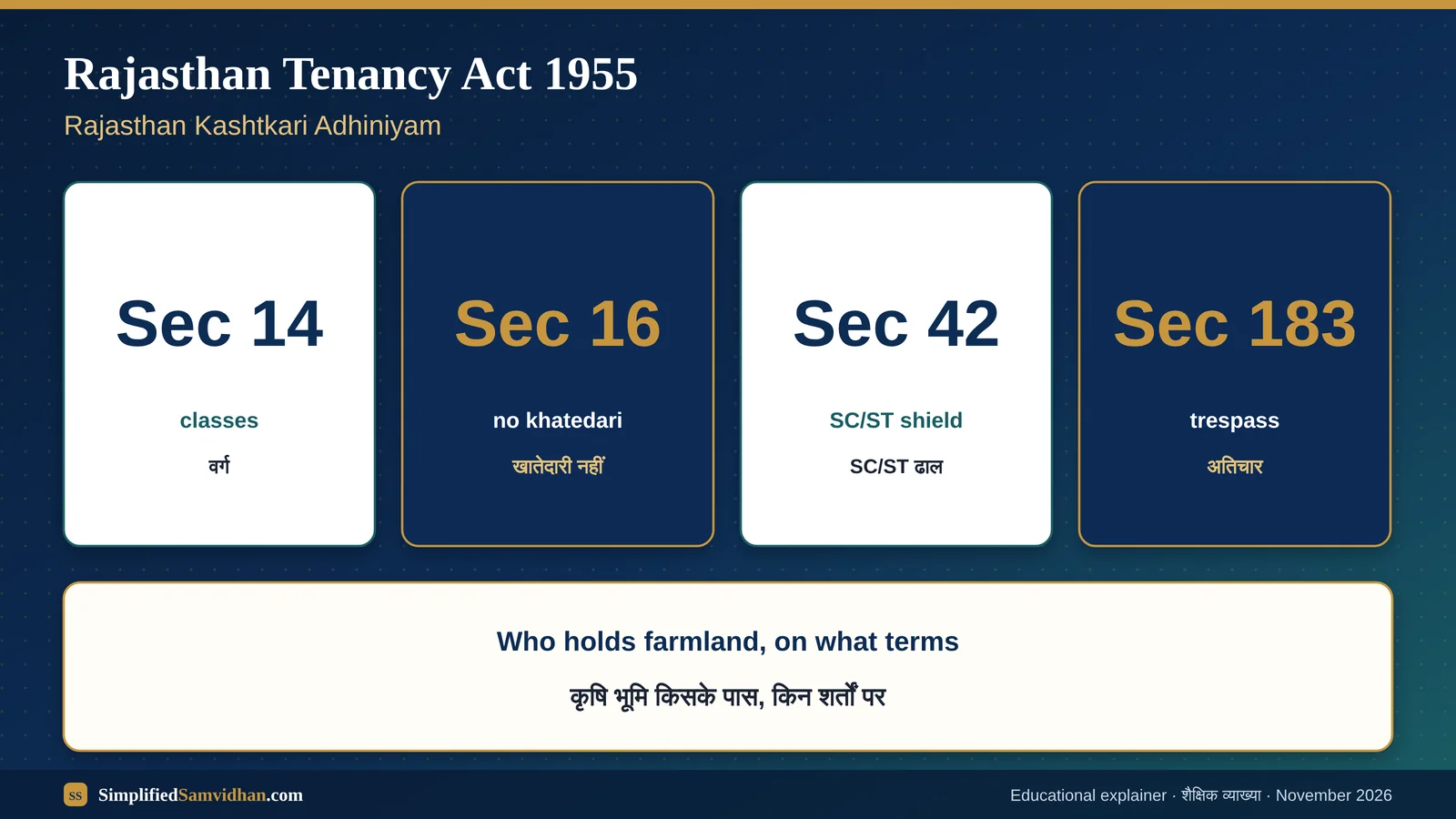
Definitions, classes of tenants, Section 16, transfer limits and the revenue courts, kept to the RAS syllabus, with practice MCQs.
Short answerRajasthan Tenancy Act in Simple Words
Short answer: the Rajasthan Tenancy Act, 1955 (Rajasthan Act No. 3 of 1955) decides who holds agricultural land and on what terms, after the end of jagirdari and zamindari. The State is the owner of land; a cultivator is a tenant. The strongest tenant is the khatedar tenant, whose rights are heritable and can be transferred only as the Act allows; a ghair khatedar tenant has weaker rights. Section 16 lists land where khatedari rights can never arise (for example pasture land, river beds, land for public purposes). Section 42 stops land of a Scheduled Caste or Scheduled Tribe member from being sold, gifted or bequeathed to a non-SC/ST person. Disputes go to revenue courts headed by the Board of Revenue, Ajmer.
🏠 Everyday analogy
Think of the State as the landlord of all farmland: a khatedar is a permanent family tenant, a ghair khatedar is a tenant on weaker terms, and a trespasser has no right at all.
🇮🇳 Real Indian example
A Tehsildar or SDO deciding a boundary or possession dispute in a village is applying this Act; appeals can go up to the Board of Revenue at Ajmer.
Prelims: not in the Prelims list; Mains law paper (Paper III)
Mains: define khatedar tenant, ghair khatedar tenant, pasture land; classes of tenants and land where khatedari rights do not accrue; restrictions on transfer (SC/ST land)
DefinitionsSection 5: Key Definitions
| Term (Sec 5) | Simple meaning |
|---|---|
| Tenant | Person by whom rent is payable for land (or would be, but for a contract); includes khatedar and ghair khatedar tenants |
| Khatedar tenant | Tenant with khatedari rights: heritable, can sell/mortgage/sublet only within the Act's limits |
| Ghair khatedar tenant | Tenant without khatedari rights (e.g. on land where such rights cannot accrue, or newly allotted land) |
| Khudkasht | Land cultivated personally by an estate-holder |
| Holding | Parcel(s) of land held under one lease or tenure |
| Pasture land (charagah) | Land used for grazing the cattle of a village, recorded as such; khatedari rights cannot accrue on it |
| Trespasser | Person who takes or keeps possession of land without lawful authority; can be ejected (Sec 183) with penalty |
SectionsSyllabus Sections at a Glance
| Section / block | What it covers |
|---|---|
| 1 | Short title, extent (whole of Rajasthan), commencement (1955) |
| 14 | Classes of tenants: khatedar tenants, tenants of khudkasht and ghair khatedar tenants |
| 15 | Who is a khatedar tenant (tenants at the commencement and those later admitted, subject to Sec 16) |
| 16 | Land where khatedari rights do not accrue: pasture land, land under water or river beds, land for public purposes, certain canal/forest/municipal land etc. |
| 16A-17A | Tenants of khudkasht and ghair khatedar tenants |
| 31-37 | Rights of tenants in abadi and to a residential house (Sec 31) and related matters |
| 38 | A tenant's interest is heritable but not transferable except as the Act allows |
| 39-54A | Rules on transfer: sale, gift, bequest, mortgage, sub-letting and division of holdings; Sec 42 bars transfer of SC/ST land to non-SC/ST persons |
| 206-232 | Procedure and jurisdiction of revenue courts; pending cases continue under the Act (Sec 206); suits that only revenue courts can hear |
| 239-242 | Further provisions in the syllabus range: read with the bare Act |
Khatedar vs ghair khatedarKhatedar vs Ghair Khatedar Tenant
Khatedar tenant
- Heritable rights
- Can sell, gift, mortgage within the Act
- Strongest class of tenant
Ghair khatedar tenant
- Weaker, limited rights
- Cannot transfer like a khatedar
- Often on land under Sec 16 or newly allotted land
Revenue courtsLadder of Revenue Courts
- 1Board of Revenue, Ajmer
Highest revenue court: second appeal, revision, reference.
- 2Revenue Appellate Authority
First appeals against SDO/Collector orders in many matters.
- 3Collector
District head of revenue administration.
- 4Sub-Divisional Officer (SDO)
Hears most tenancy suits (e.g. declaration, division).
- 5Tehsildar / Naib Tehsildar
Mutation, land records and other tehsil-level matters given by law.
Current affairsRecent Developments
- Board of Revenue: the apex revenue court at Ajmer; its chairman since March 2026 is Ajitabh Sharma. See Board of Revenue, Ajmer.
- Land law changes in 2025: the Land Revenue (Amendment and Validation) Act 2025 dealt with RIICO industrial land; see Rajasthan Land Revenue Act 1956.
- Related: District administration · Panchayati Raj in Rajasthan · RAS polity syllabus
Mains answerRAS Mains: How to Write the Answer
- Q. Define khatedar tenant and ghair khatedar tenant. Where do khatedari rights not accrue? (5 marks) Frame: definitions (Sec 5) → classes (Sec 14) → Sec 16 list (pasture, water, public purpose land) → why (protect common land) → one line on Sec 42 protection of SC/ST land.
Quick revisionOne-Line Revision Points (Exam Ready)
- Rajasthan Act No. 3 of 1955.
- Sec 5: definitions; Sec 14: classes of tenants.
- Sec 16: no khatedari on pasture, water, public land.
- Sec 38: tenant's interest heritable, not freely transferable.
- Sec 42: SC/ST land cannot go to non-SC/ST.
- Sec 183: ejection of trespassers.
Practice MCQPractice MCQs (with Answers): Rajasthan Tenancy Act
The Rajasthan Tenancy Act was enacted in:
Definitions in the Tenancy Act are in Section:
Classes of tenants are listed in Section:
Khatedari rights cannot accrue on:
Which section restricts transfer of SC/ST members' land to others?
The interest of a tenant in his holding is (Sec 38):
Ejection of trespassers is provided in Tenancy Act Section:
The highest revenue court in Rajasthan is located at:
'Khudkasht' means land:
Who owns agricultural land in Rajasthan under the tenancy system?
Doubts ClearedFrequently Asked Questions
Can a khatedar sell land to anyone?
Only within the Act's limits; for example, SC/ST land cannot go to a non-SC/ST person (Sec 42), and some land needs permission.
What should I read for Sections 239-242?
Read these few sections directly from the bare Act on India Code, since RAS may ask their exact wording.
Sources and further readingSources We Checked
Checked on 13 November 2026 against the Rajasthan Tenancy Act 1955 (India Code) and the Revenue Department, Rajasthan. Sections we could not confirm word-for-word are summarised only at block level.