RTI Act 2005: Sections 1 to 20 for RAS Mains
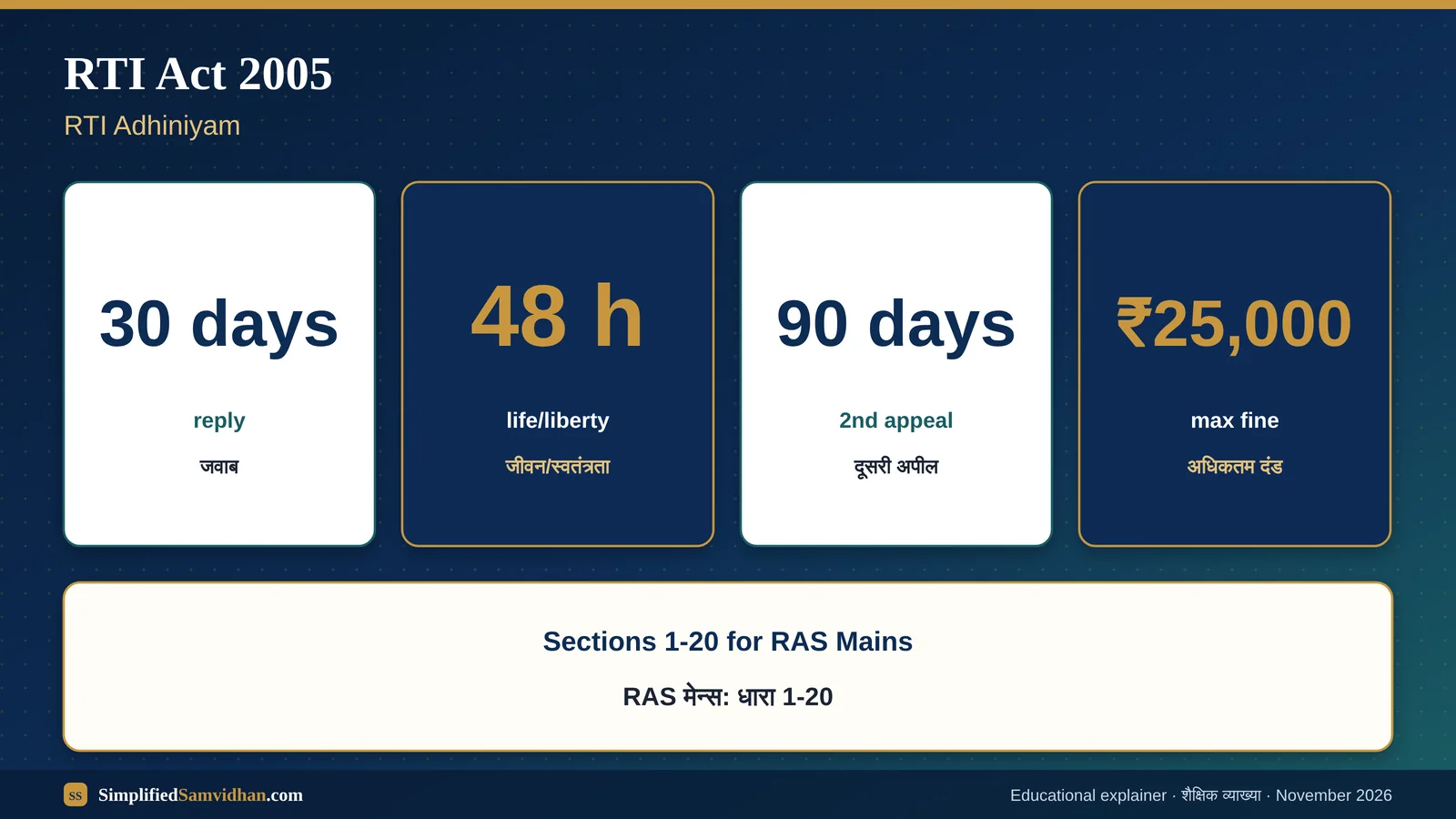
Every syllabus section of the RTI Act in one table, the application-to-penalty path and the 2025 privacy change, with practice MCQs.
Short answerRTI Act in Simple Words
Short answer: the Right to Information Act, 2005 (fully in force from 12 October 2005) lets every citizen ask any public authority for information without giving a reason. The PIO must reply in 30 days (48 hours if life or liberty is involved). Section 8 lists exemptions; Section 19 gives a first appeal (30 days) and a second appeal to the Information Commission (90 days); Section 20 fines a PIO ₹250 a day, up to ₹25,000. RAS Mains asks Sections 1-20 only. From 14 November 2025, the DPDP Act changed Section 8(1)(j) so that personal information is exempt.
🏠 Everyday analogy
RTI turns 'Why should we tell you?' into 'You must tell me within 30 days, or pay a fine.'
🇮🇳 Real Indian example
The RTI movement grew from MKSS jan sunwais in Rajasthan; Rajasthan passed its own RTI Act in 2000, before the central Act.
Prelims: not in the Prelims list; Mains law paper (Paper III)
Mains: time limits, exemptions (Sec 8), appeals (Sec 19), penalty (Sec 20); define 'information', 'public authority', 'right to information'
Sections 1-20Sections 1 to 20 in One Table
| Section | What it says |
|---|---|
| 1 | Short title, extent (whole of India), commencement |
| 2 | Definitions: (f) information (records, emails, opinions, data in electronic form etc.), (h) public authority (body made by Constitution, law or government notification, or substantially financed), (j) right to information (inspect, take notes, certified copies, samples) |
| 3 | All citizens have the right to information |
| 4 | Duties of public authorities: keep records; 4(1)(b) suo motu disclosure of 17 items |
| 5 | Designate PIOs and Assistant PIOs |
| 6 | Application in writing/electronically with fee (₹10 centrally); no reason needed (6(2)); transfer within 5 days (6(3)) |
| 7 | Reply in 30 days; 48 hours for life/liberty; +5 days via APIO; 40 days if third party; no fee for BPL; free information if late |
| 8 | Exemptions (sovereignty, security, court-forbidden, privilege, trade secrets, fiduciary, foreign govt, danger to life, investigation, Cabinet papers, personal information); 8(2) public interest; 8(3) 20-year rule |
| 9-11 | 9: refusal if it infringes non-state copyright; 10: severability (give the non-exempt part); 11: third-party information (notice in 5 days, 10 days to object) |
| 12-14 | Central Information Commission: CIC + up to 10 ICs; selection by PM, LoP and a Union Minister; term as fixed by the Centre (2019 amendment), age 65; removal by the President after SC inquiry |
| 15-17 | State Information Commission: selection by CM, LoP in the Assembly and a Cabinet Minister; appointed by the Governor |
| 18 | Complaints to the Commission (no PIO, refusal, delay, excess fee, false information); civil-court powers |
| 19 | First appeal within 30 days to a senior officer (decide in 30, max 45 days); second appeal within 90 days to the Commission; burden of proof on the PIO |
| 20 | Penalty on the PIO ₹250 per day up to ₹25,000; recommend disciplinary action |
ProcessFrom Application to Penalty
- 1Apply (Sec 6)
To the PIO with fee; no reason.
- 2Reply (Sec 7)
30 days / 48 hours.
- 3First appeal (Sec 19(1))
Within 30 days to the First Appellate Authority.
- 4Second appeal (Sec 19(3))
Within 90 days to CIC/SIC.
- 5Penalty (Sec 20)
Commission can fine the PIO.
Current affairsCurrent Affairs of the Last One Year
- DPDP change to Section 8(1)(j) (14 November 2025): the clause now simply exempts 'information which relates to personal information'; the earlier test of 'larger public interest' inside the clause is gone. Critics say this weakens RTI; the government says privacy and transparency are balanced.
- CIC full strength (15 December 2025): Raj Kumar Goyal became CIC with eight new ICs. See Lokpal, CVC and CIC.
- Already on this site: How to file an RTI · RTI first appeal · RTI exemption (Sec 24) case · RTI and private bodies (Sec 2(f)) · DPDP Act and data privacy
- Related: Rajasthan State Information Commission · Citizen charter and social audit · RAS polity syllabus
Mains answerRAS Mains: How to Write the Answer
- Q. Explain the time limits and appeal procedure under the RTI Act, 2005. (5 marks) Frame: Sec 6 application → Sec 7 (30 days, 48 hours, +5 APIO, 40 days third party, deemed refusal) → Sec 19 first appeal 30 days, second appeal 90 days → Sec 20 penalty ₹250/day up to ₹25,000 → one-line conclusion.
Quick revisionOne-Line Revision Points (Exam Ready)
- In force fully: 12 Oct 2005.
- Sec 6(2): no reason needed.
- Sec 7: 30 days; 48 hours for life/liberty.
- Sec 8(3): 20-year-old records open (most exemptions).
- Sec 19: 30 days first, 90 days second appeal.
- Sec 20: ₹250/day up to ₹25,000.
Practice MCQPractice MCQs (with Answers): RTI Act
Under Section 7, information concerning life or liberty must be given within:
Which section says an applicant need not give a reason?
The maximum penalty on a PIO under Section 20 is:
A second appeal must be filed within:
'Public authority' is defined in Section:
Suo motu (proactive) disclosure is required by Section:
An application wrongly sent must be transferred within:
Who selects the State Chief Information Commissioner?
Which RTI clause was amended by the DPDP Act from 14 November 2025?
Third-party information: the PIO must give notice to the third party within:
Doubts ClearedFrequently Asked Questions
Can a non-citizen use RTI?
No. Section 3 gives the right to citizens.
What if the PIO does not reply?
It is deemed refusal (Sec 7(2)); file a first appeal, then a second appeal or a complaint under Sec 18.
Sources and further readingSources We Checked
Checked on 13 November 2026 against the bare text of the RTI Act 2005 (India Code), the 2019 amendment and the DPDP notification of November 2025.