Electoral Reforms and One Nation One Election: RAS Notes
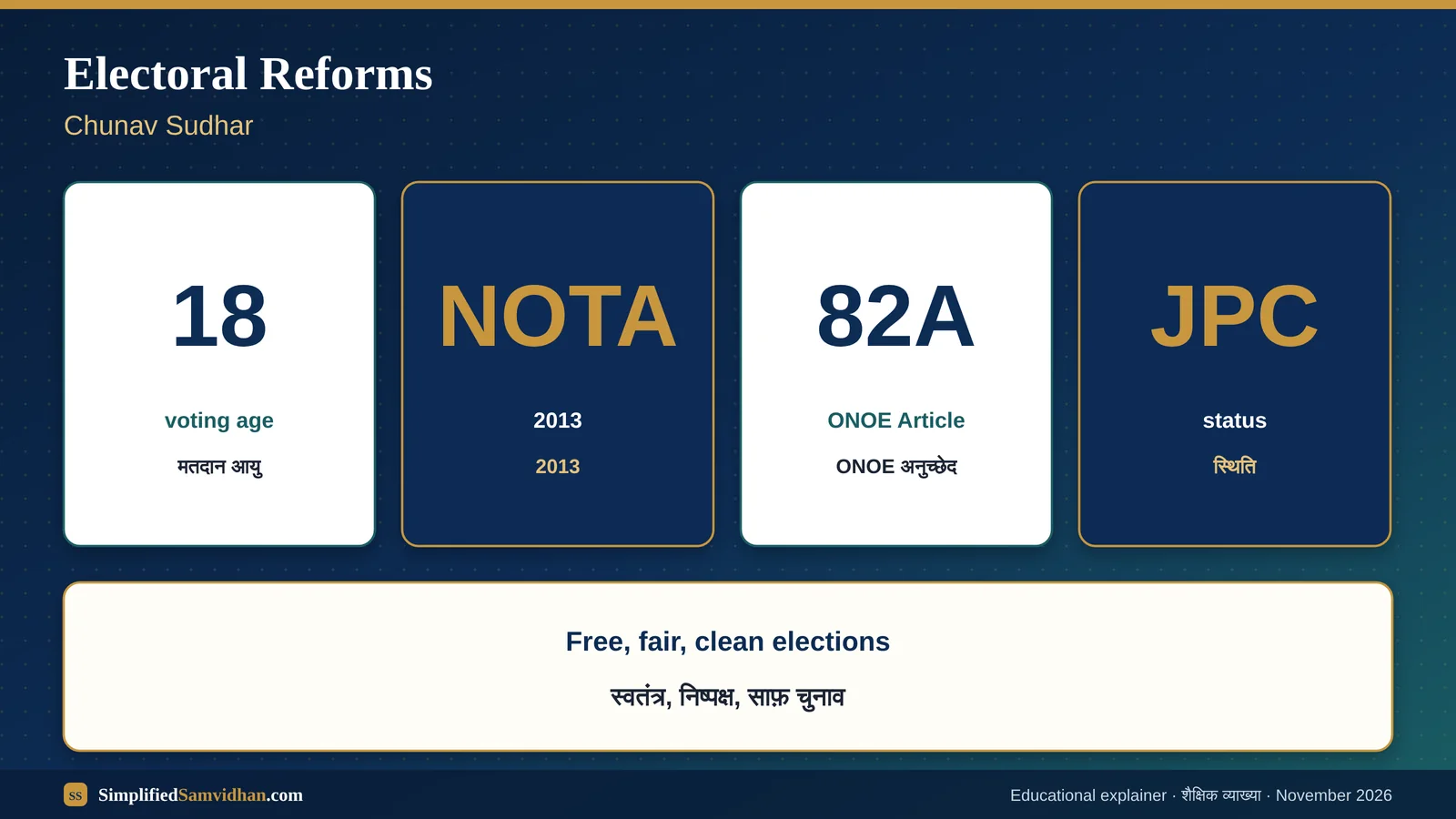
All major electoral reforms in one timeline, ONOE step by step, the for-and-against debate and the 2026 status, with practice MCQs.
Short answerElectoral Reforms and ONOE in Simple Words
Short answer: electoral reforms are changes that make elections free, fair and clean. Big steps: voting age 21 → 18 (61st Amendment, 1988), EVMs and VVPAT, NOTA (2013), disclosure of criminal and asset details by candidates (2002-03), immediate disqualification of convicted legislators (Lily Thomas, 2013), electoral bonds struck down (15 February 2024) and a new law on appointing the CEC and ECs (2023). One Nation One Election (ONOE) means holding Lok Sabha and state assembly elections together, as in 1951-67. The Kovind Committee backed it (report March 2024); the Constitution (129th Amendment) Bill, 2024 (new Art 82A) was introduced on 17 December 2024 and is with a Joint Parliamentary Committee.
🏠 Everyday analogy
Electoral reforms are like servicing the engine of democracy: cleaner fuel (money), better parts (EVM, VVPAT) and a fair referee (independent EC).
🇮🇳 Real Indian example
Rajasthan voted for its assembly in November 2023 and for the Lok Sabha in April 2024; under ONOE these would fall in the same year.
Prelims: NOTA, VVPAT, 61st Amendment, electoral bonds verdict; committees on electoral reform; ONOE: Kovind committee, 129th Amendment Bill
Mains: ONOE: merits and concerns; money and muscle power: reforms needed
Reform timelineElectoral Reforms: Year by Year
| Year | Reform |
|---|---|
| 1988 | 61st Amendment: voting age 18 (from 1989) |
| 1990 | Dinesh Goswami Committee on electoral reforms |
| 1998 | Indrajit Gupta Committee: state funding of elections |
| 2002 | ADR case: candidates must disclose criminal record, assets, education |
| 2013 | NOTA (PUCL case); Lily Thomas: convicted MPs/MLAs disqualified at once; first VVPAT use (Noksen, Nagaland) |
| 2021 | Election Laws (Amendment) Act: voluntary Aadhaar linking, four qualifying dates a year |
| 2023 | Anoop Baranwal case and CEC and Other ECs Act: selection by PM, LoP and a Union Minister |
| 2024 | Electoral bonds scheme struck down (15 February) |
| 2026 | SIR judgment: Aadhaar not proof of citizenship; ECI cannot decide citizenship |
ONOEOne Nation One Election: Step by Step
- 1History
Simultaneous polls in 1951-52, 1957, 1962 and 1967; broke after early dissolutions from 1968-69.
- 2Kovind Committee
Set up September 2023, report 14 March 2024: phase 1 Lok Sabha + assemblies, phase 2 local bodies within 100 days.
- 3Cabinet approval
18 September 2024.
- 4Bills introduced
17 December 2024: Constitution (129th Amendment) Bill (new Art 82A, changes to Arts 83, 172, 327) and Union Territories Laws (Amendment) Bill.
- 5JPC
Joint Parliamentary Committee chaired by P.P. Chaudhary (MP from Pali, Rajasthan); its term has been extended more than once in 2026.
For and againstONOE: For and Against
ONOE: for
- Saves money and administrative effort
- Less Model Code of Conduct paralysis on development
- Better voter turnout and focus on governance
ONOE: against
- Federalism: state terms cut or extended
- National issues may drown state issues
- Mid-term collapse needs fresh 'unexpired term' polls; huge EVM need
Current affairsCurrent Affairs of the Last One Year
- ONOE JPC (2026): the Lok Sabha extended the JPC's term in March 2026 and again later in the year; its chairman has spoken of a mechanism to make ONOE operational by 2029.
- Election Commission: Gyanesh Kumar became CEC in February 2025, the first under the 2023 Act. Already on this site: Appointment of the CEC · NOTA, electoral bonds, funding · EVM and VVPAT
- Related: Citizenship and SIR · State Election Commission Rajasthan · RAS polity syllabus
Mains answerRAS Mains: How to Write the Answer
- Q. Examine the merits and concerns of 'One Nation One Election'. (10 marks) Frame: meaning and history (1951-67) → Kovind Committee and 129th Amendment Bill (Art 82A) → merits (cost, governance, MCC) → concerns (federalism, unexpired-term elections, local issues, logistics) → status (JPC) → conclusion: consensus and phased approach.
Quick revisionOne-Line Revision Points (Exam Ready)
- 61st Amendment 1988: voting age 18.
- NOTA 2013 (PUCL).
- Electoral bonds struck down 15 Feb 2024.
- Kovind Committee report: 14 Mar 2024.
- 129th Amendment Bill: 17 Dec 2024, Art 82A.
- JPC chair: P.P. Chaudhary.
Practice MCQPractice MCQs (with Answers): Electoral reforms
Voting age was reduced from 21 to 18 by the:
NOTA was introduced after which case?
The electoral bonds scheme was struck down on:
The high-level committee on ONOE was chaired by:
Which new Article is proposed by the Constitution (129th Amendment) Bill, 2024?
Simultaneous elections were last held in:
Which case made convicted MPs/MLAs disqualified immediately?
VVPAT was first used in 2013 at:
Which committee recommended state funding of elections?
The JPC on ONOE is chaired by:
Doubts ClearedFrequently Asked Questions
Has ONOE become law?
No. The 129th Amendment Bill is still with the Joint Parliamentary Committee (November 2026).
Does NOTA cancel an election if it gets the most votes?
No. The candidate with the highest votes still wins; NOTA only records rejection.
Sources and further readingSources We Checked
Checked on 13 November 2026 against the Election Commission, Sansad records on the 129th Amendment Bill and JPC, and Supreme Court judgments.