Rajasthan Land Revenue Act 1956: RAS Mains Notes
The syllabus sections mapped chapter by chapter, the revenue officers' ladder, the four remedies and the 2025 amendment, with practice MCQs.
Short answerRajasthan Land Revenue Act in Simple Words
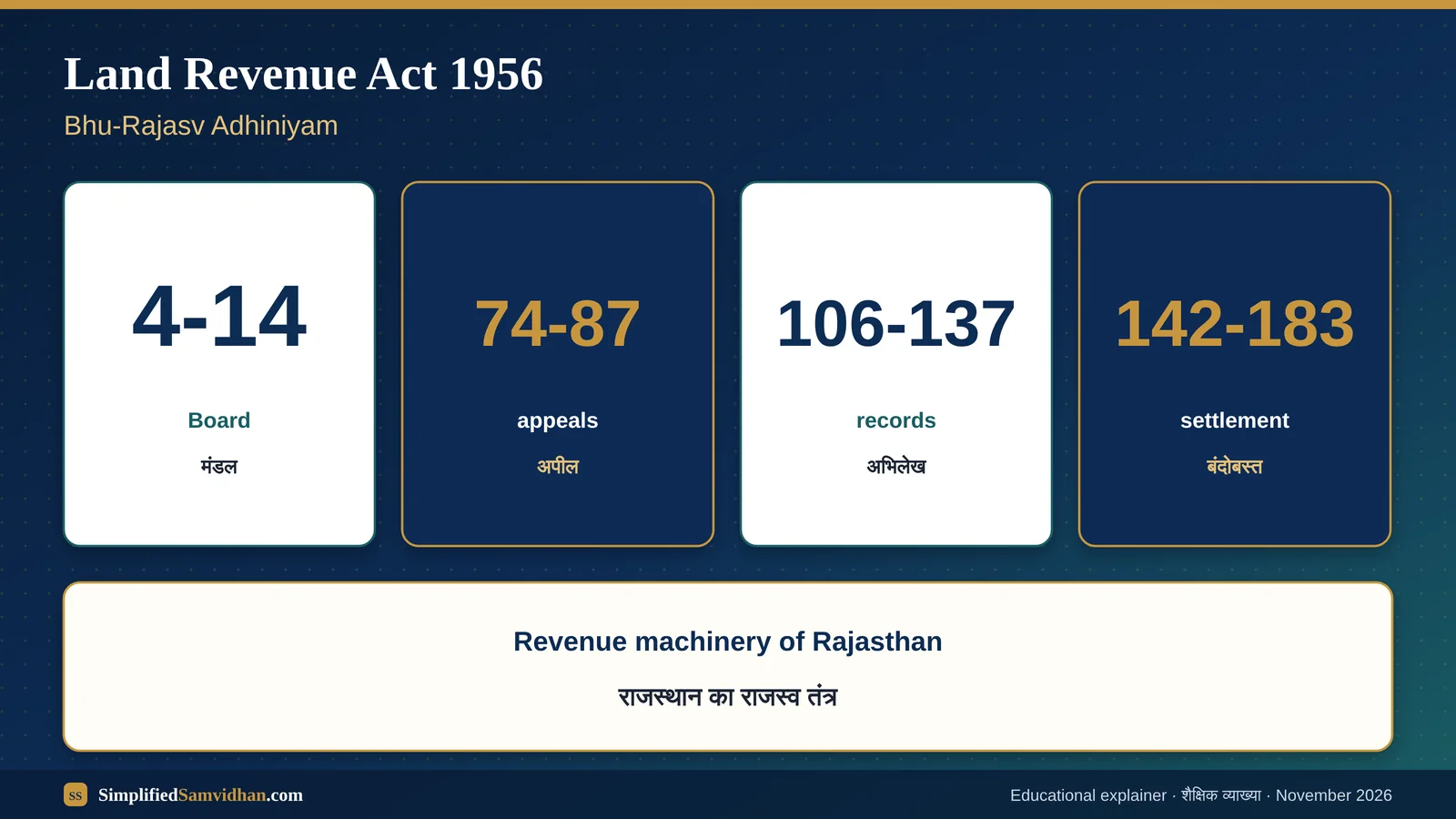
Short answer: the Rajasthan Land Revenue Act, 1956 is the rulebook of revenue administration: who the revenue officers and courts are, how appeals go, how land is surveyed and recorded (jamabandi, khasra, mutation) and how rent rates are settled. It works together with the Tenancy Act of 1955 (which decides tenants' rights). RAS asks: Sections 1-3 (preliminary, definitions), 4-36 (Board of Revenue and revenue officers), 40A, 74-87 (appeal, reference, revision, review), 106-137 (survey and records) and 142-183 (settlement operations). The Board of Revenue, Ajmer is at the top, with a Chairman and members.
🏠 Everyday analogy
If the Tenancy Act says who may farm the land, the Land Revenue Act says who keeps the record, who collects the revenue and where you appeal.
🇮🇳 Real Indian example
When a farmer's name is changed in the jamabandi after inheritance (mutation), the patwari, tehsildar and the record-of-rights rules of this Act are at work.
Prelims: not in the Prelims list; Mains law paper (Paper III)
Mains: constitution and powers of the Board of Revenue; hierarchy of revenue officers; appeal vs revision vs review; record of rights
Chapter mapSyllabus Sections: Chapter Map
| Syllabus sections | Chapter | What it covers |
|---|---|---|
| 1-3 | I Preliminary | Short title, extent, definitions (interpretation) |
| 4-14 | II Board of Revenue | Board for the State: a Chairman and other members (between 3 and 20); its powers of superintendence, sittings and rules |
| 15-36, 40A | III Revenue courts and officers | Divisions, districts, sub-divisions, tehsils; Divisional Commissioner, Collector, ADM, SDO, Tehsildar, Naib Tehsildar, land records officers; their powers and subordination |
| 74-87 | V Appeal, reference, revision, review | Who hears appeals from which officer, time limits, reference to the Board, revision by the Board, review of own orders |
| 106-137 | VII Survey and record operations | Survey of land, boundaries and survey marks, maps, record of rights (jamabandi), annual registers, mutation of names |
| 142-183 | VIII Settlement operations | Settlement of rent rates: classification of soils, assessment, term of settlement, announcement and objections |
OfficersHierarchy of Revenue Officers
- 1Board of Revenue (Ajmer)
Highest revenue court and controlling authority; revision and reference.
- 2Divisional Commissioner
Head of a division; supervises Collectors.
- 3Collector
Chief revenue officer of the district.
- 4Sub-Divisional Officer
In charge of a sub-division.
- 5Tehsildar and Naib Tehsildar
In charge of a tehsil; land records, mutation, collection.
- 6Land records staff
Inspector Land Records (Girdawar) and Patwari keep village records.
RemediesAppeal, Reference, Revision and Review
| Remedy | Meaning |
|---|---|
| Appeal | A higher authority re-examines the order on facts and law, as a right given by the Act |
| Reference | A lower authority refers a case to the Board for its decision |
| Revision | The Board checks legality or propriety of a lower order where no appeal lies |
| Review | The same authority reconsiders its own order for a mistake apparent or new evidence |
Current affairsCurrent Affairs of the Last One Year
- Rajasthan Land Revenue (Amendment and Validation) Act, 2025: passed by the Assembly on 10 September 2025 (after a select committee) and given assent in October 2025; it validates past RIICO decisions on industrial plots such as sub-division, merger and change of land use.
- Board of Revenue: chairman since March 2026 is Ajitabh Sharma. See Board of Revenue, Ajmer.
- Related: Rajasthan Tenancy Act 1955 · District administration · RAS polity syllabus
Mains answerRAS Mains: How to Write the Answer
- Q. Describe the hierarchy of revenue courts and officers under the Rajasthan Land Revenue Act, 1956. (10 marks) Frame: Board of Revenue (Chapter II, Ajmer, Chairman + members) → Divisional Commissioner, Collector, SDO, Tehsildar, Naib Tehsildar, land records staff (Chapter III) → appeal, reference, revision, review (Chapter V) → role in land records and settlement → conclusion with a Rajasthan example.
Quick revisionOne-Line Revision Points (Exam Ready)
- Chapter II (4-14): Board of Revenue.
- Board: Chairman + 3 to 20 members, at Ajmer.
- Chapter III (15-40A): revenue courts and officers.
- Chapter V (74-87): appeal, reference, revision, review.
- Chapter VII (106-141): survey and records.
- Chapter VIII (142-183): settlement operations.
Practice MCQPractice MCQs (with Answers): Rajasthan Land Revenue Act
The Rajasthan Land Revenue Act was enacted in:
Board of Revenue provisions are in which chapter?
Appeal, reference, revision and review are in Sections:
Settlement operations are covered by Sections:
Survey and record operations are in Chapter:
Where the same authority re-examines its own order, it is called:
The village-level keeper of land records is the:
The chief revenue officer of a district is the:
The 2025 Amendment and Validation Act mainly concerned land of:
'Jamabandi' is:
Doubts ClearedFrequently Asked Questions
How is this Act different from the Tenancy Act?
The Tenancy Act defines tenants' rights; the Land Revenue Act sets up the revenue machinery, records, settlement and appeals.
Where does a revision go?
Mainly to the Board of Revenue, when no appeal lies against the order.
Sources and further readingSources We Checked
Checked on 13 November 2026 against the Rajasthan Land Revenue Act 1956 (India Code), the Revenue Department, Rajasthan and reports on the 2025 Amendment and Validation Act.