Centre-State Relations and Finance Commission: RAS Notes
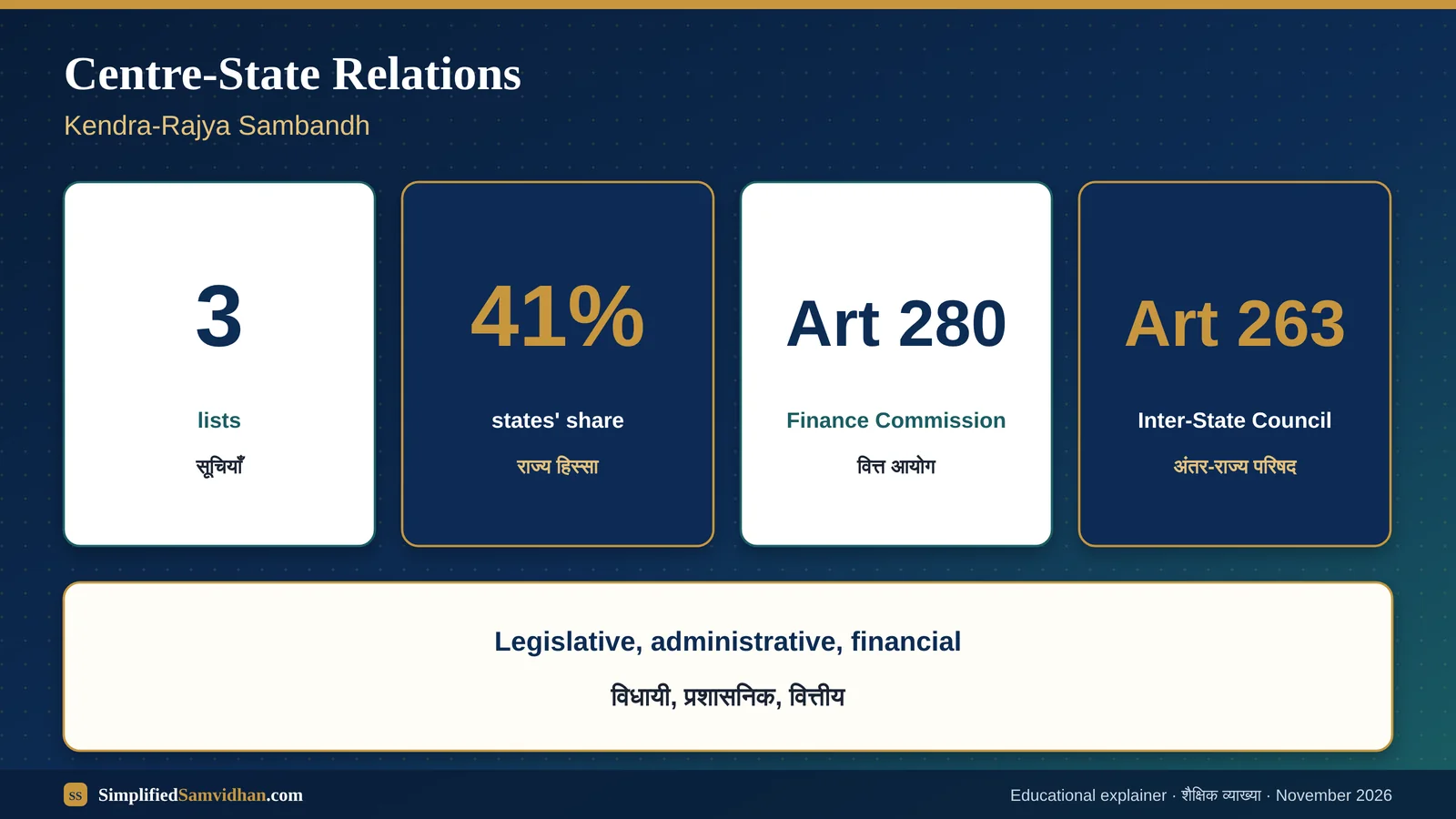
Legislative, administrative and financial relations, the Seventh Schedule, the Finance Commission and the 16th FC, GST Council and reform commissions, with practice MCQs.
Short answerCentre-State Relations in Simple Words
Short answer: India is a 'Union of States' (Art 1) with a strong Centre. Relations work at three levels: legislative (Arts 245-255, the Seventh Schedule with Union, State and Concurrent Lists; residuary power with the Centre, Art 248), administrative (Arts 256-263: states must obey Union laws, Inter-State Council under Art 263) and financial (Arts 264-293). The Finance Commission (Art 280, every 5 years) recommends how central taxes are shared. The 16th Finance Commission (chair Arvind Panagariya) kept the states' share at 41% for 2026-31. The GST Council (Art 279A) is the main forum of cooperative federalism.
🏠 Everyday analogy
Think of a joint family: the Centre earns more (big taxes), states spend more (police, health, schools), so the Finance Commission is the elder who decides each member's share.
🇮🇳 Real Indian example
Rajasthan's police, land and agriculture are State List subjects; education and forests are in the Concurrent List since the 42nd Amendment (1976).
Prelims: Seventh Schedule lists, Arts 249/252/253; Finance Commission: Art 280, chairmen, 41%; Sarkaria, Punchhi, Inter-State Council
Mains: Is India truly federal? (quasi-federal); fiscal federalism and GST; role of Governor and Art 356 in Centre-State tension
Constitution textWhat the Constitution Says
Article 246(1). Notwithstanding anything in clauses (2) and (3), Parliament has exclusive power to make laws with respect to any of the matters enumerated in List I in the Seventh Schedule...
Article 280(1). The President shall ... constitute a Finance Commission which shall consist of a Chairman and four other members to be appointed by the President.
Seventh ScheduleSeventh Schedule: Three Lists
| List | Who makes laws | Examples | Original entries |
|---|---|---|---|
| I Union | Parliament only | Defence, foreign affairs, banking, railways | 97 |
| II State | State legislature | Police, public order, agriculture, land, local government | 66 |
| III Concurrent | Both; Union law prevails (Art 254) | Criminal law, marriage, education, forests | 47 |
| Residuary | Parliament (Art 248) | Subjects in no list (e.g. cyber matters) | - |
Parliament on State ListWhen Parliament Can Make Laws on the State List
| Article | When Parliament can make law on a State List subject |
|---|---|
| 249 | Rajya Sabha resolution by 2/3 present and voting in national interest (valid 1 year, renewable) |
| 250 | During a national emergency |
| 252 | Two or more states request it (others may adopt) |
| 253 | To implement international treaties |
| 356 | During President's Rule in a state |
Finance CommissionFinance Commission (Article 280)
- 1Art 280: who
Chairman + 4 members, appointed by the President every 5 years.
- 2Vertical sharing
Share of divisible central taxes for all states together: 14th FC 42%, 15th 41%, 16th 41%.
- 3Horizontal sharing
Formula among states: population, area, income distance, forest, plus (16th FC) contribution to GDP.
- 4Grants
Art 275 grants-in-aid; Art 282 discretionary grants.
- 5Report
President lays it before Parliament with action taken (Art 281); advisory, not binding.
| Finance Commission | Chairman | Period |
|---|---|---|
| 1st | K.C. Neogy | 1952-57 |
| 14th | Y.V. Reddy | 2015-20 |
| 15th | N.K. Singh | 2020-26 |
| 16th | Arvind Panagariya | 2026-31 |
Sarkaria vs PunchhiSarkaria and Punchhi Commissions
Sarkaria Commission (1983-88)
- Art 356 only as last resort
- Permanent Inter-State Council (set up 1990)
- Governor: a detached person from outside the state
Punchhi Commission (2007-10)
- Fixed 5-year term for Governors; removal only by procedure
- 'Localised emergency' instead of full Art 356
- Time limit on assent to state bills
Current affairsCurrent Affairs of the Last One Year
- 16th Finance Commission report (tabled 1 February 2026): states' share kept at 41% for 2026-31; a new criterion of contribution to GDP added to the horizontal formula.
- GST rate rationalisation (September 2025): the GST Council moved to mainly two slabs (5% and 18%), with a higher rate for a few luxury and sin goods.
- Governor-assent opinion (20 November 2025): the Supreme Court said under Art 143 that courts cannot fix timelines for Governors on state bills. See Powers of the President.
- Already on this site: Cooperative vs competitive federalism · Unitary vs federal system · Emergency provisions (352, 356, 360) · Governor's appointment (Art 155)
- Related: Governor of Rajasthan · RAS polity syllabus
Mains answerRAS Mains: How to Write the Answer
- Q. 'India is a federation with a unitary bias.' Discuss with reference to Centre-State relations. (10 marks) Frame: federal features (two governments, lists, written Constitution, SC) → unitary tilt (Art 248, 249, 356, all-India services, Governor appointed by Centre, single citizenship) → fiscal side (vertical imbalance, FC 41%, GST Council) → reform reports (Sarkaria, Punchhi, Bommai) → conclusion: cooperative and competitive federalism.
Quick revisionOne-Line Revision Points (Exam Ready)
- Legislative 245-255, administrative 256-263, financial 264-293.
- Residuary power: Parliament, Art 248.
- Art 249: RS 2/3 resolution; Art 253: treaties.
- Inter-State Council: Art 263, set up 1990.
- FC: Art 280; 16th FC Panagariya, 41%.
- GST Council: Art 279A, 101st Amendment 2016.
Practice MCQPractice MCQs (with Answers): Centre-State relations
Residuary powers of legislation in India lie with:
The 16th Finance Commission is chaired by:
States' share in divisible central taxes recommended by the 16th FC for 2026-31:
Parliament can legislate on a State List subject in national interest after a resolution of:
The Inter-State Council is provided under Article:
Education was moved to the Concurrent List by the:
The GST Council is a constitutional body under Article:
Which commission recommended that the Governor be a person from outside the state?
If a state law on a Concurrent subject conflicts with a Union law, generally:
S.R. Bommai case (1994) is about:
Doubts ClearedFrequently Asked Questions
What does the Finance Commission do?
Every five years it recommends the share of central taxes for states (vertical), how that share is divided among states (horizontal) and grants-in-aid.
Is India federal or unitary?
Quasi-federal: federal in form, with a strong Centre. The Supreme Court in Bommai called federalism a basic feature.
Sources and further readingSources We Checked
Checked on 11 November 2026 against the Constitution (Articles 245-293), the PRS summary of the 16th Finance Commission report and PIB releases on GST.