Domestic Violence Act 2005 and POSH Act 2013: RAS Mains Notes
The syllabus sections of both women-protection laws in tables, IC vs LC, the Rajasthan link (Bhanwari Devi, Vishaka) and recent rulings, with practice MCQs.
Short answerDV Act and POSH Act in Simple Words
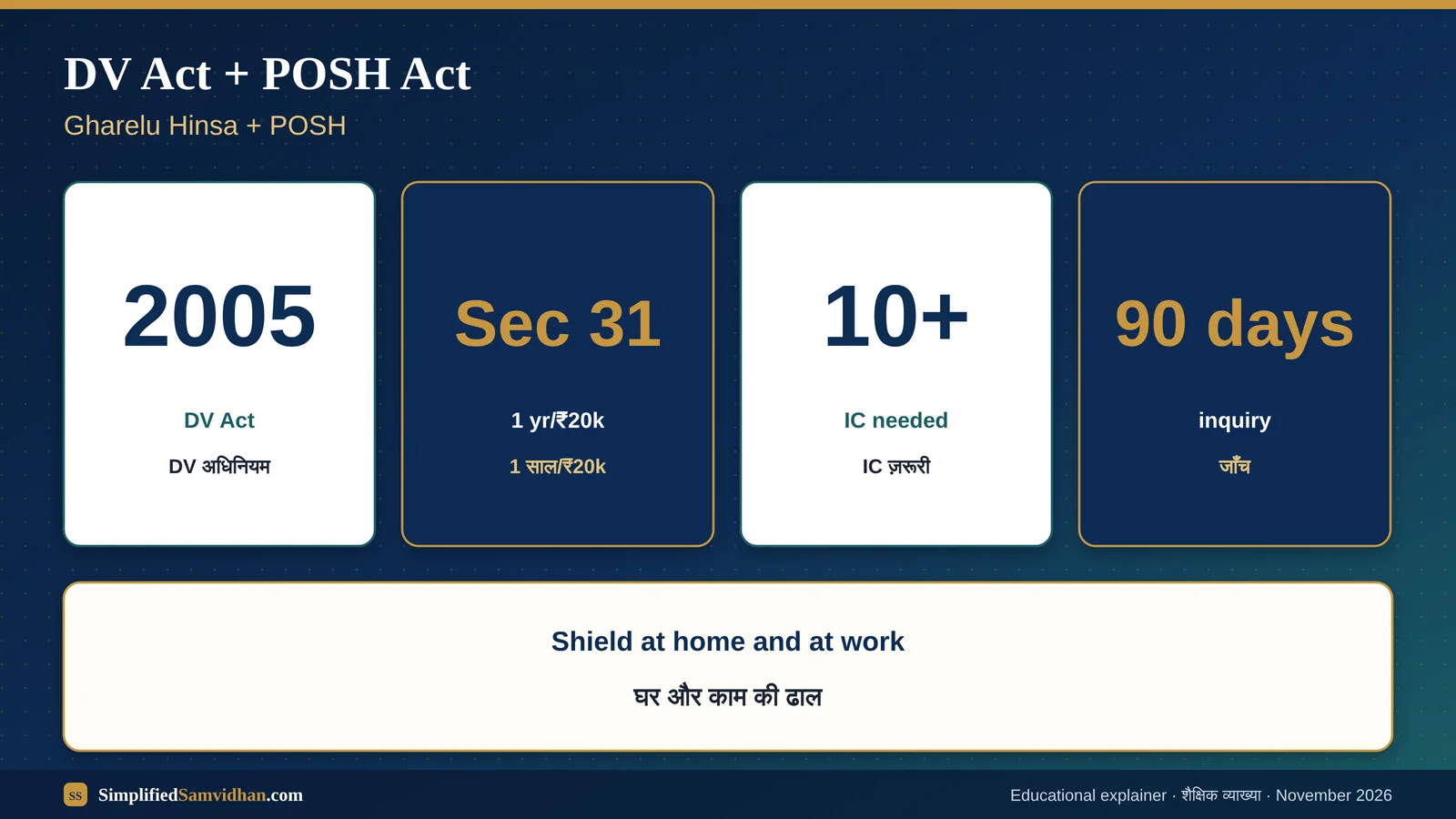
Short answer: the Protection of Women from Domestic Violence Act, 2005 (in force 26 October 2006) is a civil remedy for a woman in a domestic relationship: she can get protection, residence, money, custody and compensation orders from a Magistrate, with help from a Protection Officer. Domestic violence includes physical, sexual, verbal-emotional and economic abuse. The POSH Act, 2013 (Sexual Harassment of Women at Workplace) grew out of the Vishaka (1997) case from Rajasthan: every employer with 10 or more employees must set up an Internal Committee; others go to the district Local Committee. Complaint within 3 months, inquiry within 90 days.
🏠 Everyday analogy
The DV Act is a shield at home; the POSH Act is a shield at work.
🇮🇳 Real Indian example
Bhanwari Devi, a saathin in Bhateri (Jaipur district), was assaulted in 1992 for stopping a child marriage; the Vishaka guidelines (1997) followed and became the POSH Act.
Prelims: not in the Prelims list; Mains law paper (Paper III)
Mains: aggrieved person, domestic relationship, shared household; orders under Sections 18-22; Internal Committee vs Local Committee
DV ActDomestic Violence Act 2005: Sections 1-29, 31
| Section | DV Act 2005: what it says |
|---|---|
| 2 | Aggrieved person = a woman in a domestic relationship who alleges domestic violence; domestic relationship = living together in a shared household by marriage, relationship in the nature of marriage, blood, adoption or joint family; shared household = household where she lives or lived |
| 3 | Domestic violence: physical, sexual, verbal and emotional, economic abuse; dowry harassment included |
| 4-7 | Anyone may inform the Protection Officer (no liability for good-faith information); duties of police, Magistrate and service providers to tell her rights; shelter homes and medical facilities must help |
| 8-11 | State appoints Protection Officers (preferably women); their duties (Domestic Incident Report); registered service providers; government duties for awareness |
| 12-17 | Application to the Magistrate; first hearing within 3 days, disposal within 60 days; counselling; welfare expert; in-camera proceedings; right to reside in the shared household (Sec 17) |
| 18-22 | Orders: protection (18), residence (19), monetary relief (20), custody (21), compensation (22) |
| 23-29 | Interim and ex parte orders (23); free copies (24); duration and changes (25); relief in other suits (26); jurisdiction of JMFC (27); CrPC/BNSS procedure (28); appeal to the Sessions Court within 30 days (29) |
| 31 | Breach of a protection order: up to 1 year and/or ₹20,000; cognizable and non-bailable |
POSH ActPOSH Act 2013: Sections 1-9, 11-20
| Section | POSH Act 2013: what it says |
|---|---|
| 2-3 | Aggrieved woman (any age, employed or not, at a workplace); workplace includes places visited during work, transport given by employer, and a dwelling house (domestic workers); sexual harassment includes unwelcome physical contact, demand for sexual favours, sexual remarks, showing pornography; Sec 3 lists circumstances like promise of benefit or threat |
| 4 | Internal Committee (IC) in every office with 10+ employees: Presiding Officer a senior woman employee, at least 2 employee members, 1 external member from an NGO; at least half women; term up to 3 years |
| 5-8 | District Officer (DM/ADM/Collector etc.); Local Committee in every district for offices under 10 employees or when the complaint is against the employer; nodal officers; grants |
| 9 | Complaint in writing within 3 months of the incident (extendable by 3 more months) |
| 11-13 | Inquiry within 90 days with civil-court powers; interim relief (transfer, leave up to 3 months); report within 10 days; employer acts within 60 days |
| 14-17 | Action for malicious complaint or false evidence (not mere failure to prove); compensation factors; confidentiality (outside RTI); penalty for publishing identity |
| 18-20 | Appeal within 90 days; duties of the employer (display, training, help with criminal complaint); duties of the District Officer |
IC vs LCInternal Committee vs Local Committee
Internal Committee
- Set up by the employer
- Offices with 10 or more employees
- Presiding Officer: senior woman employee
Local Committee
- Set up by the District Officer
- Offices under 10, informal sector, or complaint against the employer
- Chairperson: eminent woman in social work
Current affairsCurrent Affairs of the Last One Year
- Sohail Malik v. Union of India (10 December 2025): the Supreme Court held that a woman can complain to the Internal Committee of her own workplace even when the harasser works in another department; the IC there has jurisdiction.
- Earlier landmarks: Hiral Harsora (2016) removed 'adult male' from the DV Act's definition of respondent, so women relatives can also be respondents; Aureliano Fernandes (2023) ordered all ministries and bodies to set up ICs properly.
- Already on this site: FIR and Zero FIR (BNSS 173) · Rape case compromise (SC) · Law and Awareness guides
- Related: POCSO and Senior Citizens Act · Rajasthan State Commission for Women · RAS polity syllabus
Mains answerRAS Mains: How to Write the Answer
- Q. Distinguish between the Internal Committee and the Local Committee under the POSH Act, 2013. (5 marks) Frame: background (Vishaka 1997, Bhanwari Devi) → IC (Sec 4: 10+ employees, composition, term) → LC (Sec 6-7: district, under-10 and complaints against employer) → common features (90 days, civil-court powers) → one-line conclusion.
Quick revisionOne-Line Revision Points (Exam Ready)
- DV Act in force 26 Oct 2006; civil remedy.
- 4 forms: physical, sexual, verbal-emotional, economic.
- Orders: 18 protection, 19 residence, 20 money, 21 custody, 22 compensation.
- Sec 31: breach = 1 year/₹20,000.
- POSH: IC for 10+ employees; LC in each district.
- POSH complaint 3 months; inquiry 90 days.
Practice MCQPractice MCQs (with Answers): DV Act and POSH Act
Which is NOT a form of domestic violence under Section 3?
A residence order is passed under DV Act Section:
Penalty for breach of a protection order (Sec 31):
A DV Act application should be disposed of within:
An Internal Committee is required where employees are:
POSH complaint must normally be made within:
The POSH inquiry must be completed within:
The Vishaka case arose from an incident in which state?
Who sets up the Local Committee under the POSH Act?
Appeal against a DV Act order lies to the Sessions Court within:
Doubts ClearedFrequently Asked Questions
Can a woman in a live-in relationship use the DV Act?
Yes, if it is a 'relationship in the nature of marriage' and they shared a household.
Does POSH cover domestic workers?
Yes. A dwelling house is a workplace; domestic workers complain to the Local Committee.
Sources and further readingSources We Checked
Checked on 13 November 2026 against the bare texts of the DV Act 2005 and POSH Act 2013 (India Code) and Supreme Court judgments.