Two-Child Norm in Panchayat Elections: Supreme Court Says It Has Lost Relevance, Sends Javed to a Larger Bench
For about 30 years, many States barred a person with more than two children from becoming a panch or sarpanch. On 4 November 2026 the Supreme Court said this logic has lost relevance now that India's fertility rate has fallen below the replacement level, and asked a larger bench to look again at its own 2003 ruling. Here is what was decided, and what was not.
What the Supreme Court said on 4 November 2026
A Bench of Justices P.S. Narasimha and Alok Aradhe heard the appeal of Mangala Bhimrao Ingle, a former sarpanch in Maharashtra who was removed from office because she had a third child. The Court stayed the disqualification and kept the stay in place until the appeal is decided.
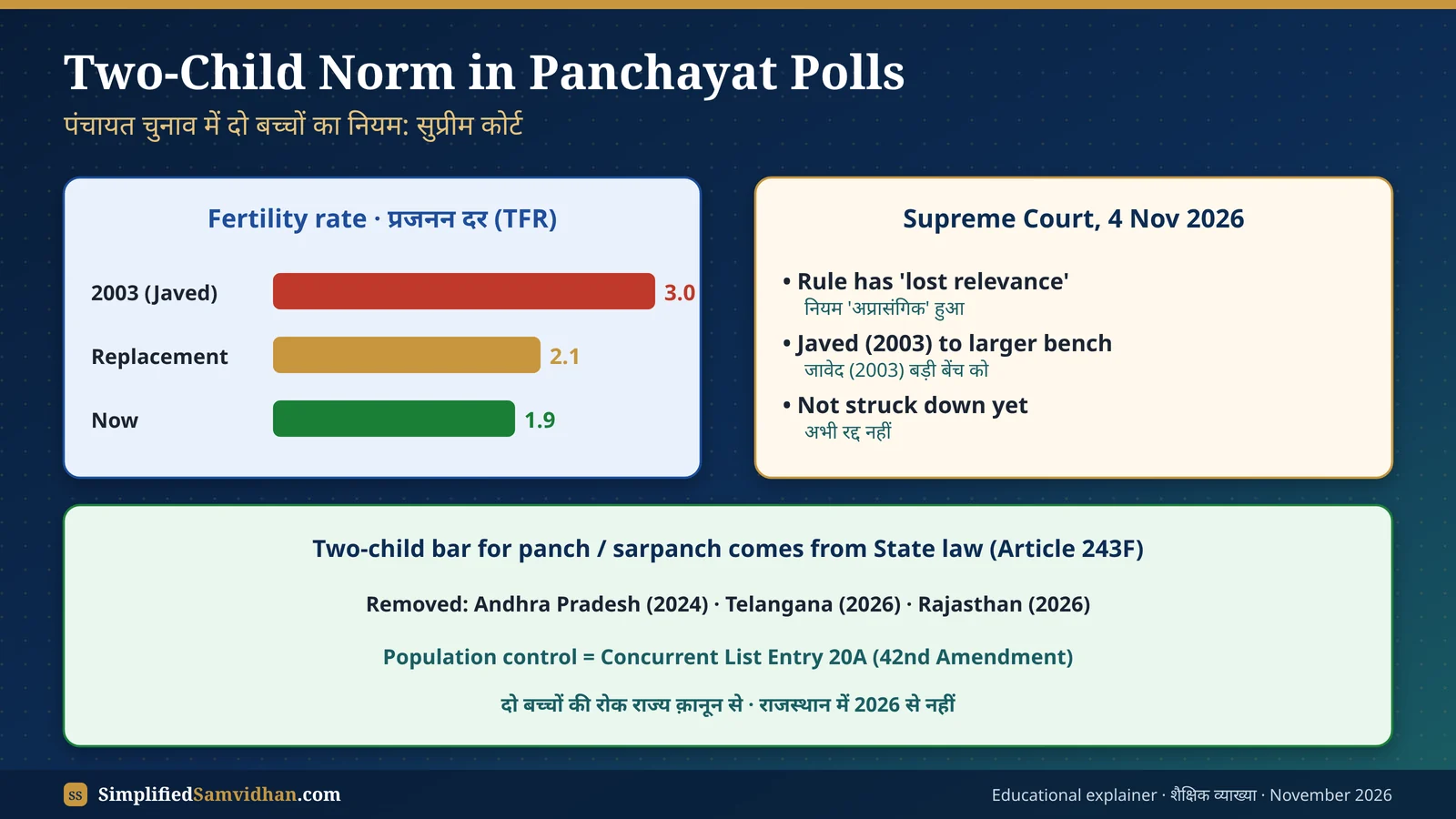
The Bench noted that when the Supreme Court upheld the two-child rule in Javed v State of Haryana (2003), India's Total Fertility Rate (TFR) was about 3.0; it is now about 1.9, below the replacement level of 2.1. In that light, it said laws penalising people for having more than two children have lost their relevance. But a two-judge Bench cannot overrule a three-judge Bench, so it did not strike the law down; it referred the question to a larger bench. Until then, State laws that still carry the rule remain in force.
At a GlanceThe Order at a Glance: Key Facts
| Point | Fact |
|---|---|
| Date and Bench | 4 November 2026; Justices P.S. Narasimha and Alok Aradhe |
| Appellant | Mangala Bhimrao Ingle, former sarpanch, Maharashtra (disqualified for a third child) |
| Earlier ruling | Javed v State of Haryana (2003, three judges) upheld the two-child rule for panchayats |
| Fertility then and now | TFR about 3.0 in 2003; about 1.9 now (replacement level 2.1), as noted by the Court |
| What the Court said | Laws penalising more than two children have lost relevance |
| What it did | Referred the question to a larger bench; stayed the disqualification meanwhile |
| Not done | The law was not struck down; Javed is not overruled yet |
| States that dropped it | Andhra Pradesh (Nov 2024), Telangana (Jan 2026), Rajasthan (2026), among others |
The rule was made when India worried about too many births. The Court is saying: that worry has changed, because families today have fewer children on average than needed to keep the population stable. Punishing a village leader for a third child no longer serves the purpose the rule was made for.
🏠 Everyday analogy
A school makes a rule that no student may bring a big bag because classrooms are crowded. Years later the school has fewer students and empty rooms. The rule is still on the notice board, but its reason is gone. The principal (here, a larger bench) has to decide whether to remove it.
🇮🇳 Real Indian example
In Rajasthan, the 2026 panchayat elections (sarpanch phases on 24 Oct, 30 Oct, 5 Nov and 16 Nov) are being held without the two-child rule, because the State removed it this year. A candidate in Maharashtra still faces it until the larger bench decides or the State changes its law.
Official TextArticle 243F and the Concurrent List Entry 20A
Constitution of India, Article 243F(1).
(1) A person shall be disqualified for being chosen as, and for being, a member of a Panchayat—
(a) if he is so disqualified by or under any law for the time being in force for the purposes of elections to the Legislature of the State concerned: Provided that no person shall be disqualified on the ground that he is less than twenty-five years of age, if he has attained the age of twenty-one years;
(b) if he is so disqualified by or under any law made by the Legislature of the State.
Seventh Schedule, List III (Concurrent List), Entry 20A (inserted by the Constitution (Forty-second Amendment) Act, 1976).
20A. Population control and family planning.
- Article 243F(1)(b) lets each State add its own disqualifications for panchayat members. The two-child rule comes from State panchayat laws, not from the Constitution.
- Entry 20A of the Concurrent List (added in 1976) lets both Parliament and States make laws on population control and family planning. There is no national two-child law for MPs or MLAs.
- In Javed (2003) the Court held the rule was a reasonable classification under Article 14, served the national goal of population control, and did not violate the right to life or religious freedom.
- Read about panchayats in Article 40 (village panchayats, a Directive Principle).
Both SidesFor and Against the Two-Child Rule
Arguments for the rule (Javed, 2003)
- Leaders should set an example in family planning
- Population control is a national goal (Entry 20A)
- Contesting an election is a statutory right, not a fundamental right
- States can fix eligibility under Article 243F
Arguments against (2026 view)
- TFR now about 1.9, below replacement level
- Hits women and the poor hardest; women lose posts for births they may not control
- Can push sex-selection, desertion or hiding of children
- Several States have already dropped it
What NextWhat Happens Now
- 1Larger bench
The Chief Justice will set up a bench of at least three judges (larger than the two-judge Bench). It may confirm, limit or overrule Javed.
- 2Stay continues
Mangala Ingle's disqualification remains stayed until her appeal is decided.
- 3State laws still apply
Where a State law still has the two-child bar, election officers must follow it until a court or the legislature changes it.
- 4States may act first
Any State can remove the rule by amending its panchayat or municipal law, as Andhra Pradesh, Telangana and Rajasthan did.
UPSC CornerTwo-Child Norm for UPSC Prelims and Mains
- Prelims: Panchayat disqualifications: Article 243F; minimum age 21 years. Panchayats were added by the 73rd Amendment (1992), Part IX.
- Prelims: 'Population control and family planning' is Entry 20A of the Concurrent List, added by the 42nd Amendment (1976).
- Prelims: Replacement-level fertility is a TFR of about 2.1 children per woman.
- Mains (GS II): "Eligibility rules for local bodies must keep pace with social change." Examine with reference to the two-child norm.
Practice MCQTest Yourself: Two-Child Norm for Panchayat Polls: Larger Bench
Consider the following statements: (1) The disqualification of panchayat members for having more than two children comes from State laws made under Article 243F. (2) 'Population control and family planning' is an entry in the Concurrent List. (3) In November 2026 the Supreme Court struck down the two-child norm for panchayat elections. Which of the statements given above is/are correct?
Doubts ClearedFrequently Asked Questions
Has the Supreme Court abolished the two-child norm?
No. On 4 November 2026 it said such laws have lost relevance and referred the question to a larger bench. It stayed the disqualification of one Maharashtra ex-sarpanch, but State laws with the rule remain valid for now.
What was Javed v State of Haryana?
A 2003 three-judge Supreme Court ruling that upheld Haryana's law disqualifying panchayat members with more than two living children, as a reasonable step for population control.
Is the two-child rule still there in Rajasthan panchayat elections?
No. Rajasthan removed it in 2026 by amending its Panchayati Raj law, so it does not apply in the 2026 panchayat elections.
Why did the Court say the rule lost relevance?
Because India's Total Fertility Rate has fallen from about 3.0 in 2003 to about 1.9, below the replacement level of 2.1, so the reason behind the rule has weakened.
Does any two-child rule apply to MPs and MLAs?
No. There is no two-child condition in the Constitution or the Representation of the People Act for Parliament or State Assembly elections.
Sources and further readingSources We Checked
Facts checked against the news reports below on 6 November 2026. We could not read the written order; the list of States that still keep the rule changes often, so check the State law before relying on it.
- Law Trend: Two-child norm for panchayat polls has lost relevance as India's fertility falls below replacement level: Supreme Court
- Outlook India: Supreme Court refers two-child disqualification law for local body elections to larger bench
- TaxGuru: Two-child norm lost relevance: SC refers election disqualification law to larger bench
- Indian Masterminds: Supreme Court questions two-child election rule as India's fertility rate falls
- NewKerala: Rajasthan Assembly scraps two-child norm for Panchayati Raj polls (2026)
- News On AIR: Telangana Assembly passes Bill abolishing two-child norm for local body elections (Jan 2026)