The 24-Hour Clock Starts When Police Hold You, Not When They Write 'Arrested': Supreme Court
Police often pick a person up in the morning, question him all day, and show the 'arrest' only at night. Which time starts the 24-hour limit of Article 22(2)? On 5 November 2026 the Supreme Court answered clearly: the moment your liberty is taken. Here is the ruling in simple words, and what it means for you.
What the Supreme Court decided on 5 November 2026
A Bench of Justices Ujjal Bhuyan and Atul S. Chandurkar decided Sujit Das v Union of India (2026 INSC 1195) on 5 November 2026. The question was simple: does the 24-hour period of Article 22(2) begin when the person is first held, or only when the agency formally records the arrest?
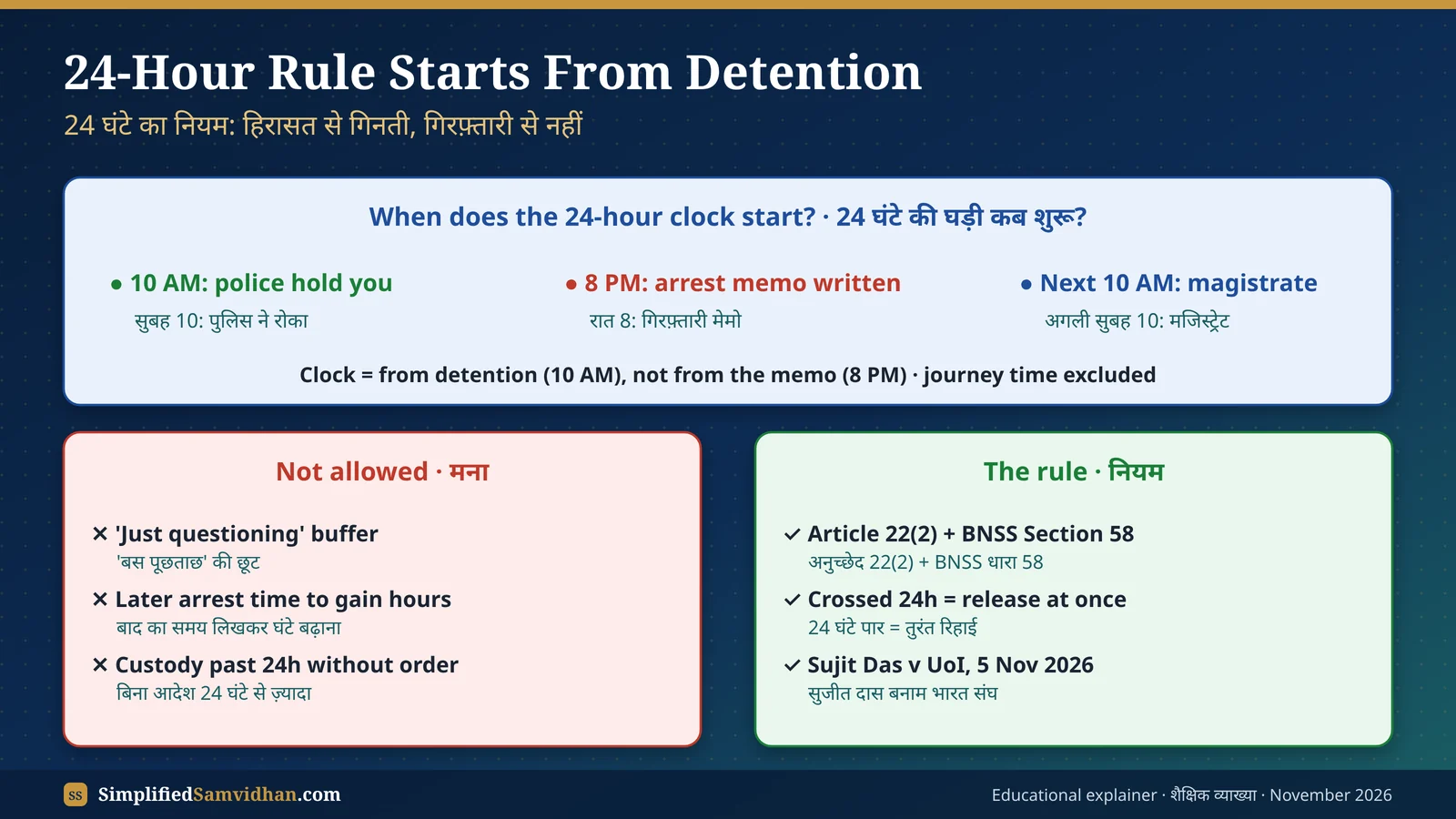
The Court held that the 24 hours begin from the date and time of detention, when the person's liberty is actually curtailed. There is no informal 'buffer' period in which a person can be kept for questioning without the clock running. If custody goes beyond 24 hours (plus journey time) without a magistrate's order, the person must be released at once. As reported, the Court also said detention must be reasonable even inside the 24 hours, and told magistrates to record the actual time of detention and check compliance before granting remand. The appellants were ordered to be released.
At a GlanceThe Ruling at a Glance: Key Facts
| Point | Fact |
|---|---|
| Case | Sujit Das v Union of India, 2026 INSC 1195 |
| Date and Bench | 5 November 2026; Justices Ujjal Bhuyan and Atul S. Chandurkar |
| Provision | Article 22(2) of the Constitution; BNSS 2023 Section 58 (old CrPC Section 57) |
| Key holding | 24 hours run from actual detention, not from the formal arrest memo |
| No buffer | No informal period for interrogation outside the 24-hour clock |
| Inside 24 hours | Detention must still be reasonable; magistrate may refuse remand |
| Duty of magistrate | Record the real date and time of detention and verify compliance |
| Result | Appellants ordered to be released |
'Arrest' is not a word on paper. If police stop you from leaving, you are in custody, and the Constitution's 24-hour clock starts. Police cannot keep you 'just for questioning' for a day and then write a later arrest time to gain extra hours.
🏠 Everyday analogy
A taxi meter starts when you sit in the taxi, not when the driver decides to switch it on halfway. Writing a later arrest time is like starting the meter late: the law counts from the moment you were really inside.
🇮🇳 Real Indian example
Ramesh, a shopkeeper in Jaipur, is taken to the police station at 10 AM on Monday 'to answer some questions'. He is not allowed to go home. Even if the arrest memo says 8 PM, he must be produced before a magistrate by about 10 AM on Tuesday (plus travel time).
Official TextArticle 22(1), 22(2) and BNSS Section 58
Constitution of India, Article 22(1) and 22(2).
(1) No person who is arrested shall be detained in custody without being informed, as soon as may be, of the grounds for such arrest nor shall he be denied the right to consult, and to be defended by, a legal practitioner of his choice.
(2) Every person who is arrested and detained in custody shall be produced before the nearest magistrate within a period of twenty-four hours of such arrest excluding the time necessary for the journey from the place of arrest to the court of the magistrate and no such person shall be detained in custody beyond the said period without the authority of a magistrate.
Bharatiya Nagarik Suraksha Sanhita, 2023, Section 58 (earlier CrPC Section 57).
No police officer shall detain in custody a person arrested without warrant for a longer period than under all the circumstances of the case is reasonable, and such period shall not, in the absence of a special order of a Magistrate under section 187, exceed twenty-four hours exclusive of the time necessary for the journey from the place of arrest to the Magistrate's Court, whether having jurisdiction or not.
- Article 22(1): right to be told the grounds of arrest and to consult a lawyer of one's choice.
- Article 22(2): production before the nearest magistrate within 24 hours, journey time excluded; no custody beyond that without a magistrate's authority.
- Article 22(3): clauses (1) and (2) do not apply to an enemy alien or to a person held under a preventive detention law. Those cases follow Article 22(4) to (7). See our preventive detention page.
- BNSS Section 58 repeats the 24-hour limit in the criminal code, and adds that even a shorter period must be 'reasonable'. Section 187 (old CrPC 167) is the magistrate's remand power.
What ChangesDetention vs Formal Arrest: Before and After
The practice the Court stopped
- Person held 'for questioning' for hours
- Arrest memo written later in the day
- 24 hours counted from the memo time
- Magistrate sees only the paper time
The rule now
- Clock starts when liberty is curtailed
- Paper time cannot extend custody
- Crossing 24 hours = release at once
- Magistrate must record the real detention time
Your RightsIf Police Detain You or a Family Member
- 1Note the real time
Write down or tell a relative the exact time police first held you, and where. Witnesses and CCTV help.
- 2Ask the grounds
You have a right to know why you are held (Article 22(1)) and to call a lawyer.
- 3Inform family
Police must inform a relative or friend about the arrest and place of custody (BNSS Section 48).
- 4Count 24 hours
Count from the time of detention, not from the arrest memo. Travel time to the court is excluded.
- 5Tell the magistrate
At production, the lawyer can point out the real detention time. If 24 hours have passed, ask for release; a habeas corpus petition under Article 32 or 226 is the remedy for illegal custody.
UPSC CornerArticle 22 for UPSC Prelims and Mains
- Prelims: Article 22(2): production within 24 hours, journey time excluded. Article 22(3) excludes enemy aliens and preventive detention.
- Prelims: Habeas corpus ('you may have the body') is the writ against illegal detention; it can be filed under Article 32 (SC) or Article 226 (HC).
- Prelims: BNSS 2023 Section 58 corresponds to CrPC 1973 Section 57; remand power is in BNSS Section 187.
- Mains (GS II): "Procedural safeguards at the moment of arrest are the real test of Article 21." Discuss with reference to recent Supreme Court rulings on Article 22.
Practice MCQTest Yourself: 24-Hour Rule Starts From Detention, Not Arrest
With reference to Article 22 of the Constitution of India, consider the following statements: (1) A person arrested and detained must be produced before the nearest magistrate within 24 hours, excluding journey time. (2) According to the Supreme Court in November 2026, the 24 hours are counted from the time the formal arrest is recorded. (3) Clause (2) does not apply to a person detained under a preventive detention law. Which of the statements given above is/are correct?
Doubts ClearedFrequently Asked Questions
From when are the 24 hours counted after arrest?
From the time of actual detention, when the person is no longer free to leave, as the Supreme Court held on 5 November 2026 in Sujit Das v Union of India. The later time written in the arrest memo does not reset the clock.
Is the travel time to court included in the 24 hours?
No. Article 22(2) and BNSS Section 58 exclude the time needed for the journey from the place of arrest to the magistrate's court.
What happens if police keep a person beyond 24 hours?
Custody beyond 24 hours without a magistrate's order is illegal. The Court said the person must be released forthwith. A habeas corpus petition can be filed in the High Court or Supreme Court.
Can police keep someone 'just for questioning' without arresting?
If the person is not free to go, it is detention, and the 24-hour clock runs. The Court rejected any informal buffer period for interrogation.
Does the 24-hour rule apply to preventive detention?
No. Article 22(3) excludes persons held under preventive detention laws; their safeguards are in Article 22(4) to (7), such as the Advisory Board.
Sources and further readingSources We Checked
Facts checked against the legal news reports below on 6 November 2026. We could not read the full judgment text; reports differ on the exact deadline date in this case, so check the Supreme Court's copy (2026 INSC 1195) for the details.
- LiveLaw: 24-hour period for production before Magistrate runs from time of detention and not from formal arrest (5 Nov 2026)
- Verdictum: 24-hour timeline under Article 22(2) starts from detention, not formal arrest (Sujit Das v Union of India, 2026 INSC 1195)
- Bar & Bench: 24-hour period to produce accused before magistrate starts with detention, not formal arrest
- Deccan Herald: 24-hour period to produce before magistrate starts from detention, not formal arrest
- Business Standard: 24-hour arrest deadline starts from detention, not formal arrest: SC
- Constitution of India, Article 22 (Legislative Department)