Grandson's Right in Grandfather's Property: Supreme Court Says No Birthright in Property Father Inherited
Can a grandson sue his own father for a share in the house that came from the grandfather? On 6 November 2026 the Supreme Court said no, if the grandfather died after 1956 and his property was divided among his legal heirs. The father's share then becomes his own property. Here is the ruling, the law behind it and what it means for families.
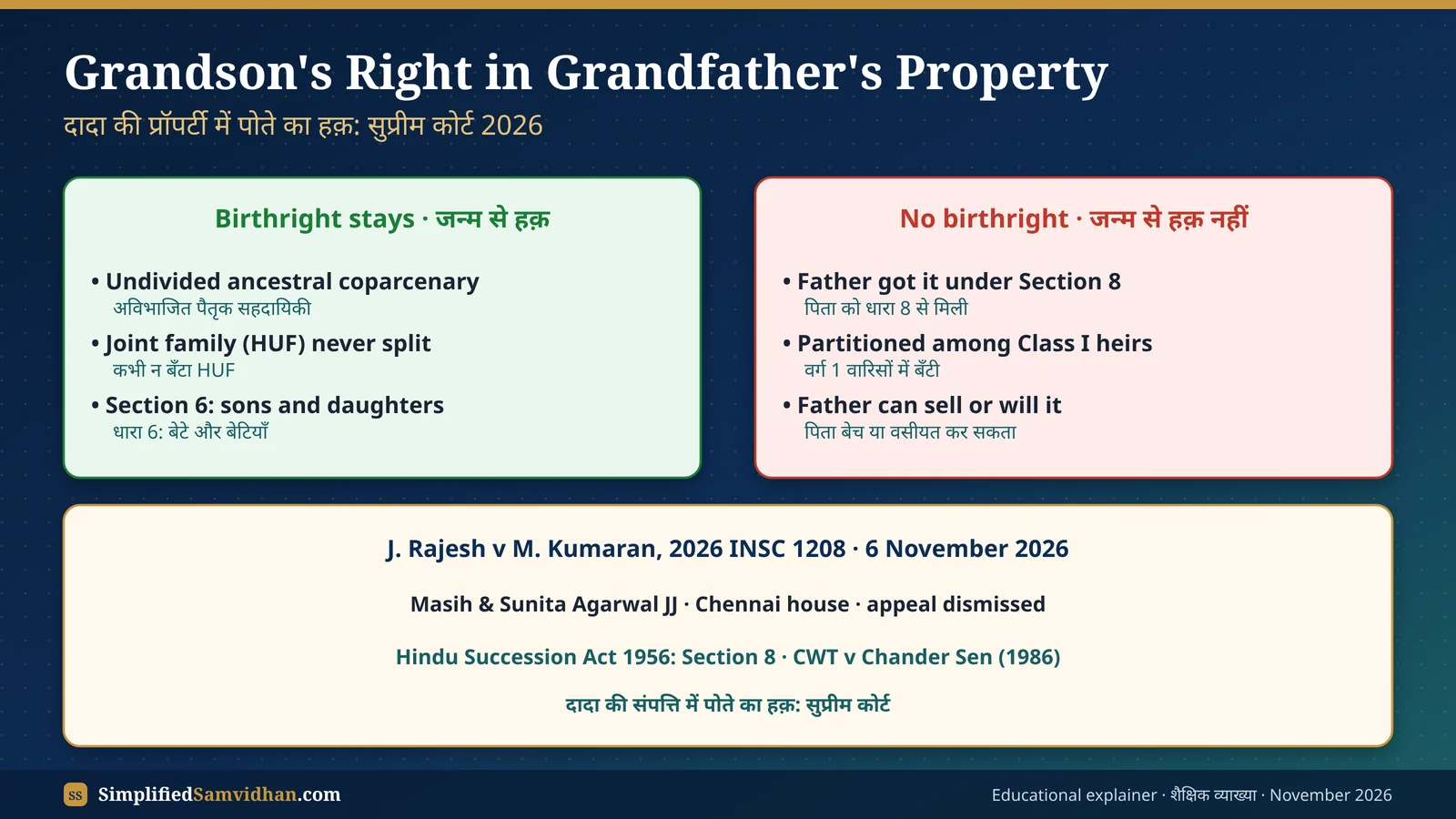
What the Supreme Court decided
In J. Rajesh (minor) v. M. Kumaran (dead) through LRs, 2026 INSC 1208, a Bench of Justices Augustine George Masih and Sunita Agarwal decided on 6 November 2026 (reported widely on 11 November) that a grandson does not get a right by birth in a property his father received when the grandfather's estate passed to the grandfather's Class I legal heirs under Section 8 of the Hindu Succession Act, 1956 and was partitioned among them.
The case was about a house of about 1,811 sq ft in Chennai. The grandson, through his mother, sought partition of his father's share. The Court held that once the grandfather's estate devolved under Section 8, it stopped being joint family property; the heirs held their shares as tenants-in-common, and the father's share became his individual property. Neither Section 6 of the Act nor Section 29-A of the Tamil Nadu amendment helped the grandson. The appeal, pending since 2011, was dismissed.
At a GlanceGrandson's Right in Grandfather's Property at a Glance
| Point | Fact |
|---|---|
| Case | J. Rajesh (minor) v. M. Kumaran (dead) through LRs, 2026 INSC 1208 |
| Bench and date | Augustine George Masih and Sunita Agarwal JJ, 6 November 2026 |
| Property | House of about 1,811 sq ft in Chennai owned by the grandfather |
| Question | Does a grandson get a share by birth in property his father inherited from the grandfather? |
| Answer | No, if it came to the father under Section 8 and was partitioned among Class I heirs |
| Key law | Hindu Succession Act, 1956: Section 8 and Class I of the Schedule |
| Earlier ruling followed | Commissioner of Wealth Tax v. Chander Sen (1986) |
| Result | Grandson's appeal dismissed; High Court view upheld |
Old Hindu law treated family land like a shared pot: every boy born into the family got a share in it at birth. The 1956 Act changed this for property passed on by inheritance. When a man dies without a will, his property goes to his Class I heirs (son, daughter, widow, mother and others). What the son gets is now his own, just like money he earned himself.
🏠 Everyday analogy
A grandfather leaves a cake to his wife, son and daughter. They cut it into three pieces. The son's piece is now his, not a piece that his child can claim a bite of while the father is alive.
🇮🇳 Real Indian example
Ramesh's father died in 2000 without a will. The house in Jaipur was divided between Ramesh, his sister and their mother. Ramesh's share is his own. His son cannot file a partition suit against him for it; Ramesh can sell it or leave it by will to anyone.
Official TextSection 8 of the Hindu Succession Act and Class I Heirs
Hindu Succession Act, 1956, Section 8. General rules of succession in the case of males.
The property of a male Hindu dying intestate shall devolve according to the provisions of this Chapter: (a) firstly, upon the heirs, being the relatives specified in class I of the Schedule; (b) secondly, if there is no heir of class I, then upon the heirs, being the relatives specified in class II of the Schedule; ...
Schedule, Class I (main heirs).
Son; daughter; widow; mother; son of a pre-deceased son; daughter of a pre-deceased son; son of a pre-deceased daughter; ... (other descendants of pre-deceased children).
- A son's son is a Class I heir only if his father (the son) has already died. When the father is alive, the father inherits and the grandson gets nothing directly.
- Succession is in the Concurrent List (Entry 5), so both Parliament and States can make laws. Tamil Nadu's 1989 amendment (Section 29-A) had made daughters coparceners there before the 2005 central amendment.
- Read more: Law & Awareness guides and Legal Updates.
Ancestral or OwnAncestral Property vs Property Inherited Under Section 8
Grandson HAS a birthright
- Old ancestral property that stayed in an undivided Mitakshara coparcenary
- Property already held as joint family (HUF) property and never split
- Coparcenary property under Section 6 (sons and, since 2005, daughters)
Grandson has NO birthright
- Property the father got under Section 8 after the grandfather died without a will (post-1956)
- Grandfather's estate partitioned among Class I heirs: shares become individual
- Father's self-acquired property: he can sell or will it freely
PrecedentsEarlier Supreme Court Rulings the Court Relied On
- CWT v. Chander Sen (1986): property a son inherits from his father under Section 8 is his individual property, not joint family property in which his sons get a share.
- Yudhishter v. Ashok Kumar (1987) and Uttam v. Saubhag Singh (2016) repeated this view.
- Vineeta Sharma v. Rakesh Sharma (2020): daughters are coparceners by birth under the amended Section 6, whether or not the father was alive on 9 September 2005.
- This case (2026): applies Chander Sen to a grandson claiming a share while his father is alive.
Both SidesWhat It Means for Families
Clarity it brings
- A father can sell, gift or will the share he inherited
- Fewer partition suits by sons against fathers
- Buyers can rely on the father's title
- Ends a 29-year dispute
Points to remember
- Truly ancestral, undivided coparcenary property still gives a birthright
- If the father dies without a will, the grandson inherits as a Class I heir
- Daughters have equal coparcenary rights since 2005
- Muslim, Christian and Parsi families follow different succession laws
What To DoWhat You Can Do
- 1Check the source
Find out how the property came to your father: old ancestral HUF, Section 8 inheritance, or self-earned.
- 2Check documents
Look at the sale deed, partition deed, mutation entries and any will.
- 3Write a will
Owners of individual property can avoid disputes by making a clear registered will.
- 4Get advice
For a partition suit or sale, take advice from a lawyer or the District Legal Services Authority (free for eligible people).
UPSC CornerHindu Succession Law for UPSC and Judiciary Exams
- Prelims: Succession is in the Concurrent List (Entry 5, List III).
- Prelims: Hindu Succession (Amendment) Act, 2005 made daughters coparceners by birth (Section 6).
- Prelims: Son of a pre-deceased son is a Class I heir; son's son is not, when the son is alive.
- Mains (GS II): "Codified succession law has slowly replaced the idea of birthright with individual ownership." Discuss with reference to recent Supreme Court rulings.
Practice MCQTest Yourself: Grandson's Right in Grandfather's Property
With reference to the Hindu Succession Act, 1956, consider the following statements: (1) A son's son is a Class I heir even when his father is alive. (2) Property a son inherits from his father under Section 8 is his individual property. (3) Daughters are coparceners by birth after the 2005 amendment. Which of the statements given above is/are correct?
Doubts ClearedFrequently Asked Questions
Does a grandson have a right in his grandfather's property?
Not by birth, if the grandfather died after 1956 and the property passed to his Class I heirs under Section 8 and was divided. The father's share is the father's own property.
Can a grandson sue his father for partition?
Not for property the father inherited under Section 8 as his individual share. He may for genuinely ancestral coparcenary property that never stopped being joint.
Can the father sell or will that property?
Yes. It is his individual property, so he can sell, gift or will it to anyone.
What happens if the father dies without a will?
Then the grandson (as son) inherits as a Class I heir of his father, along with others like his mother and sisters.
Which case is this?
J. Rajesh (minor) v. M. Kumaran (dead) through LRs, 2026 INSC 1208, decided on 6 November 2026 by Justices Augustine George Masih and Sunita Agarwal.
Sources and further readingSources We Checked
Facts checked on 12 November 2026 against the law reports and news below. We did not read the full judgment text; check the official judgment on sci.gov.in before relying on exact wording. This page is general information, not legal advice.
- Verdictum: J. Rajesh v. M. Kumaran, 2026 INSC 1208: grandson has no birthright in property father got on partition among Class I heirs
- ANI: SC says grandson cannot claim coparcenary rights in grandfather's property after partition among legal heirs (11 Nov 2026)
- Business Today: Grandson has no right to grandfather's property held by father, Supreme Court rules (11 Nov 2026)
- StudyIQ: Supreme Court on grandson's rights in ancestral property (J. Rajesh v. M. Kumaran)
- India Code: The Hindu Succession Act, 1956