Strait of Hormuz: Iran Exempts Indian Ships From Its Curbs, What It Means for India
About a fifth of the world's oil passes through one narrow sea lane, the Strait of Hormuz. In early November 2026 Iran said ships from India, China, Iraq and Qatar are exempt from its restrictions there. Why India got this, what international law says about such straits, and why Indian ships are still not fully safe.
What Iran announced, and what is still unclear
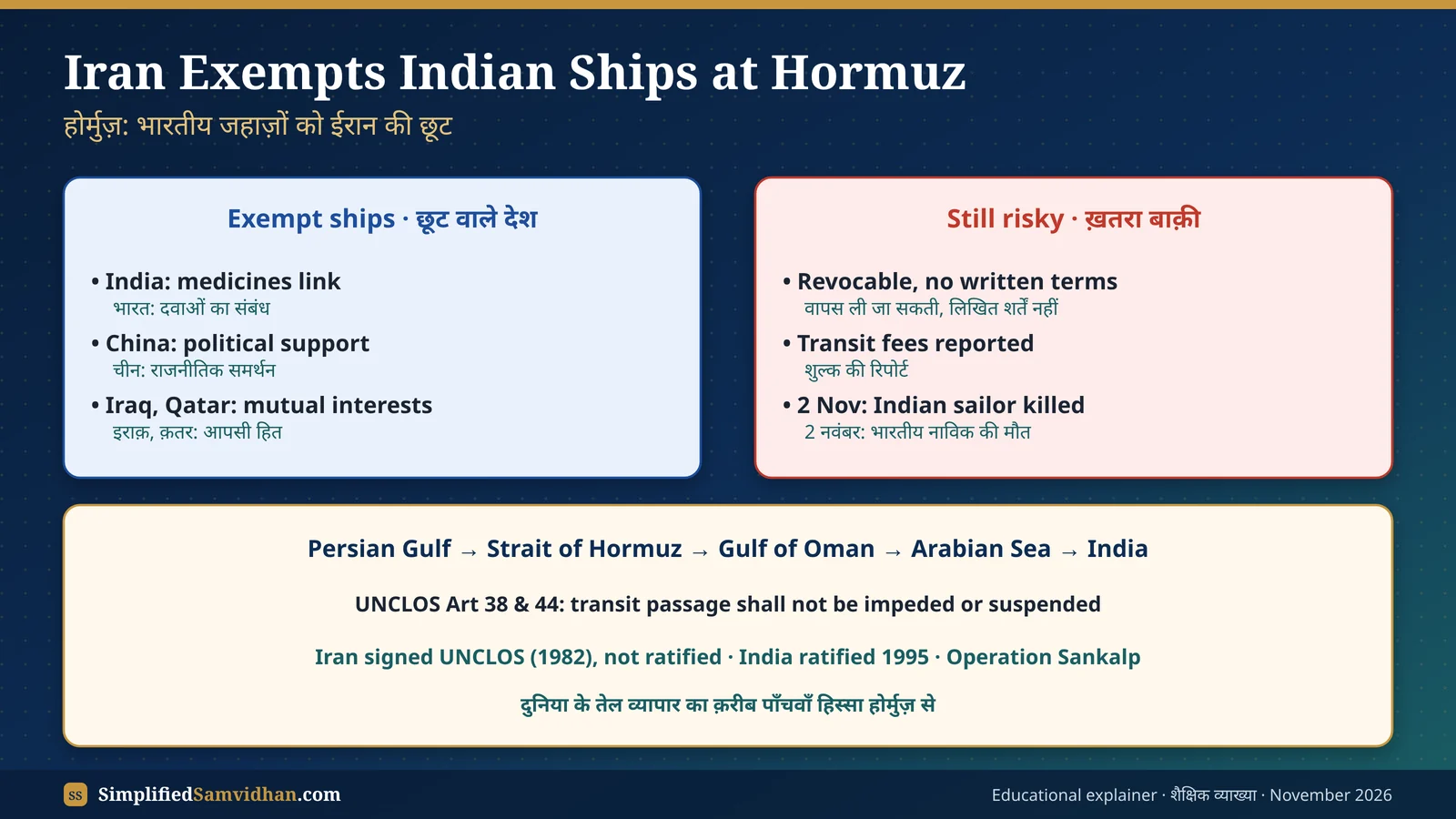
On 3-4 November 2026, Iranian lawmaker Amir Hayat-Moghaddam told the ISNA news agency that merchant ships from India, China, Iraq and Qatar are exempt from the transit restrictions Iran has placed on the Strait of Hormuz during its conflict with the United States. He said the Indian exemption helps Iran import medicines from India; for China he cited political support, and for Iraq and Qatar 'mutual interests'.
Reports say Iran collects transit fees from Indian and Chinese ships but not from Qatari ships. No official written list of terms has been published. Al Jazeera notes the exemption is revocable and that a US naval blockade also affects which ships move. Risk remains: on 2 November a vessel with an Indian crew, MSV Al Jusufi, was struck near Oman and one Indian sailor was killed, as reported.
At a GlanceThe Hormuz Exemption at a Glance
| Point | Fact |
|---|---|
| Who announced | Iranian MP Amir Hayat-Moghaddam (to ISNA), 3-4 November 2026 |
| Exempt countries | India, China, Iraq, Qatar |
| Reason given for India | Easier import of medicines from India |
| Fees | Reported for Indian and Chinese ships; not for Qatari ships |
| Strait | Between Iran and Oman; joins the Persian Gulf to the Gulf of Oman and Arabian Sea |
| Why it matters | Roughly one-fifth of world oil trade; a large share of India's crude, LPG and LNG |
| Law | UNCLOS Articles 37-44: transit passage 'shall not be impeded' or suspended |
| Indian Navy | Operation Sankalp (since June 2019) escorts Indian-flagged ships in the region |
Think of Hormuz as the only gate of a busy colony. One house owner (Iran) has put a guard at the gate during a fight with a neighbour. Now he says four families may pass. That helps those families, but the gate was never meant to be his to close, and he can change his mind any day.
🏠 Everyday analogy
A toll-free highway passes next to a village. During a quarrel, the village blocks the road but lets some trucks pass for a fee. Drivers are happy to move, but the rule book says the highway should be open to all and free for simple passage.
🇮🇳 Real Indian example
A tanker carrying Saudi or Iraqi crude to Jamnagar or Paradip must pass Hormuz. If it waits outside for weeks, petrol, diesel and LPG costs in India rise. That is why New Delhi watches every statement from Tehran.
Official TextUNCLOS on Straits, and Article 51 of the Constitution
UN Convention on the Law of the Sea (UNCLOS), 1982, Article 38(1). Right of transit passage.
In straits referred to in article 37, all ships and aircraft enjoy the right of transit passage, which shall not be impeded; ...
UNCLOS, Article 44. Duties of States bordering straits.
States bordering straits shall not hamper transit passage and shall give appropriate publicity to any danger to navigation or overflight within or over the strait of which they have knowledge. There shall be no suspension of transit passage.
Constitution of India, Article 51.
The State shall endeavour to (a) promote international peace and security; (b) maintain just and honourable relations between nations; (c) foster respect for international law and treaty obligations in the dealings of organised peoples with one another; and (d) encourage settlement of international disputes by arbitration.
- Transit passage (UNCLOS Part III) is stronger than 'innocent passage': it cannot be suspended. The Strait of Hormuz is about 33 km wide at its narrowest, so the shipping lanes run through Iranian and Omani territorial waters.
- UNCLOS Article 26 says no charge may be levied on foreign ships only for passing; charges are allowed only for specific services.
- Iran signed UNCLOS in 1982 but has not ratified it, and argues transit passage binds only parties. The United States is not a party either. India ratified UNCLOS in 1995.
- Parliament can make laws to implement treaties under Article 253. Read Article 51 and our International Relations hub.
Both SidesGood News for India, With Limits
Why it helps India
- Indian ships face fewer delays at Hormuz
- Oil, LPG and fertiliser cargo can move
- Shows India's working ties with Tehran (medicines, Chabahar)
- Some relief for freight and insurance costs
Why caution remains
- Exemption is political and revocable
- Fees, if paid, may clash with the free-passage principle
- US blockade and attacks still create risk
- India must balance ties with the US and Gulf states
What NextWhat to Watch
- 1Written terms
Whether Iran publishes formal rules on which ships qualify and what fee, if any, applies.
- 2Shipping data
Whether Indian tankers actually move faster; insurers and the Directorate General of Shipping issue advisories.
- 3Seafarer safety
India's steps after the 2 November attack near Oman, including Navy escorts under Operation Sankalp.
- 4Diplomacy
Talks between the US and Iran; any UN Security Council move on shipping in the Gulf.
UPSC CornerStrait of Hormuz for UPSC Prelims and Mains
- Prelims (map): Hormuz links the Persian Gulf and the Gulf of Oman; Iran to the north, Oman's Musandam peninsula to the south.
- Prelims: UNCLOS 1982 (in force 1994); India ratified in 1995; transit passage applies in straits used for international navigation.
- Prelims: Operation Sankalp, Indian Navy, launched in June 2019 to protect Indian ships in the Gulf region.
- Mains (GS II/III): "Choke points decide India's energy security." Discuss with reference to Hormuz and Bab el-Mandeb.
Practice MCQTest Yourself: Hormuz: Iran Exempts Indian Ships
Consider the following statements about the Strait of Hormuz: (1) It connects the Persian Gulf with the Gulf of Oman. (2) Under UNCLOS, transit passage through such straits may be suspended by the coastal State in times of tension. (3) India has ratified UNCLOS. Which of the statements given above is/are correct?
Doubts ClearedFrequently Asked Questions
Which countries did Iran exempt from Hormuz restrictions?
India, China, Iraq and Qatar, according to Iranian lawmaker Amir Hayat-Moghaddam on 3-4 November 2026.
Why did Iran exempt India?
He said it helps Iran import medicines from India. India supplies medicines on humanitarian grounds.
Do Indian ships pay a fee to cross Hormuz?
Reports say Iran collects transit fees from Indian and Chinese ships. No official document with the terms has been published.
Is the Strait of Hormuz now fully safe for Indian ships?
No. The exemption can be withdrawn, a US blockade affects movement, and an Indian sailor was killed in an attack near Oman on 2 November.
What does international law say?
UNCLOS gives all ships a right of transit passage through international straits that shall not be impeded or suspended. Iran has not ratified UNCLOS.
Sources and further readingSources We Checked
Facts checked against the reports below on 7-9 November 2026. Iran has not published written terms; fee details are as reported and may change. We take no side in the conflict.
- Business Today: Iran allows Indian ships through Hormuz, exempts 3 other countries (4 Nov 2026)
- The Week (PTI): Iran exempts ships from India and 3 other nations from transit restrictions in Strait of Hormuz
- ThePrint: Ships from India, Iraq, Qatar and China exempted by Iran from restrictions in the Strait of Hormuz
- News On AIR: Iran reiterates no restrictions on Indian shipping through Strait of Hormuz (4 Nov 2026)
- Al Jazeera: Why is Iran exempting India, China, Qatar, Iraq from Hormuz restrictions? (6 Nov 2026)
- United Nations Convention on the Law of the Sea, 1982 (full text, UN)