OBC Creamy Layer: Supreme Court Says Parents' Salary Alone Cannot Decide, No Delay in Applying It
Is a candidate 'creamy layer' just because a parent earns a good salary in a bank, PSU or private company? In March 2026 the Supreme Court said no, salary alone cannot decide it. On 6 November 2026 it refused the Centre's request to apply that ruling only to future cases. Here is the rule in plain words, and what it means for OBC job seekers.
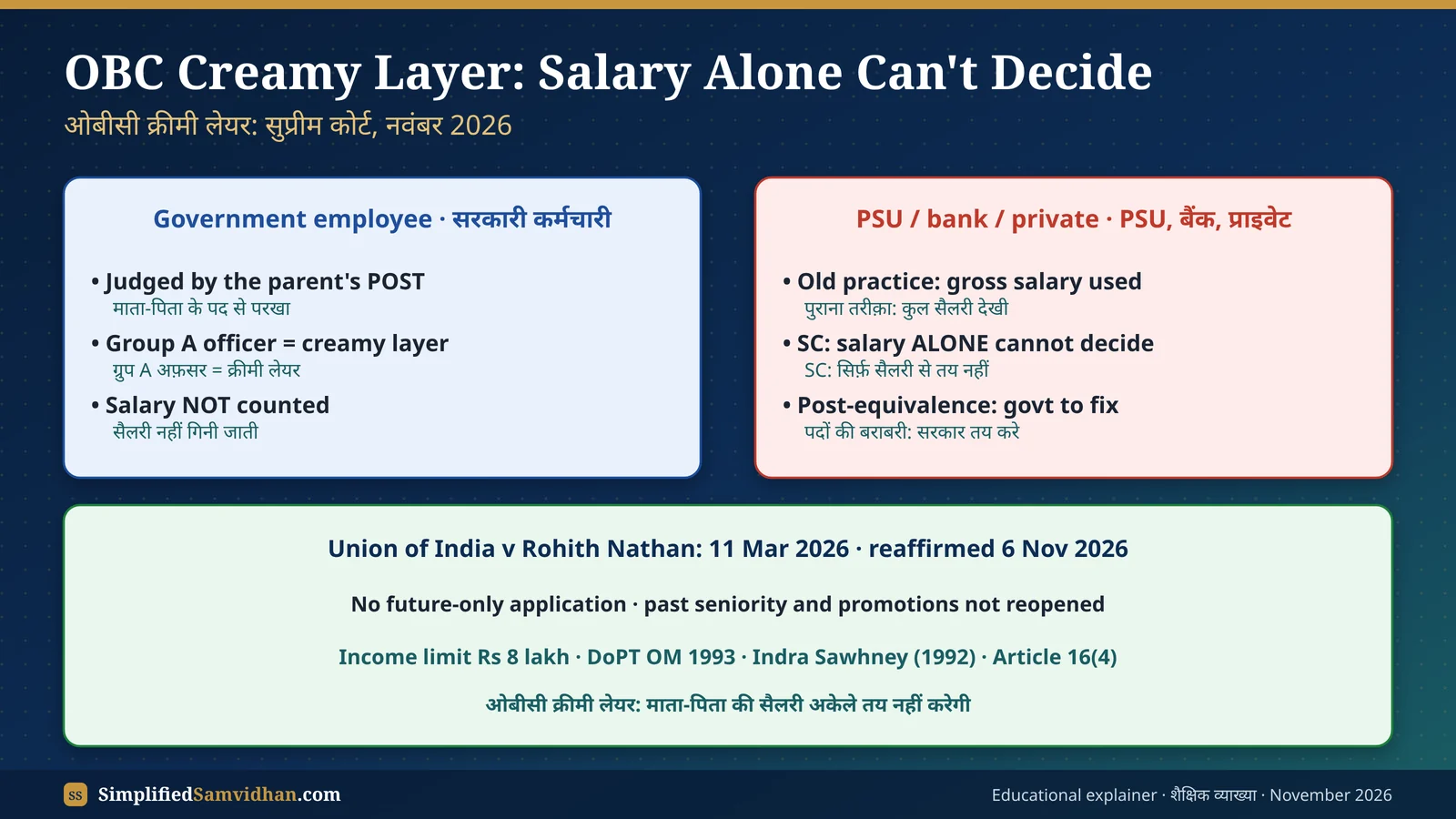
What the Supreme Court said on 6 November 2026
A Bench of Justices P.S. Narasimha and R. Mahadevan heard the Centre's application to clarify its 11 March 2026 judgment in Union of India v Rohith Nathan. That judgment had held that the salary or income of a parent working in a PSU or the private sector cannot by itself be the deciding test for putting an OBC candidate in the creamy layer.
On 6 November the Court reaffirmed that view and refused to make it prospective (future-only), saying there was no convincing reason to delay it. Selections, appointments and service allotments made after 11 March 2026 follow the 1993 creamy-layer rules as the Court read them. To avoid chaos, seniority and promotions already finalised will not be reopened. As reported by LiveLaw, the principle will also guide service allocation of OBC candidates selected in the Civil Services Examination 2025.
At a GlanceThe Ruling at a Glance: Key Facts
| Point | Fact |
|---|---|
| Case | Union of India v Rohith Nathan (judgment 11 March 2026); clarification order 6 November 2026 |
| Bench | Justices P.S. Narasimha and R. Mahadevan |
| Main rule | A parent's PSU or private-sector salary alone cannot decide OBC creamy layer |
| Centre asked | Apply the ruling only to future cases (prospective) |
| Court said | No: no convincing reason to defer; applies to selections after 11 March 2026 |
| Protected | Seniority and promotions already finalised are not reopened |
| Income limit | Rs 8 lakh a year (since 2017), income test excludes salary and farm income |
| Base rules | DoPT Office Memorandum of 8 September 1993, made after Indra Sawhney (1992) |
The creamy layer is the better-off section of OBCs who do not get reservation. For a government employee, the rule looks at the parent's rank (for example a Group A officer), not the salary. For people in PSUs, banks and private firms, no matching ranks were fixed, so officers simply used the salary figure. The Court said that is unfair: the same salary cannot count against one child and not against another.
🏠 Everyday analogy
Two cricket trials pick players by age group. One coach checks birth certificates; the other just looks at a player's height. A tall 14-year-old gets pushed into the senior team. The Court is saying: measure everyone by the same test.
🇮🇳 Real Indian example
Ravi's father is a clerk in a public sector bank earning Rs 9 lakh a year, mostly salary. Under the old practice he could be called creamy layer. A clerk in a central ministry with the same pay would not be, because only his rank counts. After this ruling, Ravi cannot be excluded on the salary figure alone.
Official TextArticle 16(1) and 16(4): The Basis of OBC Job Reservation
Constitution of India, Article 16. Equality of opportunity in matters of public employment.
(1) There shall be equality of opportunity for all citizens in matters relating to employment or appointment to any office under the State.
(4) Nothing in this article shall prevent the State from making any provision for the reservation of appointments or posts in favour of any backward class of citizens which, in the opinion of the State, is not adequately represented in the services under the State.
- Article 16(4) allows reservation in posts for backward classes not adequately represented. The creamy layer is not written in the Constitution; it comes from Indra Sawhney v Union of India (1992), where nine judges upheld 27% OBC reservation but asked the government to exclude the advanced section.
- The DoPT Office Memorandum of 8 September 1993 lists who is creamy layer: constitutional post holders, Group A and certain Group B officers' children, and others above an income/wealth test, now Rs 8 lakh a year.
- For the income test, salary and agricultural income are not counted. The dispute was about a 2004 DoPT letter that let officials judge PSU and private employees by gross salary where equivalent posts were not fixed.
- Read the full article: Article 16: equality in public employment and Article 15.
Both SidesWhy the Centre Wanted Delay, and Why the Court Said No
Centre's concerns
- Many selections since 2004 used the salary test
- Applying it now may disturb service lists
- Post equivalence for PSUs and private jobs is not yet notified
- Wanted the ruling to apply only in future
Court's answer
- Equal treatment under Articles 14 and 16 cannot wait
- No convincing reason to defer
- Past seniority and promotions stay safe
- Fixing equivalence is the executive's job; no deadline set by the Court
What NextWhat Happens Now
- 1Fresh scrutiny
Departments must re-check creamy-layer status in selections made after 11 March 2026 that relied only on a parent's PSU or private salary.
- 2CSE 2025 allocation
OBC candidates of the Civil Services Examination 2025 get service allocation under this principle, as reported.
- 3Policy work
DoPT may notify equivalence between PSU, bank and private posts and government Group A/B posts; the Court left this to the government.
- 4Your certificate
OBC candidates should keep the parent's post and rank details ready, not just salary slips, when applying for an OBC-NCL certificate.
UPSC CornerOBC Creamy Layer for UPSC Prelims and Mains
- Prelims: The creamy layer concept comes from Indra Sawhney (1992), not from the text of the Constitution.
- Prelims: OBC reservation in central jobs is 27%; creamy-layer income limit Rs 8 lakh (revised 2017).
- Prelims: Article 16(4) = reservation for backward classes in posts; Article 16(4A) = promotion for SC/ST; Article 16(6) = EWS up to 10%.
- Mains (GS II): "Creamy layer exclusion must rest on social advancement, not a single number." Discuss with the 2026 Rohith Nathan rulings.
Practice MCQTest Yourself: OBC Creamy Layer: Salary Alone Can't Decide
With reference to the OBC creamy layer, consider the following statements: (1) The concept of creamy layer is written in Article 16(4) of the Constitution. (2) It was laid down in Indra Sawhney v Union of India (1992). (3) In 2026 the Supreme Court held that a parent's PSU or private-sector salary cannot by itself decide creamy layer status. Which are correct?
Doubts ClearedFrequently Asked Questions
What did the Supreme Court decide on OBC creamy layer in November 2026?
On 6 November 2026 it reaffirmed its 11 March 2026 judgment that a parent's PSU or private-sector salary cannot by itself decide creamy layer, and refused the Centre's plea to apply it only to future cases.
Will old promotions be cancelled?
No. The Court said seniority and promotions already finalised will not be reopened. Selections and allotments after 11 March 2026 follow the ruling.
What is the creamy layer income limit?
Rs 8 lakh a year, fixed in 2017. Salary and agricultural income are not added for the income test; government employees are judged by their post.
Who decides equivalence of PSU and private jobs with government posts?
The government (DoPT). The Court did not set a deadline and left the policy to the executive.
Does creamy layer apply to SC and ST?
Not in the current reservation rules for jobs. It applies to OBCs under the 1993 DoPT memorandum.
Sources and further readingSources We Checked
Facts checked against the news reports below on 7-9 November 2026. We could not read the written order, so we keep to what reports say; check the DoPT notification before applying for a certificate.
- LiveLaw: Supreme Court clarifies judgment on OBC creamy layer parental salary computation (6 Nov 2026)
- ThePrint (PTI): SC reaffirms stand on OBC creamy layer criteria, says no prospective application
- Deccan Herald: Supreme Court clarifies OBC creamy layer ruling will not reopen past appointments, selections or promotions
- ETV Bharat: 'No prospective application': Supreme Court reaffirms stand on OBC creamy layer criteria
- The Statesman: Supreme Court reaffirms stand on OBC creamy layer criteria
- Indian Masterminds: Supreme Court OBC creamy layer verdict, what changes for UPSC candidates