Trump, Xi and Putin at APEC 2026 in Shenzhen: What the First Three-Way Meeting Means
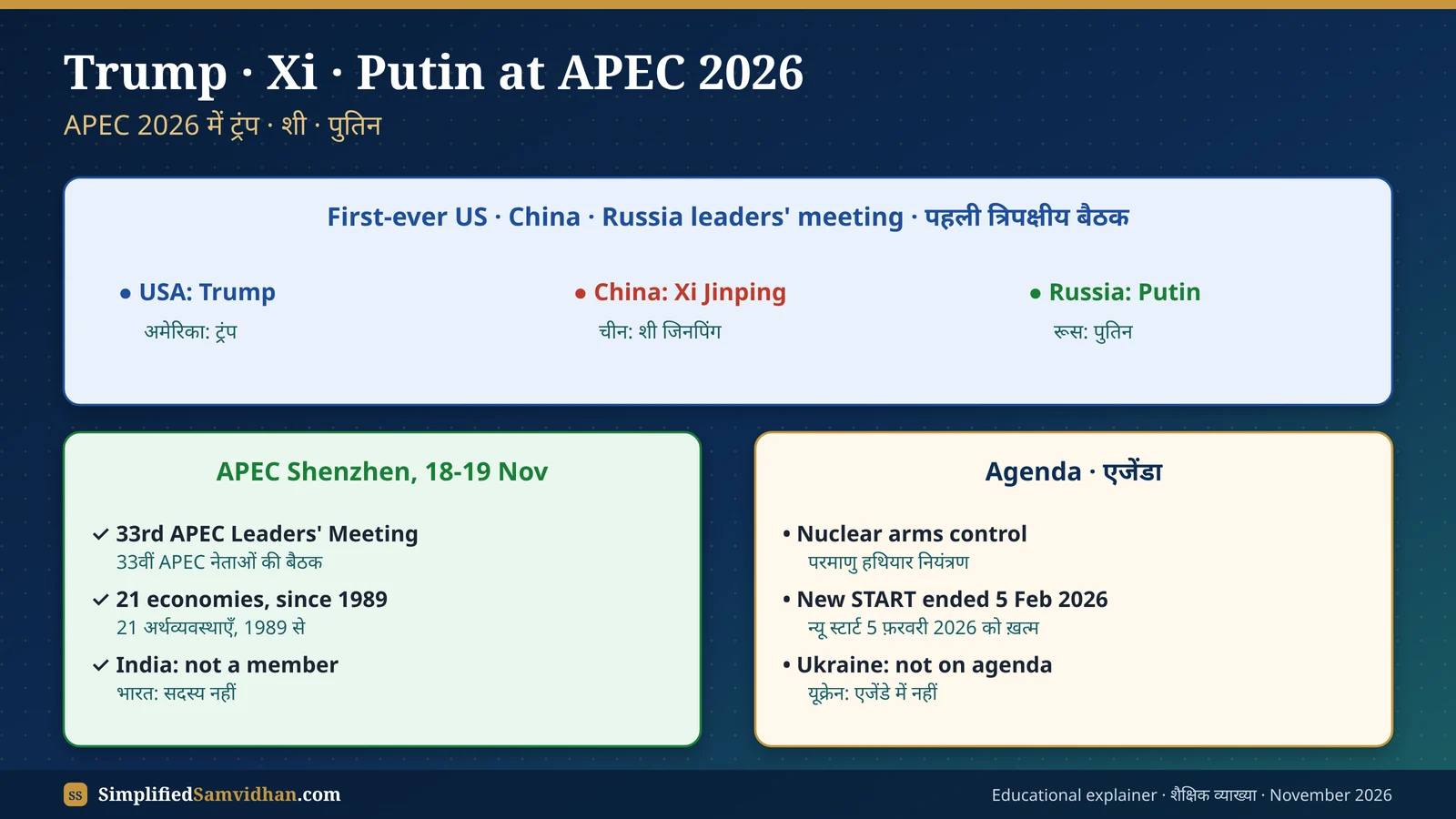
For the first time ever, the leaders of the United States, China and Russia are set to sit at one table. The White House says Donald Trump, Xi Jinping and Vladimir Putin will meet on the sidelines of the APEC summit in Shenzhen, China, on 18-19 November 2026. The main topic is nuclear arms control, because the last US-Russia arms treaty ended in February. Here is what it means, and where India stands.
What has been announced (as of 14 November 2026)
The White House has said that US President Donald Trump, Chinese President Xi Jinping and Russian President Vladimir Putin will hold a three-way (trilateral) meeting on the sidelines of the 33rd APEC Economic Leaders' Meeting in Shenzhen, China (18-19 November 2026). It will be the first such meeting of the three countries' leaders. Reports citing US officials say it is planned for Thursday, 19 November, along with a Trump-Xi bilateral meeting and working lunch.
US officials say the talks will focus on nuclear arms control, and may touch the Iran war and North Korea, but not Ukraine. A senior US official said no agreement is expected and called it an "entry point". Kremlin spokesman Dmitry Peskov called it "extremely significant" but rejected comparisons with the 1945 Yalta Conference.
Update, 19 November 2026: Trump arrived in Shenzhen on 18 November, two days after the Quad summit in Manila, and Xi Jinping greeted him at the airport. At APEC, Xi and Putin spoke against Western trade protectionism and sanctions. The White House said Trump would raise the Iran war and a possible three-way deal on nuclear weapons; China has repeatedly refused to join arms-control talks with the US and Russia. The Trump-Xi talks are also expected to cover extending the US-China trade truce beyond January 2027. We will add the results once official statements are out.
Outcome, 19 November 2026: after about an hour and a half of talks the three leaders issued a joint "Declaration for Peace". It reaffirmed that "there can be no winners in a nuclear war and that it must never be unleashed" and pledged a three-way dialogue on reducing nuclear risks and preventing the proliferation of nuclear weapons. It set no timetable or framework for arms-control talks and did not mention a trilateral arms-reduction treaty, which China has long rejected. Reports say the leaders also spoke of reforming the United Nations, warned international bodies not to overstep their jurisdiction, and discussed energy and oil production. Xi called nuclear weapons a "sword of Damocles hanging over humanity". Analysts called the result largely symbolic; the last US-Russia arms treaty, New START, expired in February 2026.
At a GlanceTrump-Xi-Putin Meeting at a Glance
| Point | Fact |
|---|---|
| What | First-ever leaders' meeting of the US, China and Russia together |
| Where | Shenzhen, China, on the sidelines of the 33rd APEC Economic Leaders' Meeting |
| When | APEC leaders: 18-19 November 2026 (trilateral reported for 19 November) |
| APEC theme | "Building an Asia-Pacific Community to Prosper Together" |
| Main agenda | Nuclear arms control after New START ended on 5 February 2026 |
| Not on agenda | War in Ukraine (as per the White House) |
| Expectation | No agreement expected; a starting point for talks |
| India | Not an APEC member; not part of this meeting |
The US, Russia and China hold most of the world's nuclear weapons. Until February 2026, a treaty called New START put a limit on US and Russian weapons. That treaty is now over, and there is no limit at all. Trump wants a new deal that also includes China. China says the US and Russia, which have far more weapons, should cut first. This meeting is the first time all three leaders will discuss it together.
🏠 Everyday analogy
Imagine three neighbours who each keep dangerous fireworks at home. Two of them had a written promise to keep only a fixed amount; the promise has expired. Now all three are meeting for the first time to talk about a new promise, but nobody expects a signature on day one.
🇮🇳 Real Indian example
If the three powers start a new arms race, China may build more warheads; India, which shares a long border with China, would then face pressure to spend more on its own deterrence instead of on schools and hospitals.
Official TextIndia's Constitutional Lens: Article 51
Constitution of India, Article 51. Promotion of international peace and security.
The State shall endeavour to (a) promote international peace and security; (b) maintain just and honourable relations between nations; (c) foster respect for international law and treaty obligations in the dealings of organised peoples with one another; and (d) encourage settlement of international disputes by arbitration.
- Article 51 (a Directive Principle) asks India to promote international peace and respect treaty obligations. India supports universal, non-discriminatory nuclear disarmament.
- India is not a party to the NPT (it calls the treaty discriminatory) and follows a No First Use nuclear doctrine (2003) with credible minimum deterrence.
- Foreign policy and treaties are Union subjects (Union List Entries 10 and 14) under the Union's executive power (Article 73).
- Read more: Trump after the midterms, ASEAN-India Summit 2026 in Manila, India-China face-off in Arunachal and the International Relations hub.
New STARTWhy Nuclear Arms Control Is the Main Topic
- New START was signed by the US and Russia in Prague on 8 April 2010 and came into force in February 2011. It limited each side to 1,550 deployed strategic warheads and 700 deployed launchers (missiles and bombers).
- It was extended once, in 2021, for five years. Russia suspended its participation in 2023. The treaty expired on 5 February 2026, so for the first time in over 50 years the two biggest nuclear powers have no treaty limits.
- Russia offered to keep the limits for one more year. Trump refused and asked for a "new, improved and modernized" deal that includes China.
- China's view: its arsenal (estimated around 600 warheads) is far smaller than those of the US and Russia (over 5,000 each), so the two should cut first. China has avoided direct arms-control talks so far.
- Together, the three countries hold well over 90% of the world's nuclear warheads.
APECWhat Is APEC, and Why Is India Not in It?
APEC facts
- Asia-Pacific Economic Cooperation, set up in 1989 (first meeting in Canberra)
- 21 'member economies' (not 'countries'), including the US, China, Russia, Japan, Australia, Hong Kong and Chinese Taipei
- Secretariat in Singapore; decisions are voluntary and by consensus
- China hosted earlier in 2001 (Shanghai) and 2014 (Beijing)
India and APEC
- India applied in 1991 but is not a member
- APEC froze new memberships in 1997 (Russia, Peru and Vietnam were the last to join, in 1998)
- India is not on the Pacific rim, a point used against its entry
- India meets most APEC members through the East Asia Summit, G20 and Quad instead
India AngleWhat It Means for India
- Strategic balance: India has close ties with both the US (trade deal talks, Quad) and Russia (defence, oil). A US-Russia-China table where India is absent shows why India pushes for reformed global forums.
- China factor: if arms control fails and China expands its arsenal, India's security planning on the northern border is directly affected.
- Same week: PM Modi is in Manila for the ASEAN-India Summit and East Asia Summit (16-18 November), where both the US and Russia are EAS members.
- History check: the Kremlin rejected comparisons with Yalta (February 1945), where Roosevelt, Churchill and Stalin shaped post-war Europe. Smaller countries fear big powers deciding their fate without them.
What NextWhat Happens Now
- 117-18 Nov
APEC CEO Summit and leaders' week in Shenzhen.
- 218-19 Nov
APEC Economic Leaders' Meeting; Trump-Xi bilateral and the Trump-Xi-Putin trilateral (reported for 19 November).
- 3After
Any joint statement or plan for arms-control talks; APEC leaders' declaration.
- 4Update
We will add the outcomes to this page after the meeting.
UPSC CornerTrump-Xi-Putin and APEC for UPSC
- Prelims: APEC: 1989, 21 economies, secretariat Singapore; India is not a member.
- Prelims: New START: US-Russia, Prague 2010, limits 1,550 deployed strategic warheads, expired 5 February 2026.
- Prelims: Yalta Conference, February 1945 (Crimea): Roosevelt, Churchill, Stalin.
- Mains (GS II): "The end of US-Russia arms control and the rise of China's arsenal call for a new trilateral framework." Discuss the implications for India's nuclear doctrine and security.
Practice MCQTest Yourself: Trump, Xi, Putin: first three-way meeting at APEC
Consider the following statements: (1) India is a member of APEC. (2) New START was a nuclear arms treaty between the USA and Russia. (3) China was a party to New START. Which of the statements given above is/are correct?
Doubts ClearedFrequently Asked Questions
When and where is the Trump-Xi-Putin meeting?
On the sidelines of the APEC Economic Leaders' Meeting in Shenzhen, China, on 18-19 November 2026; reports say the three-way meeting is planned for 19 November.
Is this the first time the three leaders are meeting together?
Yes. US officials describe it as the first-ever trilateral meeting of the leaders of the US, China and Russia.
What will they discuss?
Mainly nuclear arms control after New START expired in February 2026; Iran and North Korea may come up. The White House says Ukraine is not on the agenda.
Is India a member of APEC?
No. India applied in 1991, but APEC has not admitted new members since 1998. India is not part of this meeting.
What was New START?
A 2010 treaty between the US and Russia that capped deployed strategic nuclear warheads at 1,550 each. It expired on 5 February 2026.
Sources and further readingSources We Checked
Facts checked on 14 November 2026 against the reports below. The exact day and outcomes of the meeting are not yet confirmed; warhead numbers are public estimates.
- Gulf News: 'No winners in nuclear war': Trump, Xi, Putin pledge dialogue after Shenzhen summit (19 Nov 2026)
- CBC: Xi-Trump-Putin statement warns world bodies not to 'abuse their jurisdiction' (19 Nov 2026)
- The Washington Post: Trump, Putin, Xi agreed to work jointly (19 Nov 2026)
- CNBC: Trump arrives in China for historic meeting with Xi, Putin (18 Nov 2026)
- Al Jazeera: What do Trump, Putin and Xi want from their Shenzhen meeting? (19 Nov 2026)
- Al Jazeera: Trump, Xi and Putin to hold first three-way summit in China (14 Nov 2026)
- NBC News: Trump, Xi and Putin plan an unprecedented meeting on the sidelines of APEC, officials say (Nov 2026)
- US News (Reuters): Trump to hold summit with Xi, Putin in Shenzhen on Thursday, NY Post reports (13 Nov 2026)
- ABC News: Trump to meet with Putin and Xi in China next week, US officials say (Nov 2026)
- CGTN: What to watch as Shenzhen prepares to host APEC leaders (12 Nov 2026)