Ganga Water Treaty Expires on 12 December 2026: What Happens to Farakka Water Sharing?
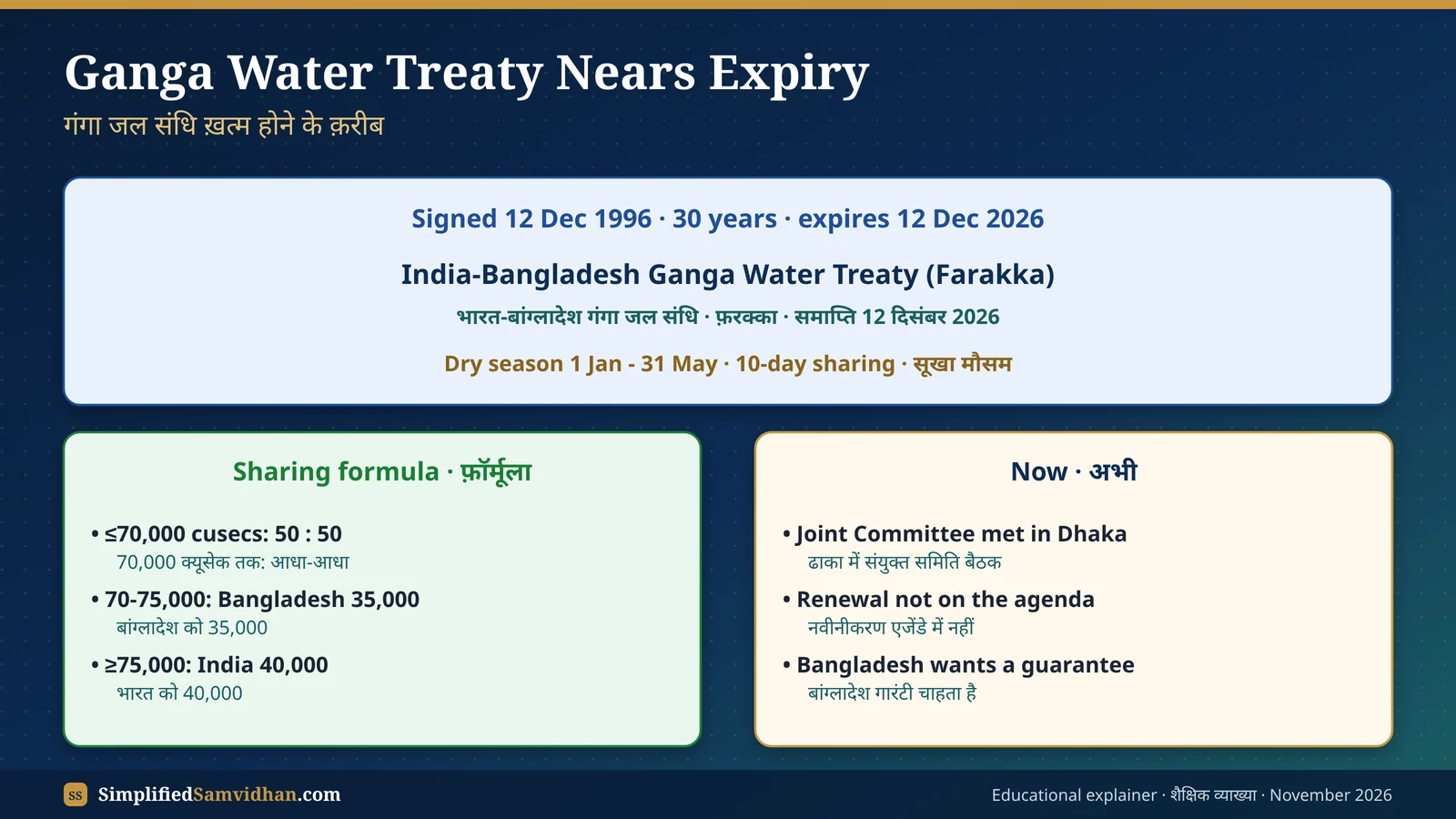
India and Bangladesh share the Ganga's water at Farakka under a 30-year treaty signed on 12 December 1996. It expires on 12 December 2026. The two sides' Joint Committee met in Dhaka from 22 November 2026, but only for routine work; renewal was not on the agenda and no date for formal talks has been set. Bangladesh wants a new deal with a guaranteed minimum flow in the dry season; India says all river issues go through the Joint Rivers Commission.
Where things stand, 23 November 2026
The 91st meeting of the Joint Committee under the Ganga Water Treaty began in Dhaka on 22 November 2026, with a team from India's Jal Shakti Ministry. Reports say it was a routine meeting: it reviewed how water was shared in the last dry season, exchanged flow data and finalised the 2026 annual implementation report.
Renewal of the treaty was not on the formal agenda, because the Joint Committee's job is only to watch over the existing treaty. With the treaty ending on 12 December 2026, neither government has announced a timetable for formal talks. Bangladesh has urged India to start them and wants a revised deal with a dry-season guarantee; India's Ministry of External Affairs says river talks run through the Joint Rivers Commission framework.
At a GlanceThe Treaty at a Glance
| Point | Fact |
|---|---|
| Signed | 12 December 1996, New Delhi, by PMs H. D. Deve Gowda and Sheikh Hasina |
| Term | 30 years (Article XII); renewable by mutual consent |
| Expires | 12 December 2026 |
| Where water is shared | Farakka Barrage, West Bengal |
| When | Dry season, 1 January to 31 May, in 10-day periods |
| Who monitors | Joint Committee; flows observed at Farakka (India) and Hardinge Bridge (Bangladesh) |
| Status now | Joint Committee met in Dhaka from 22 Nov 2026; renewal talks not started |
The Ganga flows from India into Bangladesh, where it is called the Padma. In winter and summer the river carries much less water. At Farakka, India diverts part of the flow into a canal to keep the Hooghly river and Kolkata port alive. The treaty is a timetable that says how much of the lean-season water each country gets, every ten days.
🏠 Everyday analogy
Imagine two brothers sharing one tube-well in summer. They agree that every ten days the water is split by a fixed chart, and a joint register is kept at both ends. The written agreement has an end date; before it expires, they must sit down and write a new one.
🇮🇳 Real Indian example
A farmer near Kushtia in Bangladesh and the Kolkata port authority both depend on how much water passes Farakka in April, the driest month.
Official TextTreaty Clause and India's Constitution
Ganga/Ganges Waters Treaty, 1996, Article XII.
This Treaty shall enter into force upon signature and shall remain in force for a period of thirty years and it shall be renewable on the basis of mutual consent.
Constitution of India, Article 253.
Notwithstanding anything in the foregoing provisions of this Chapter, Parliament has power to make any law for the whole or any part of the territory of India for implementing any treaty, agreement or convention with any other country or countries or any decision made at any international conference, association or other body.
- India signs such treaties through the Union's executive power (Article 73; Union List Entry 14). A State's consent is not legally required, but West Bengal's views matter politically, as the 2011 Teesta deal showed.
- Inter-State water disputes inside India fall under Article 262; disputes with another country are handled by diplomacy and treaties.
- Read more: India-Nepal ties and the Mahakali Treaty and International Relations hub.
FormulaHow the Water Is Shared at Farakka
| Flow at Farakka (10-day average) | India's share | Bangladesh's share |
|---|---|---|
| 70,000 cusecs or less | 50% | 50% |
| 70,000 to 75,000 cusecs | Balance of flow | 35,000 cusecs |
| 75,000 cusecs or more | 40,000 cusecs | Balance of flow |
HistoryFrom Farakka to the 1996 Treaty
- 11975: Farakka Barrage
India commissions the barrage and a feeder canal to push water into the Bhagirathi-Hooghly for Kolkata port.
- 21977: First agreement
A five-year deal with a guarantee clause giving Bangladesh at least 80% of its share in very low flows.
- 31982 and 1985: MoUs
Short memoranda without a guarantee; they lapsed by 1988, leaving no deal for eight years.
- 41996: The 30-year treaty
Signed on 12 December 1996; Joint Committee to monitor, review every five years (Article X).
- 52026: Expiry
Ends 12 December 2026 unless both sides agree to renew or sign a new treaty.
PositionsWhat Each Side Wants
Bangladesh
- A new or revised treaty, not a simple extension
- A dry-season guarantee clause, as in 1977
- Formal negotiations to start before 12 December
- Talks on other rivers such as the Teesta
India
- All river talks through the Joint Rivers Commission
- Needs of the Hooghly and Kolkata port
- West Bengal's concerns over water availability
- No public timetable for renewal yet
UPSC CornerGanga Water Treaty for UPSC
- Prelims: The Ganga is called the Padma in Bangladesh; Farakka Barrage is in Murshidabad district, West Bengal.
- Prelims: The treaty covers the dry season, 1 January to 31 May; flows are measured at Farakka and Hardinge Bridge.
- Prelims: India and Bangladesh share 54 rivers; the Joint Rivers Commission was set up in 1972.
- Mains (GS II): "Water diplomacy will shape the next phase of India-Bangladesh relations." Discuss with the Ganga and Teesta examples.
Practice MCQTest Yourself: Ganga Water Treaty expires 12 December: what next for Farakka?
The India-Bangladesh Ganga Water Treaty of 1996 was signed for how many years?
Doubts ClearedFrequently Asked Questions
When does the Ganga Water Treaty expire?
On 12 December 2026, thirty years after it was signed on 12 December 1996. It can be renewed by mutual consent.
Who signed the Ganga Water Treaty?
Indian Prime Minister H. D. Deve Gowda and Bangladesh Prime Minister Sheikh Hasina, in New Delhi.
Was renewal discussed at the November 2026 Dhaka meeting?
No. The 91st Joint Committee meeting was routine; renewal was not on its formal agenda, and no date for formal talks has been announced.
What is the sharing formula?
If the flow at Farakka is 70,000 cusecs or less, it is split 50:50; between 70,000 and 75,000 Bangladesh gets 35,000 cusecs; at 75,000 or more India gets 40,000 cusecs.
Why was the Farakka Barrage built?
To divert water into the Bhagirathi-Hooghly through a feeder canal, to reduce silt and keep Kolkata port navigable. It was commissioned in 1975.
Sources and further readingSources We Checked
Facts checked on 23 November 2026 against the treaty text and the news reports below. Reports differ slightly on the exact dates of the Dhaka meeting.
- The Business Standard (TBS): Ganges water treaty set to expire, but neither country clarifies position on new agreement (Nov 2026)
- The Daily Star: Ganges water sharing: routine meets on, Delhi mum over new treaty talks (Nov 2026)
- ThePrint: Clock ticking on Ganga Water Treaty, Indian delegation heads to Dhaka but renewal not on agenda (Nov 2026)
- Millennium Post: Jal Shakti delegation heads to Dhaka as Ganga Treaty renewal talks remain elusive (Nov 2026)
- ANI: MEA reiterates Ganga Water Treaty discussions held under Joint Rivers Commission framework (Oct 2026)
- Treaty between India and Bangladesh on Sharing of the Ganga/Ganges Waters at Farakka, 12 December 1996 (MEA treaty text)